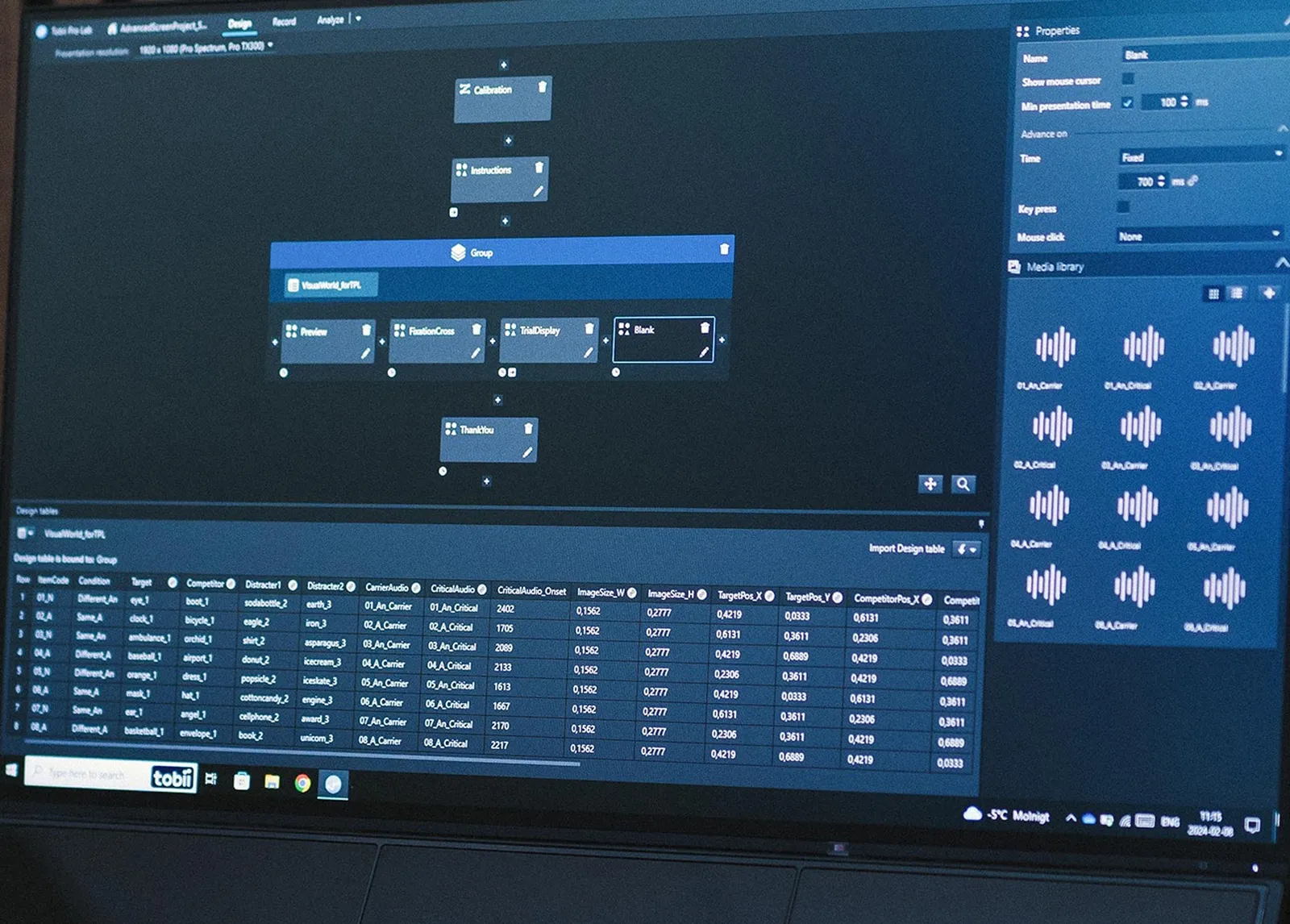
Design without programming
Images, video, web pages, and text on a timeline; randomization and trial blocks. You can later run the same project with a dedicated eye tracker.

Tobii software determines from the webcam image which point on the screen a study participant is looking at. No extra device: in the lab, in a classroom, or online in the participant's home — and you design and analyze the entire study in Tobii Pro Lab.
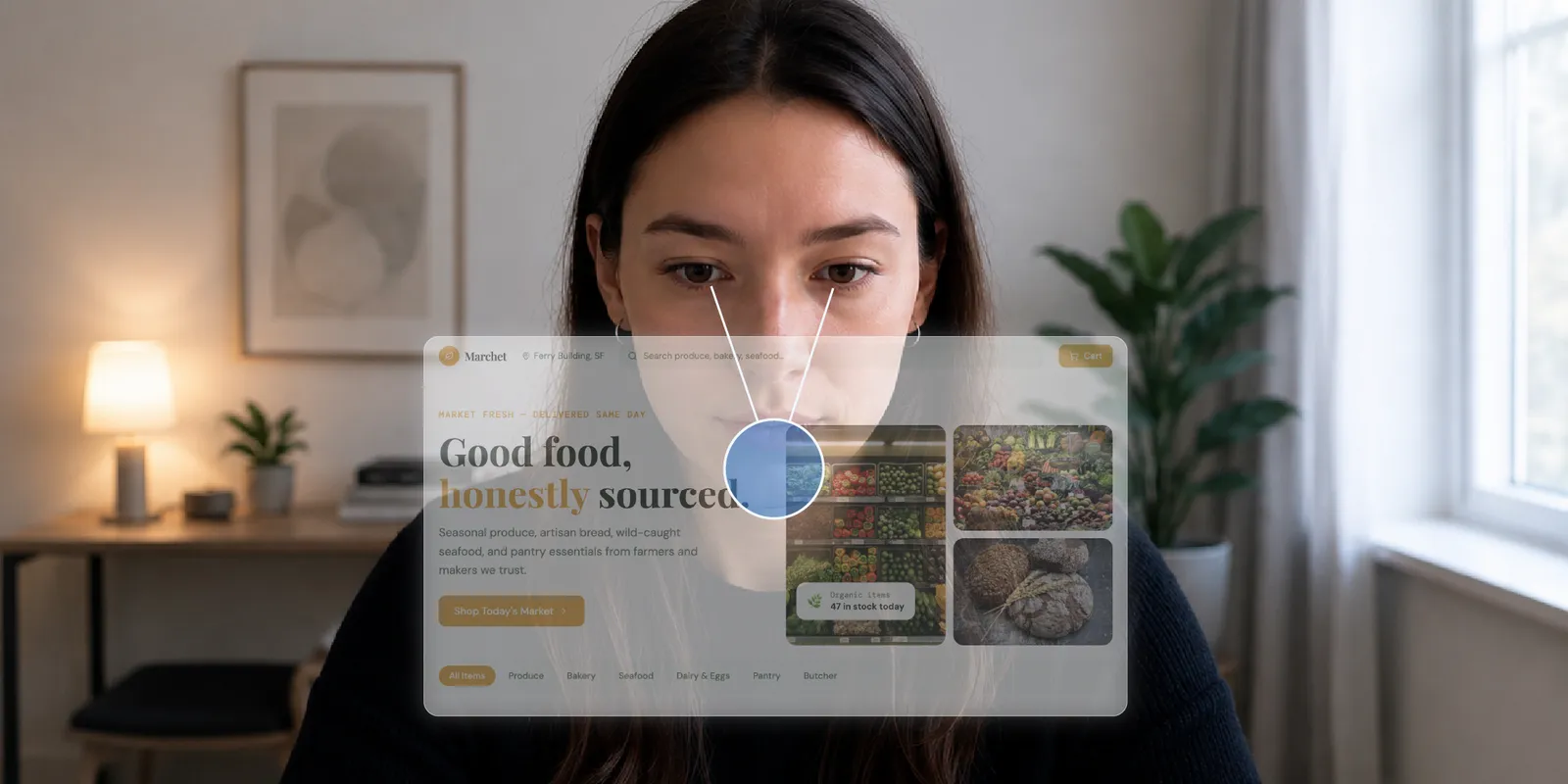
Eye tracking measures which point on the screen a person is looking at, and for how long. This is usually done by a separate device with an infrared illuminator. Tobii Webcam Eye Tracking does it in software alone: all you need is a webcam above the screen, and the image of the face is analyzed by a model developed by Tobii (Tobii Nexus technology).
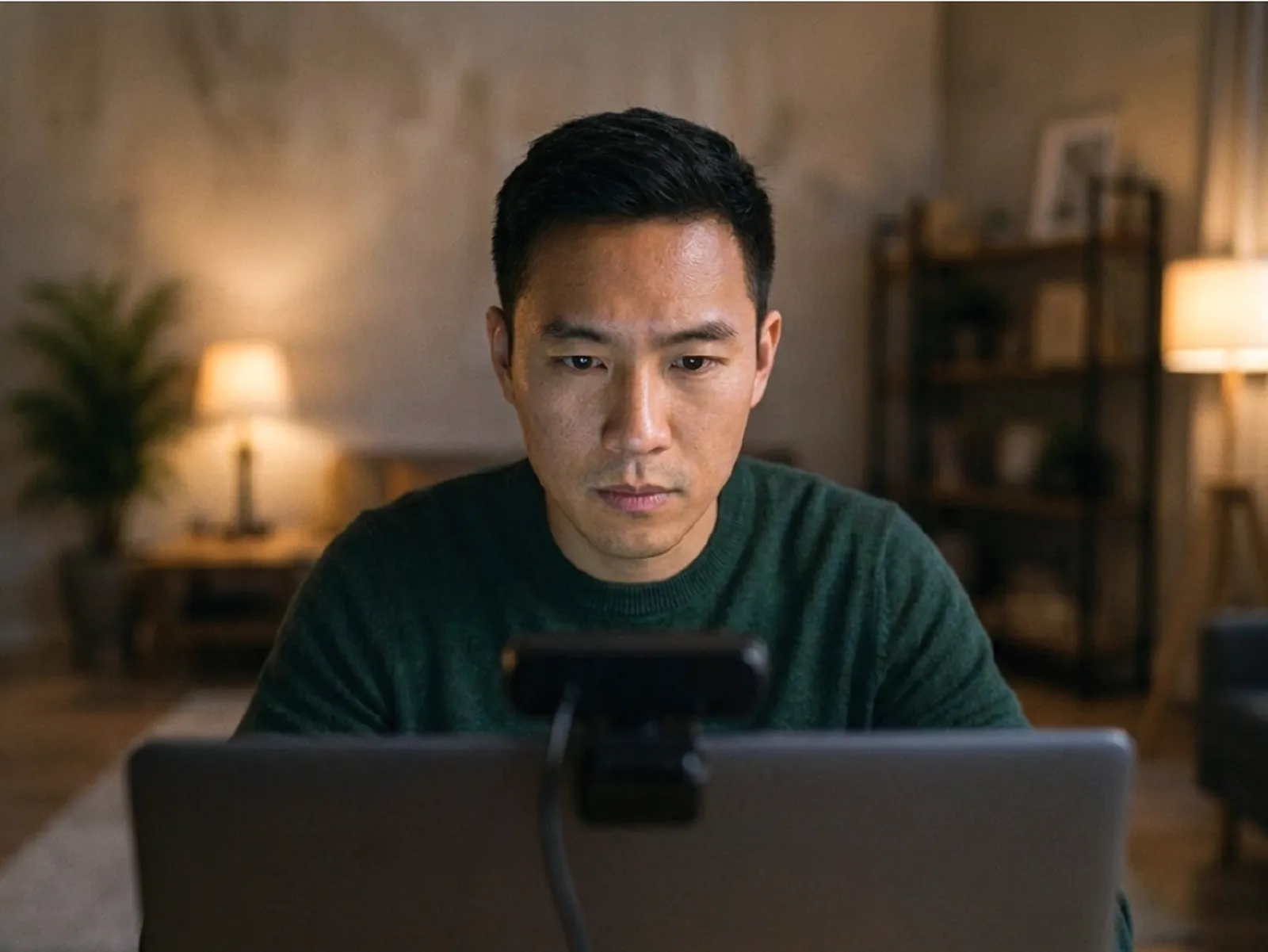
How is this different from an eye tracker? A dedicated eye tracker illuminates the eye with infrared light and measures the reflection on the cornea. A webcam “sees” the eyes the way a person does — so it is less precise, but requires no additional device.
Each camera frame yields one timestamped row of data. From these rows, Tobii Pro Lab derives fixations, heat maps, and metrics for areas of interest (AOIs).
Illustrative values generated in the browser — not a device recording. Data fields according to the Tobii specification.
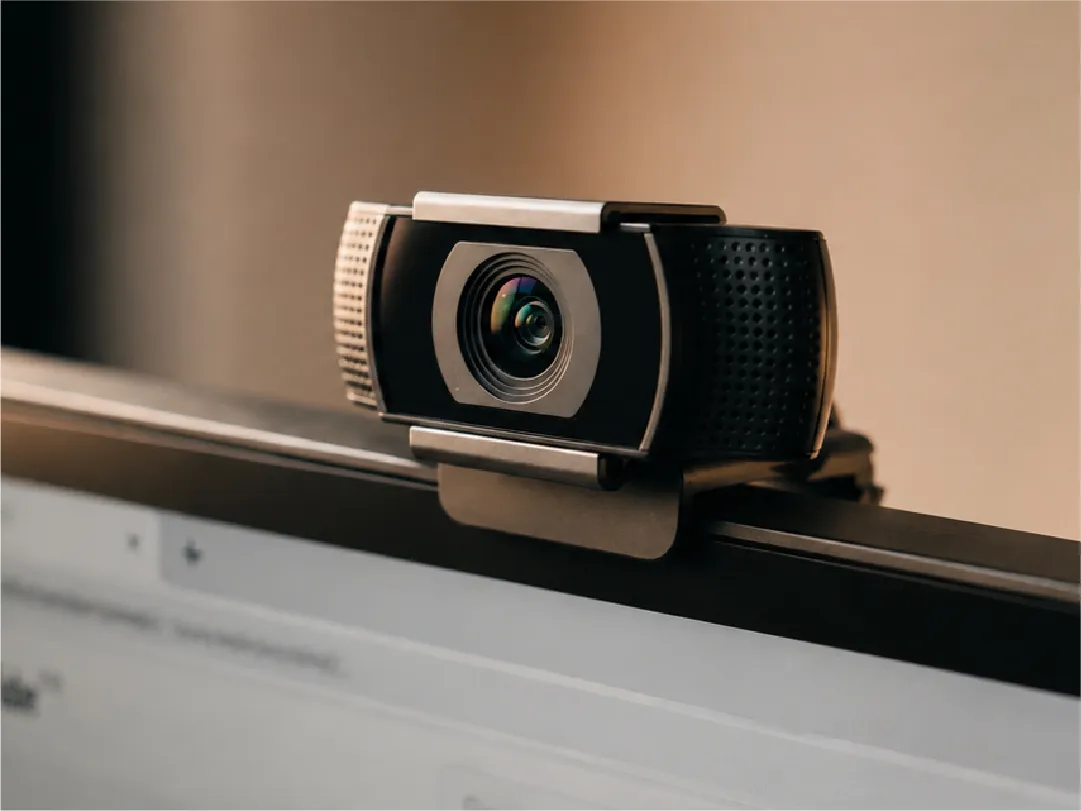
Data quality depends on the camera, lighting, the participant's posture, and the distance from the screen. Tobii recommends:
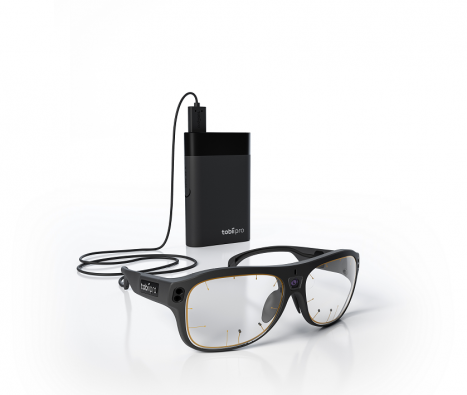
Photos: Tobii. Method description and parameters: tobii.com (Webcam Eye Tracking — Local on-site research) and Tobii Connect articles on webcam setup.
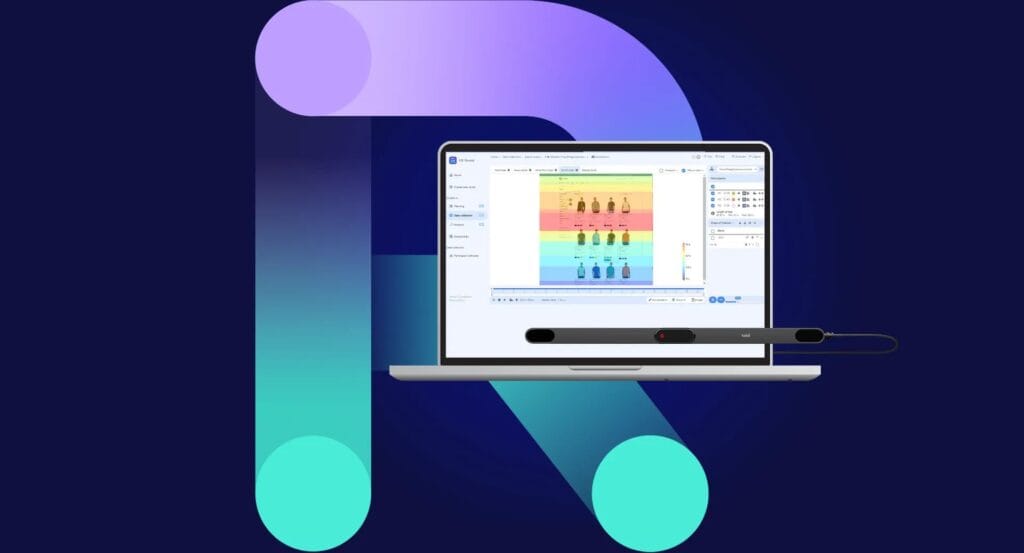
Webcam eye tracking is not a separate application. It runs in Tobii Pro Lab, the same software used with Tobii eye trackers: you design, record, and analyze your study with the same tools and metrics. You can collect data in two ways.
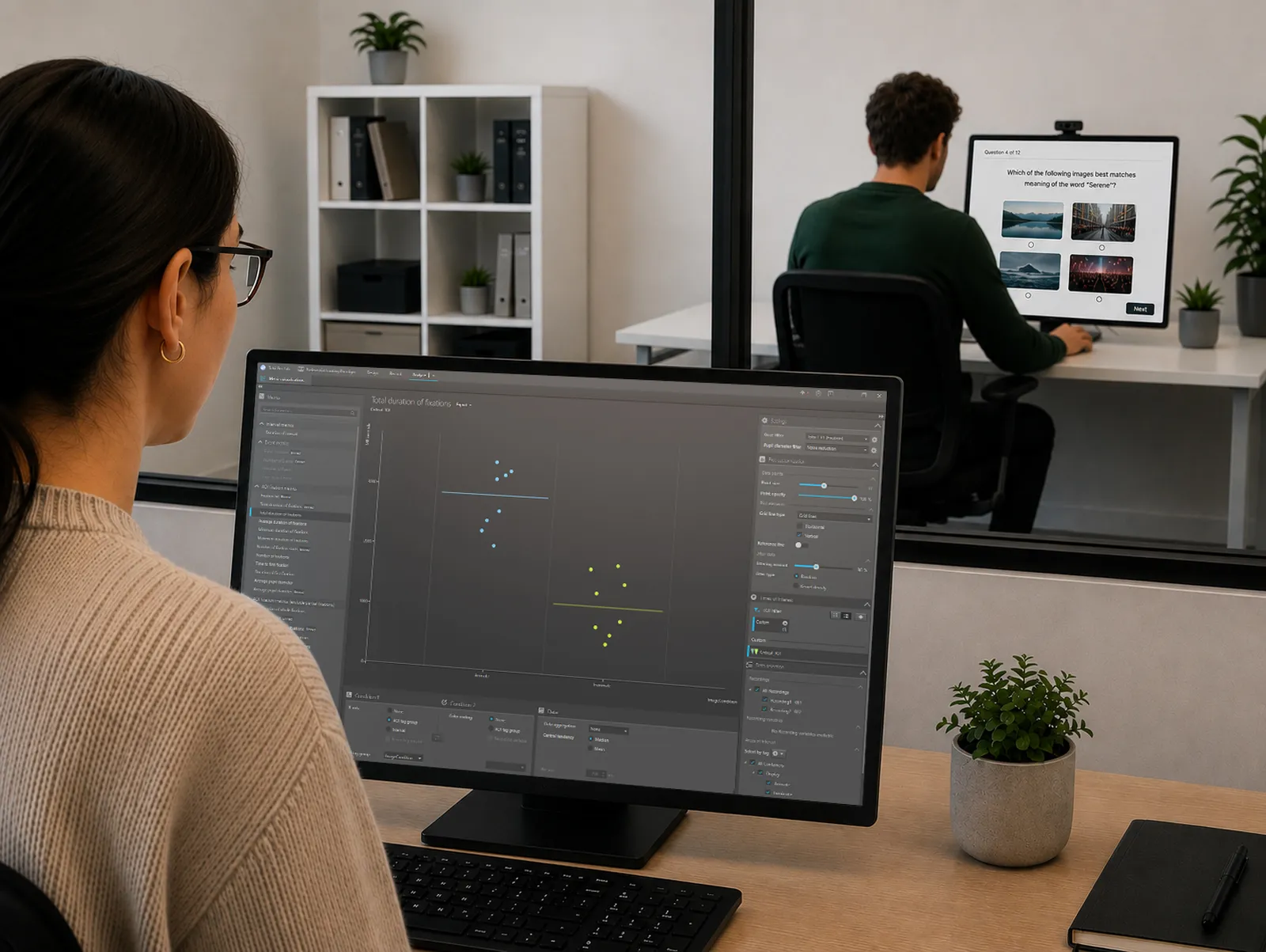

For the lab, the classroom, or field studies on laptops — wherever consistent conditions and researcher supervision matter.
Participants take part from home, with their own webcam — no trip to the lab. More people, from different locations.
Images, video, web pages, and text on a timeline; randomization and trial blocks. You can later run the same project with a dedicated eye tracker.
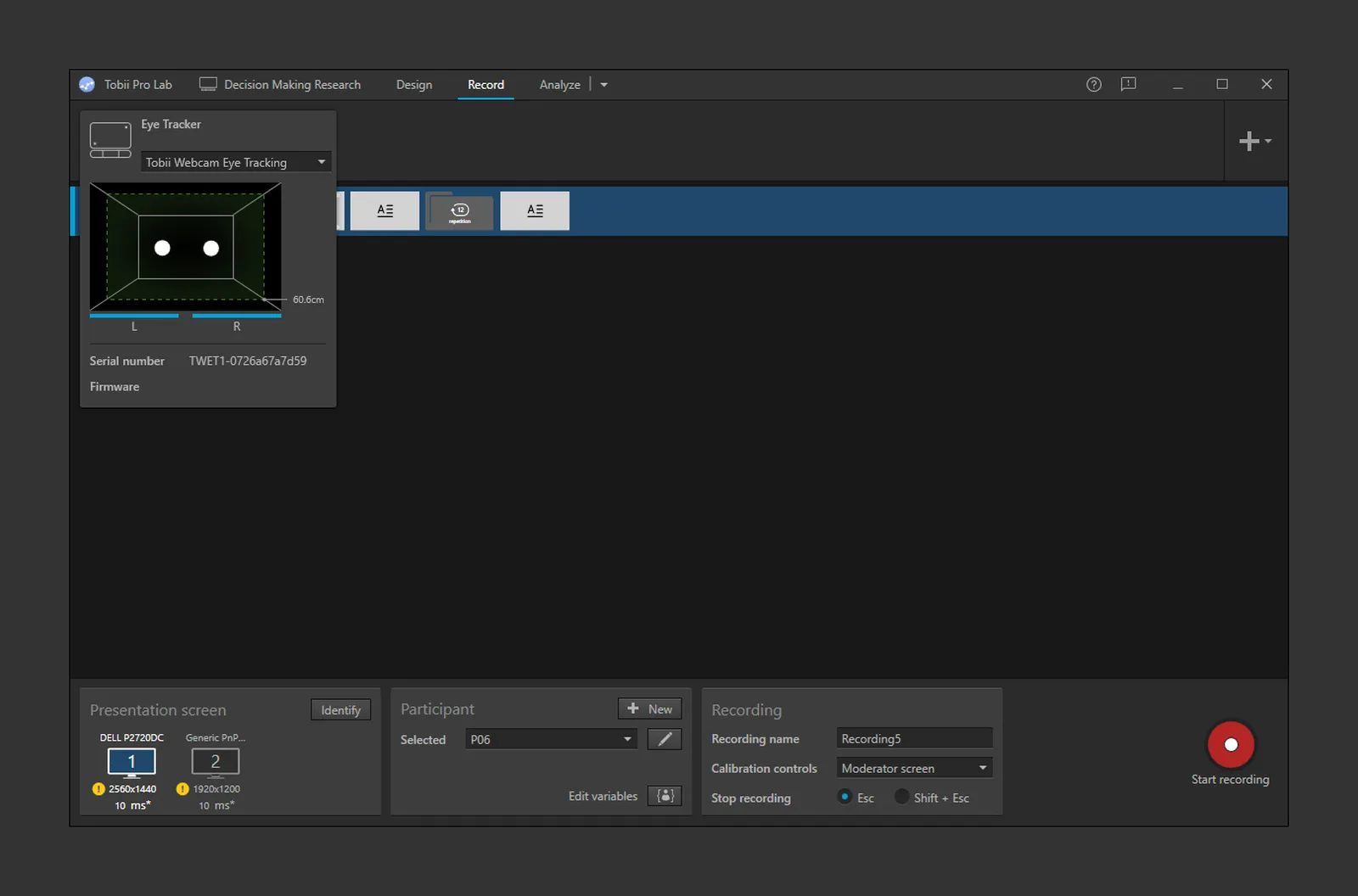
Since version 26.18, Pro Lab officially supports Tobii Webcam Eye Tracking — you select it in the Record module just like an eye tracker.
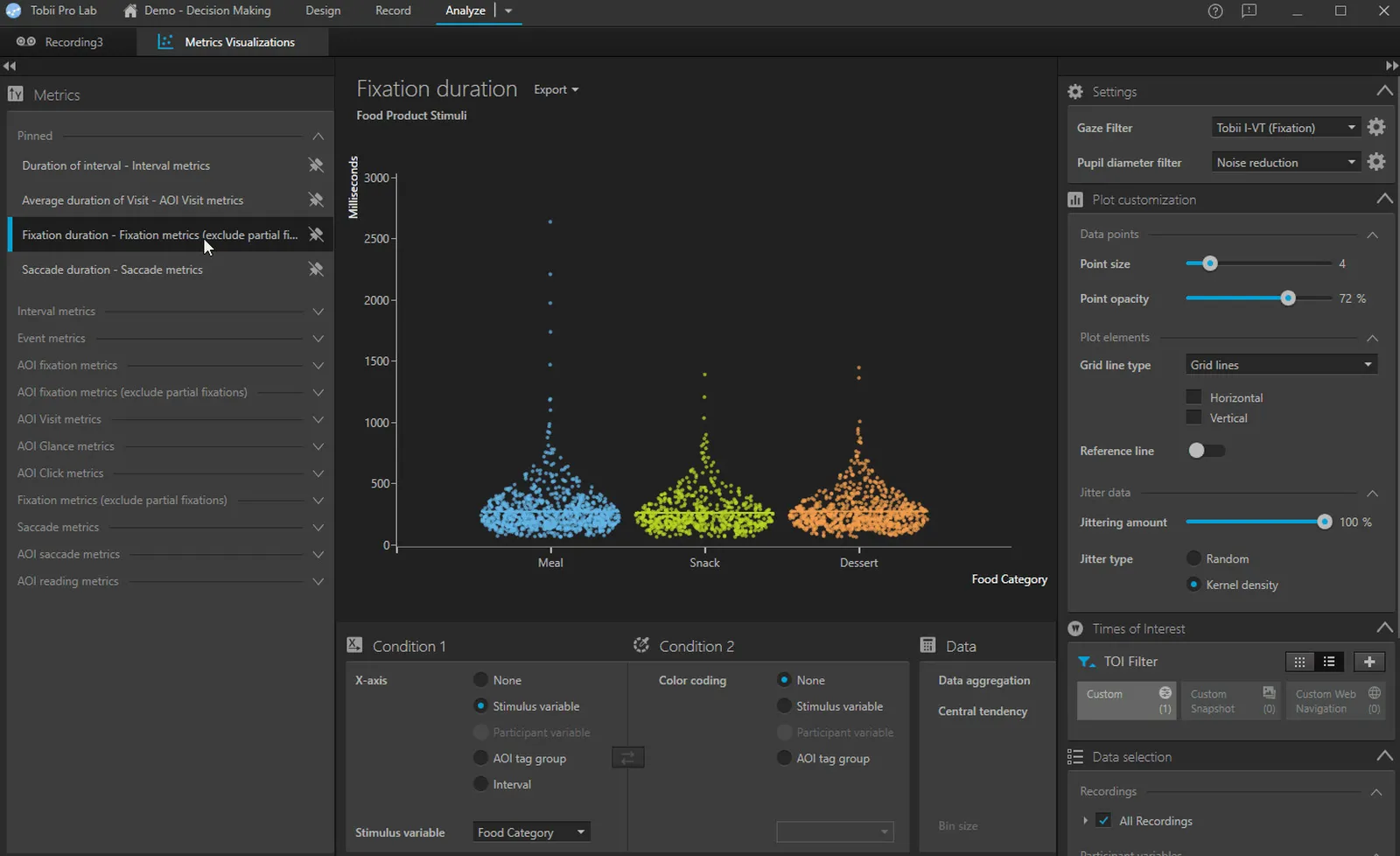
Areas of interest, heat maps, gaze plots, time to first fixation; export to R or SPSS.
All three use a webcam and come from Tobii, but they serve different work. Sticky is a separate platform for marketing and consumer research; Webcam Eye Tracking is a research tool in Pro Lab.
Tobii Pro Lab screenshots and photos: Tobii. Features and editions: tobii.com (Tobii Pro Lab, “What's new” 26.10 and 26.18) and Tobii Connect.
Webcam eye tracking is also offered by subscription-based multimodal platforms, which connect to other manufacturers' eye trackers only in the lab. With Tobii, the webcam, eye trackers, and Pro Lab form a single path: a study started with a webcam can be repeated with an eye tracker in the same project.
| Feature | Tobii Webcam Eye Tracking from Interlab | Subscription platform with webcam module |
|---|---|---|
| Analysis software license | Tobii Pro Lab — choice of perpetual license or annual subscription | mandatory core module + separately priced webcam module; fee renewed every year |
| Moving to an eye tracker | the same experiment and the same analysis in Pro Lab with a Tobii eye tracker (Spark, Fusion, Spectrum) — the manufacturer provides for verifying online study results on Tobii Pro Spark | eye trackers from other manufacturers; according to the platform vendor, eye tracking capabilities depend on the connected hardware |
| Validation | study by an Uppsala University team: 101 participants, in the lab and outside it, compared with an infrared eye tracker; preprint publicly available | validation report published by the platform vendor |
Subscription platform: a popular multimodal platform with a webcam eye tracking module. Data according to manufacturers' websites, as of October 2026.
Both methods have their place — the research question decides: the size of the analyzed areas, the metrics you need, and where the study takes place. We help you assess this before purchase.
We help you assess whether a webcam is enough for your study, set up the station, and stay with your team after the purchase.
A team from Uppsala University compared Tobii Nexus with an infrared eye tracker (Tobii Pro Nano) in 101 participants — in the lab and outside it. The photo below shows both methods at the scale of a typical four-image study: the cross is where the participant is looking, the blue dots are successive samples, and the red circle is the mean error (accuracy).
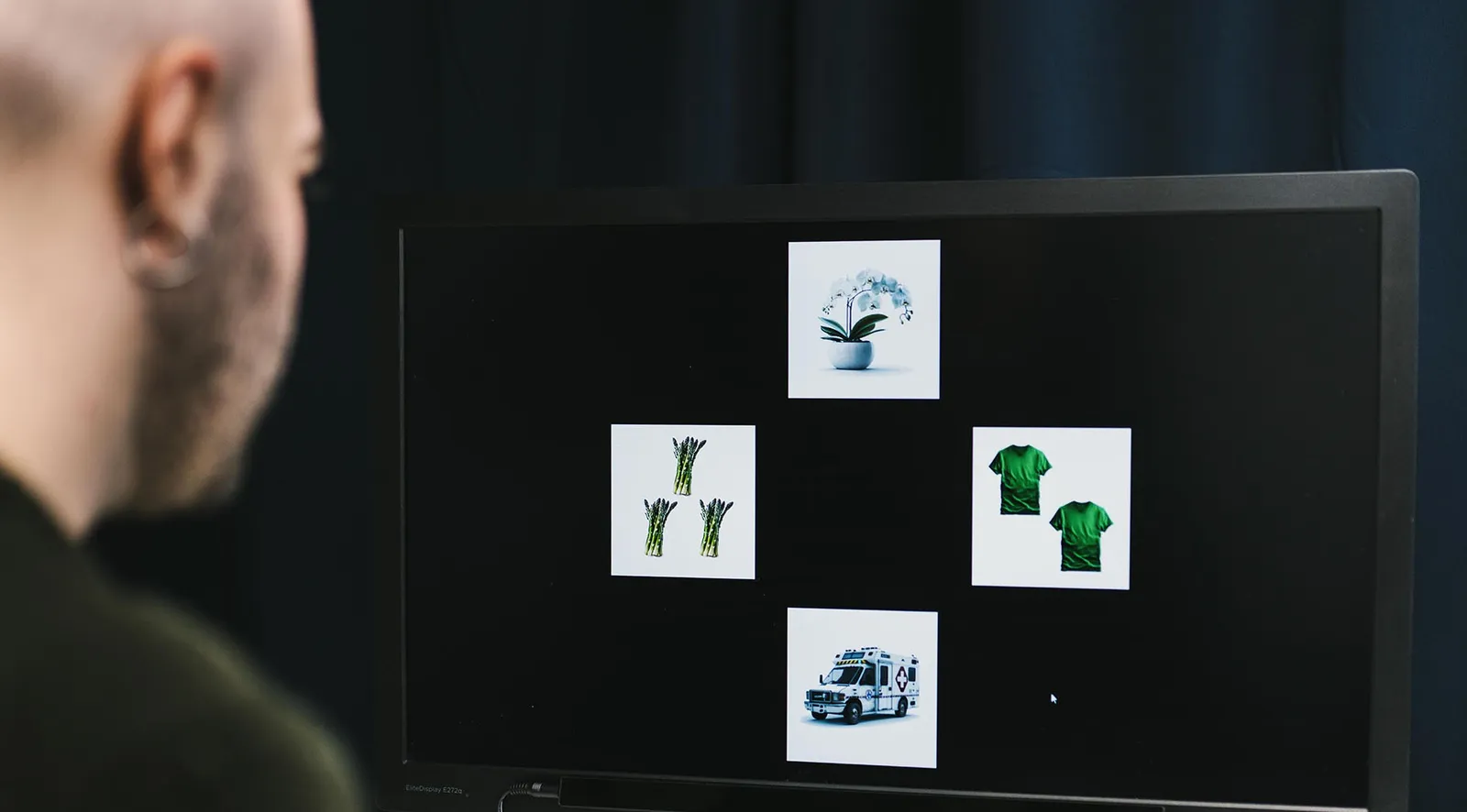
How to read the angles. At a distance of approx. 60 cm from the screen, 1° is approx. 1 cm on the screen. An accuracy of 1.64° corresponds to a typical deviation of approximately 1.7 cm from where the participant is looking. An image several centimeters wide is a safe area of interest; a single word in a text is not.
Outside the lab, webcam results degraded slightly, mainly in precision, while the proportion of valid data remained high. Accuracy was better at the center of the screen and almost independent of stimulus background brightness. The authors: the webcam provides stable, interpretable data for many AOI-based paradigms, such as preferential-looking tasks; infrared eye trackers retain higher precision.
“We were surprised by how well Tobii Nexus performed right out of the box. This technology marks an important step forward for eye tracking research.”
Source: K. Astor et al., “Toward Scalable Eye-Tracking: Validating the Tobii Nexus Webcam-Based System”, PsyArXiv preprint, 2026; quote and 3–5° range: tobii.com. Illustrative visualization: sample spread generated in the browser at angular scale (27″ monitor, 65 cm distance). Photo: Tobii.
It works best where the question concerns attention to larger screen elements and where the number of participants and the accessibility of the study matter.

Websites, apps, dashboards, onboarding screens, and prototypes — remotely too, together with tasks and a survey.

Attention to e-learning materials, videos, and diagrams; eye tracking in student classes without separate hardware.
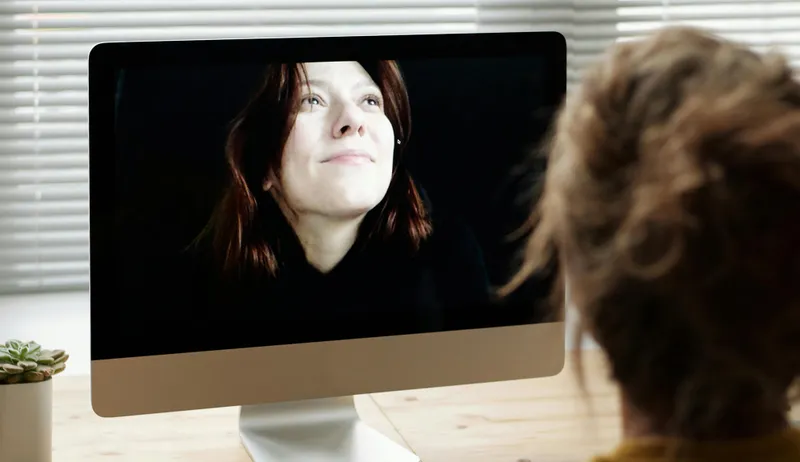
Attention to faces, social scenes, and emotional content within defined areas.
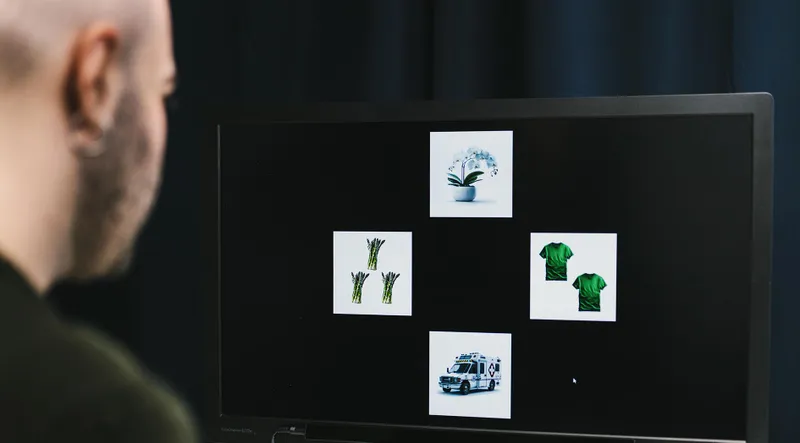
Attention, perception, search, and decision-making — with on-screen stimuli and AOI-level metrics.
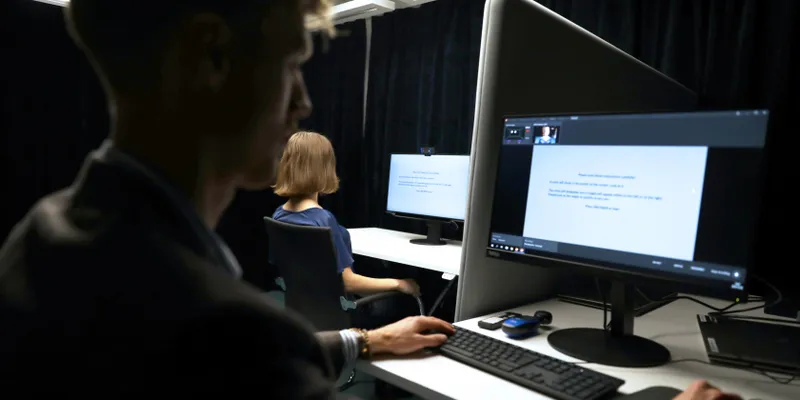
Scientific, supervised research only: social attention, neurodevelopmental patterns, on-screen cognitive tasks.

Dashboards, alerts, maps, operational displays, and training videos — with distributed participant groups.
Photos and scope of applications: Tobii (Webcam Eye Tracking page).
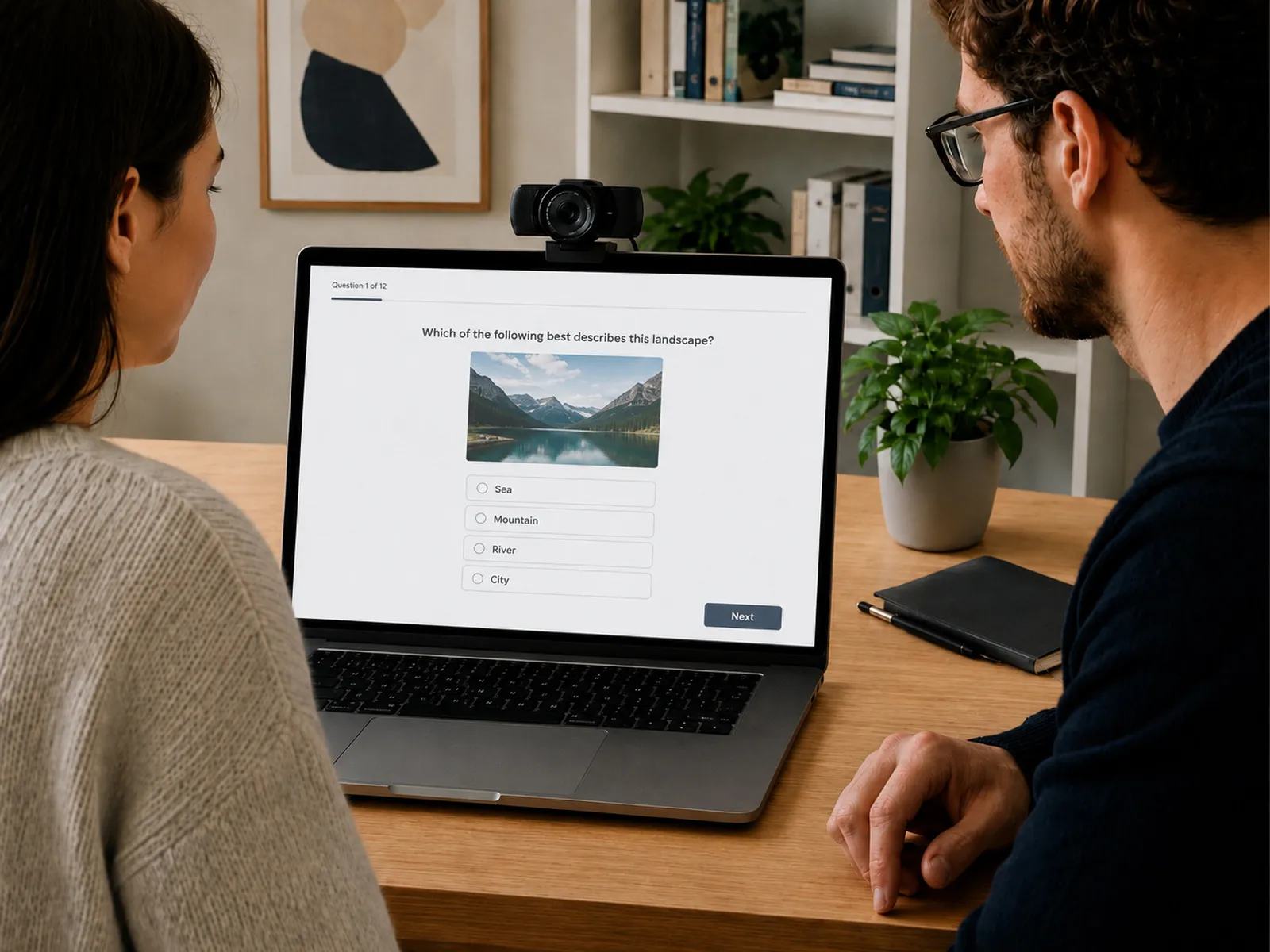
Tobii Webcam Eye Tracking in on-site mode (Tobii Pro Lab). Accuracy and precision values from the manufacturer's table apply to optimal conditions; for the Uppsala study results, see Accuracy.
| Measurement | |
|---|---|
| Method | appearance-based gaze estimation from RGB images of a standard webcam; timestamps and on-screen point coordinates |
| Sampling frequency | 30 Hz |
| Accuracy | 1.85°in optimal conditions |
| Precision | 0.44° RMSin optimal conditions |
| Eyes | combined gaze point for both eyes; no separate data for each eye |
| Data per sample | timestamp, gaze point, gaze origin (eye position)no pupil diameter, eye openness, or eye images |
| Latency | 1 frameon a reference computer with Intel Core i7-12800H |
| Calibration | participant calibration supported and recommended |
| Participant and setup | |
| Distance from screen | 25–85 cm; optimally approx. 60 cm |
| Freedom of head movement | 22 × 15 cm at 25 cm; 40 × 44 cm at 55–85 cmhead movement up to 20 cm/s; after calibration the participant should sit still |
| Screen | optimally up to 17″ (16:9) |
| Webcam | built-in or external, centered above the screenminimum 1280 × 720 at 78° field of view, 30 fps; ideally external 1920 × 1080, 70–80°, 30 fps or more |
| Software and integration | |
| Software | Tobii Pro Lab (version 26.18 or later), Tobii Pro Eye Tracker Manager; online — Pro Lab Distributed Online and Tobii Sticky |
| Operating system | Windows |
| Synchronization | TTL input not available; timestamps from the computer clock |
| License | Tobii Webcam Eye Tracking key tied to one computer, separate from the Pro Lab license |
Source: tobii.com — Local Webcam Eye Tracking, technical specifications; Tobii Connect — “Get Started with Tobii Webcam Eye Tracking in Tobii Pro Lab”. As of October 2026.
It is the measurement of where a person is looking, performed by software on the image from an ordinary webcam — without a separate infrared eye tracker. The research workflow stays the same as in classic eye tracking: experiment design, gaze recording, and analysis in Tobii Pro Lab.
Sticky is a separate online platform for testing ads, packaging, and websites — with a participant panel and results in the browser. Tobii Webcam Eye Tracking is a research tool in Tobii Pro Lab: you record on-site, on the station computer, while online studies are launched via Sticky and analyzed in Pro Lab (Distributed Online edition). About Sticky: Sticky by Tobii.
The minimum is 1280 × 720 pixels, 30 frames per second, and a field of view of approx. 78°. The best results come from a good external 1920 × 1080 webcam centered above the screen; older built-in laptop cameras usually perform worse. We will help you choose a webcam for your setup.
In the Uppsala University study, the webcam achieved an accuracy of 1.64° and a precision of 0.85° in the lab (infrared eye tracker in the same study: 0.96° and 0.68°). This is sufficient for analyzing larger areas of interest and comparing attention between them. Studies that require pixel-level precision — e.g., reading individual words — require a dedicated eye tracker.
Tobii Webcam Eye Tracking has no TTL input, and timestamps come from the computer clock. For multimodal studies with precise synchronization, we recommend a Tobii eye tracker — we integrate it with BIOPAC physiology into a single station.
On-site mode runs in Tobii Pro Lab, i.e., on Windows. In online studies, participants take part via the browser on their own computers.
Results depend on webcam quality, lighting, the participant's posture, and the distance from the screen; movement after calibration reduces accuracy. The webcam does not measure the pupil or each eye separately and samples 30 times per second, so it is not suited to saccade analysis. Under controlled on-site conditions, data quality is more predictable than online.