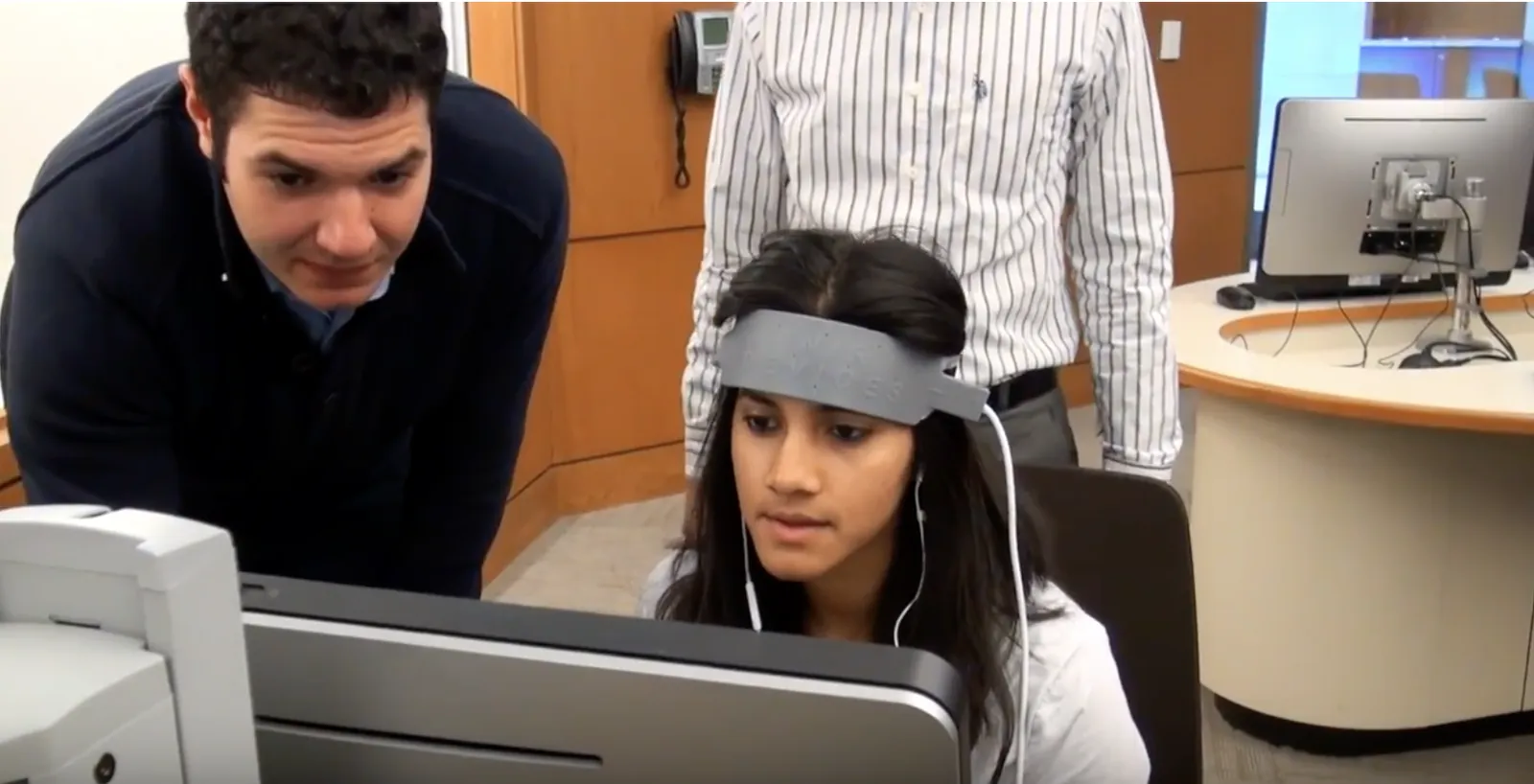
Cognitive workload and attention
Working memory (n-back), attention, problem solving, ergonomics of workstations and interfaces — mental effort measured, not just declared in a questionnaire.

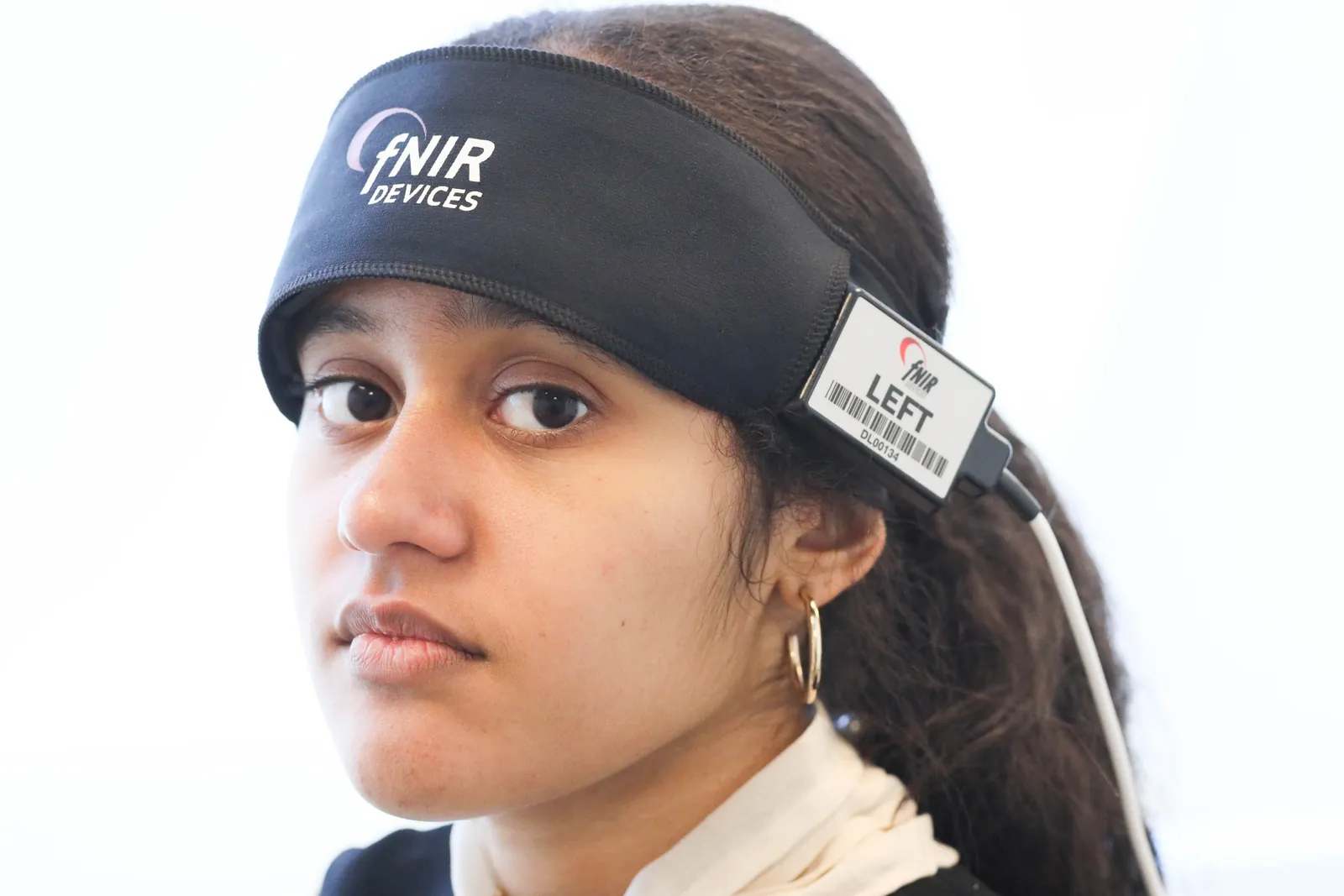
A headband with a sensor on the forehead shines near-infrared light deep into the head and measures how much oxygen the blood carries in the prefrontal cortex. When mental effort increases — attention, working memory, decisions — oxygenation changes, and the system shows it in real time. The Imager 3000C from fNIR Devices, compatible with the BIOPAC lab.
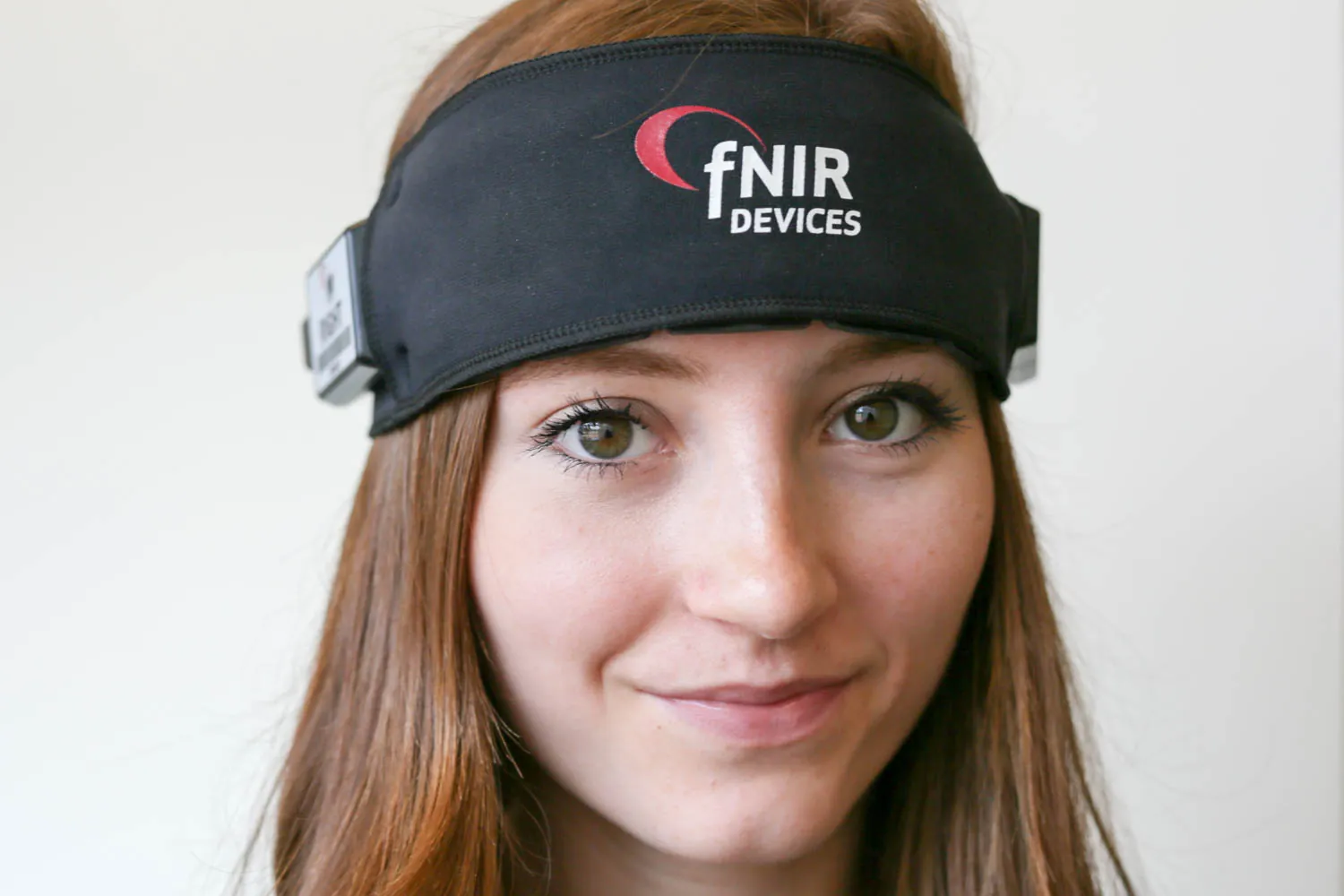
fNIRS — functional near-infrared spectroscopy — measures how blood oxygenation changes in the cerebral cortex. When an area works harder, more oxygen-rich blood flows into it. Hemoglobin with and without oxygen absorbs light differently — and this is exactly the difference the sensor on the forehead reads.
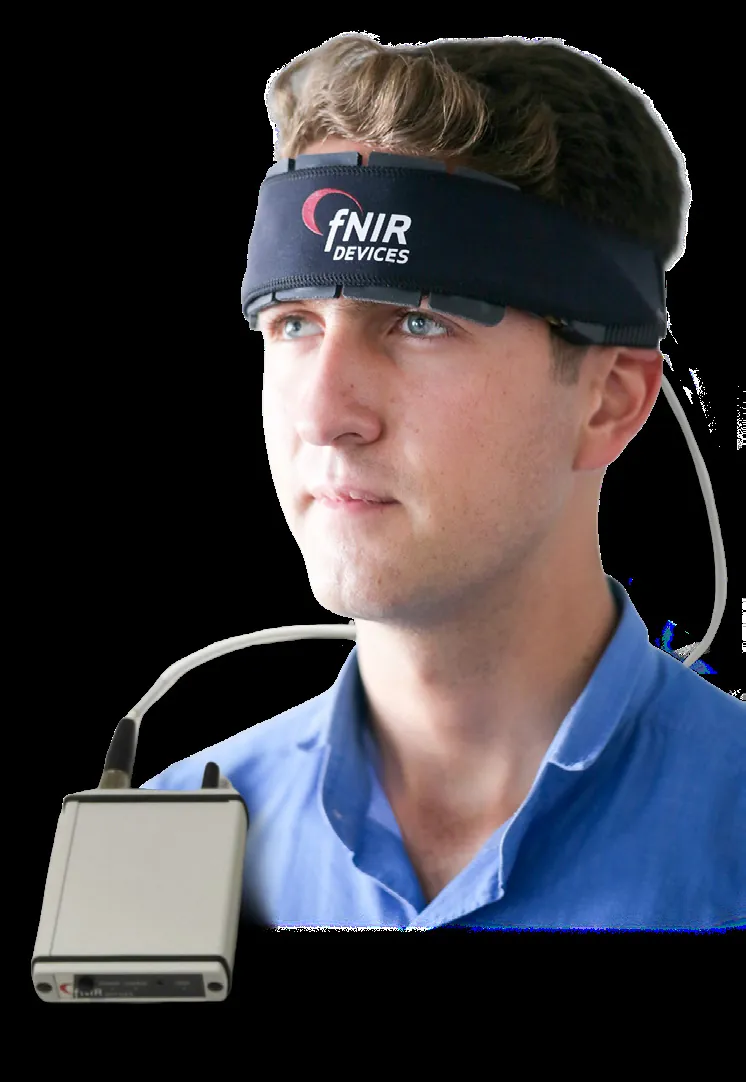
Illustration — the waveform is generated by the browser, not recorded by the device.
Blood reaches the working area after a moment. According to the manufacturer, the hemodynamic response appears 2–6 s after the stimulus, and in a sleep-deprived person even after 10 s.
The sensor is a flexible silicone strip hidden under a headband that blocks ambient light. The light sources switch on in turn, and the detectors receive light from neighboring sources. Each source–detector pair is one channel — one measured patch of cortex.
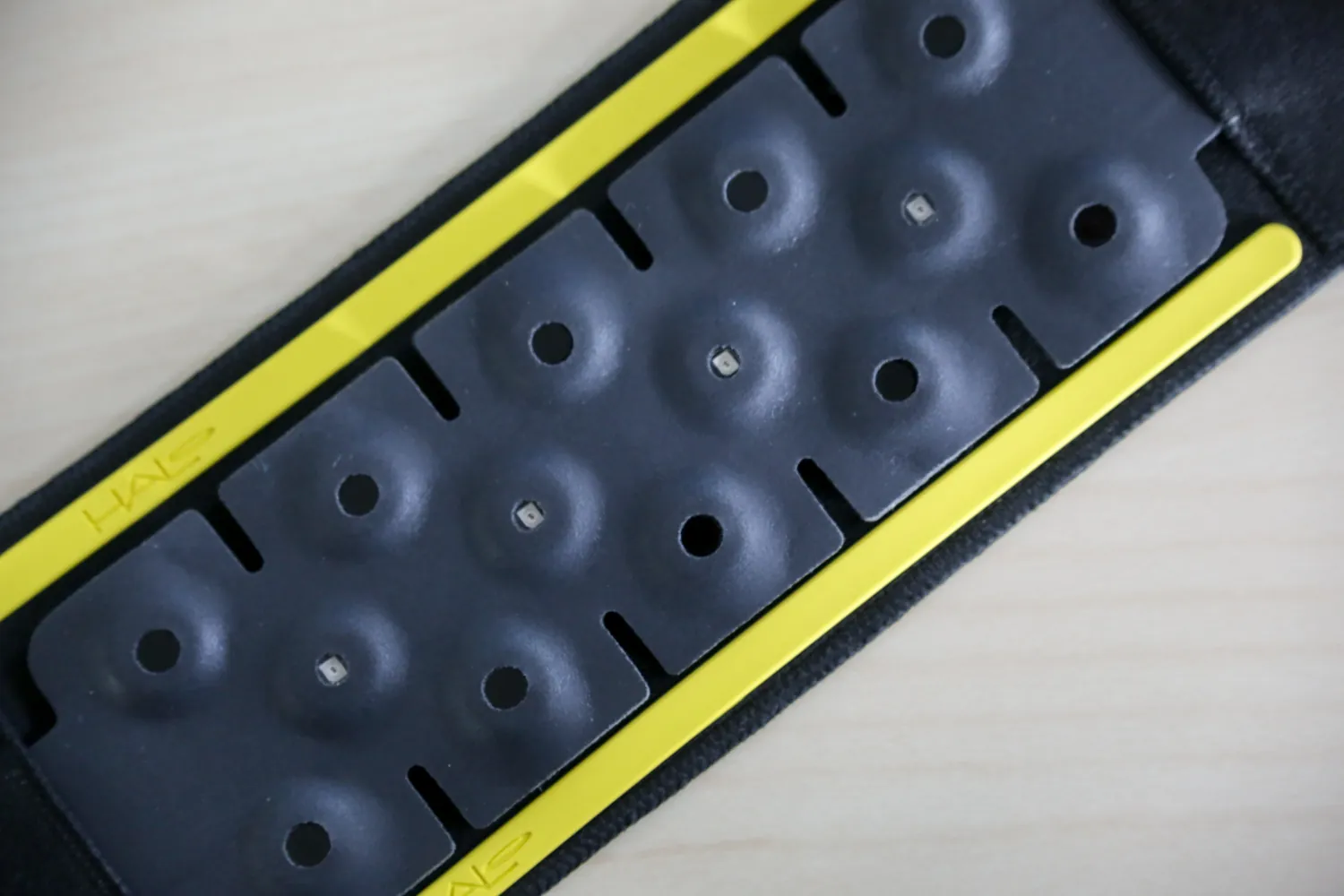
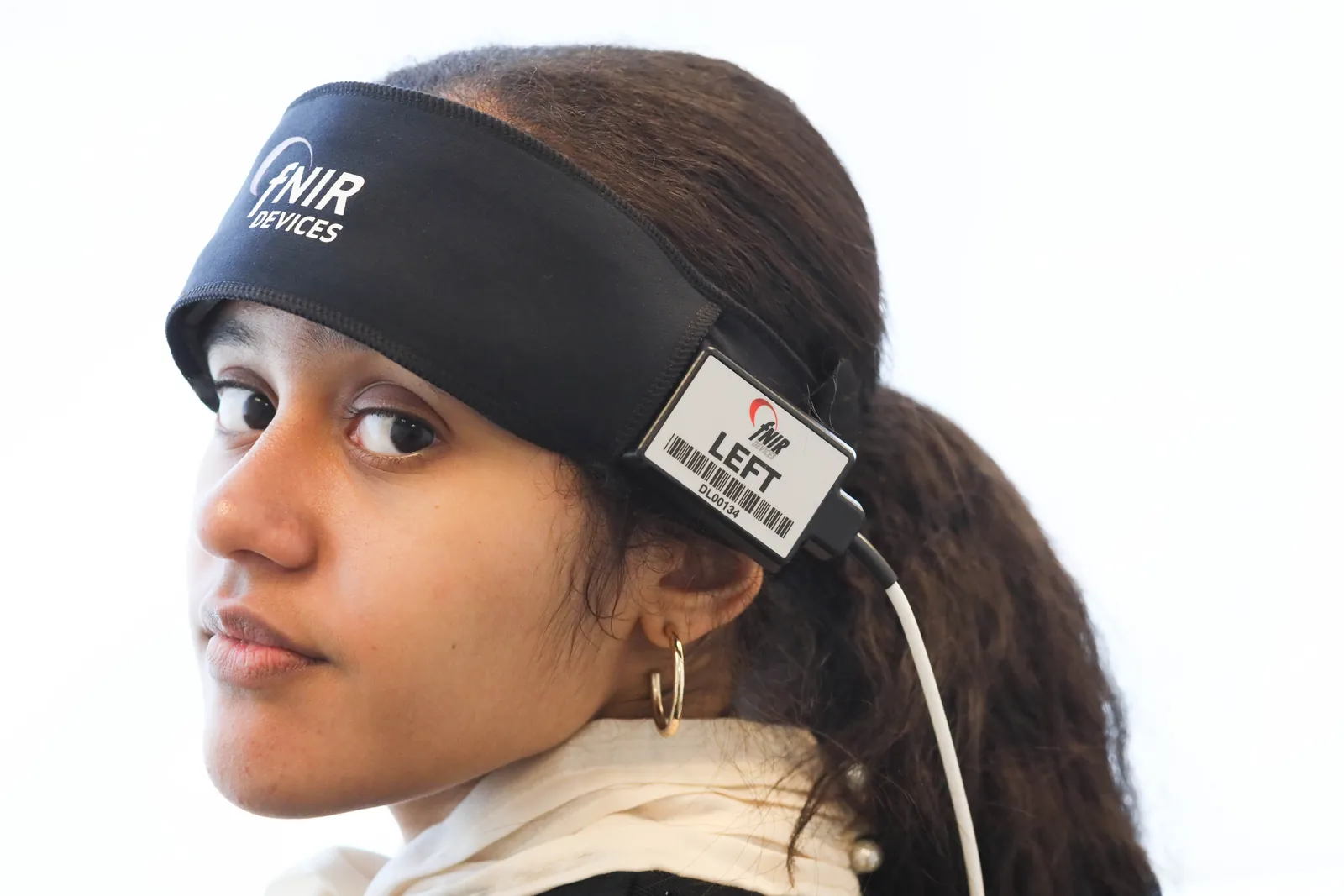
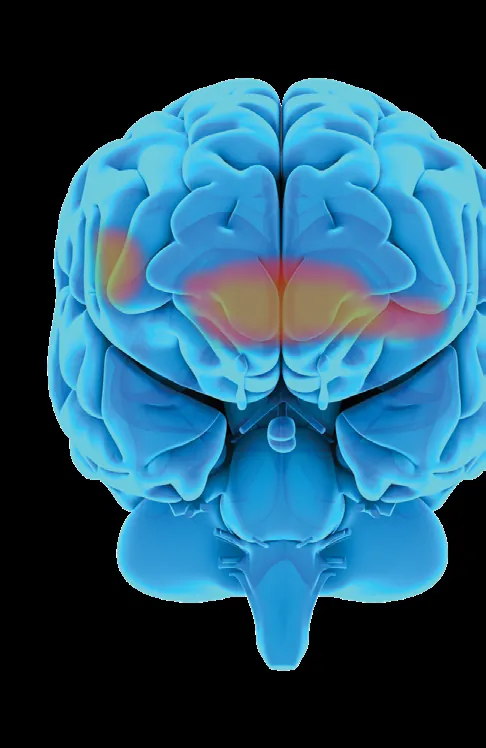
Where exactly does it measure? The sensor rests on the forehead just above the eyebrows. According to the manufacturer, it covers Brodmann areas 10, 11, 46 and 47 — associated with working memory, attention, problem solving and decision making.
raw 730 / 850Raw light intensityfor both wavelengths — for quality control and your own analysisHbO₂Oxygenated hemoglobinrises when oxygenated blood flows into the areaHbRDeoxygenated hemoglobinusually falls when the area is working hardoxy · HbTOxygenation and total hemoglobincalculated in fNIRSoft from HbO₂ and HbRmarkerEvent markersfrom stimulus software, keyboard, buttons or a TTL triggerBoth programs are included. COBI Studio records the session and calculates hemoglobin in real time. fNIRSoft is used for analysis — through the program’s windows or scripts, no programming required.
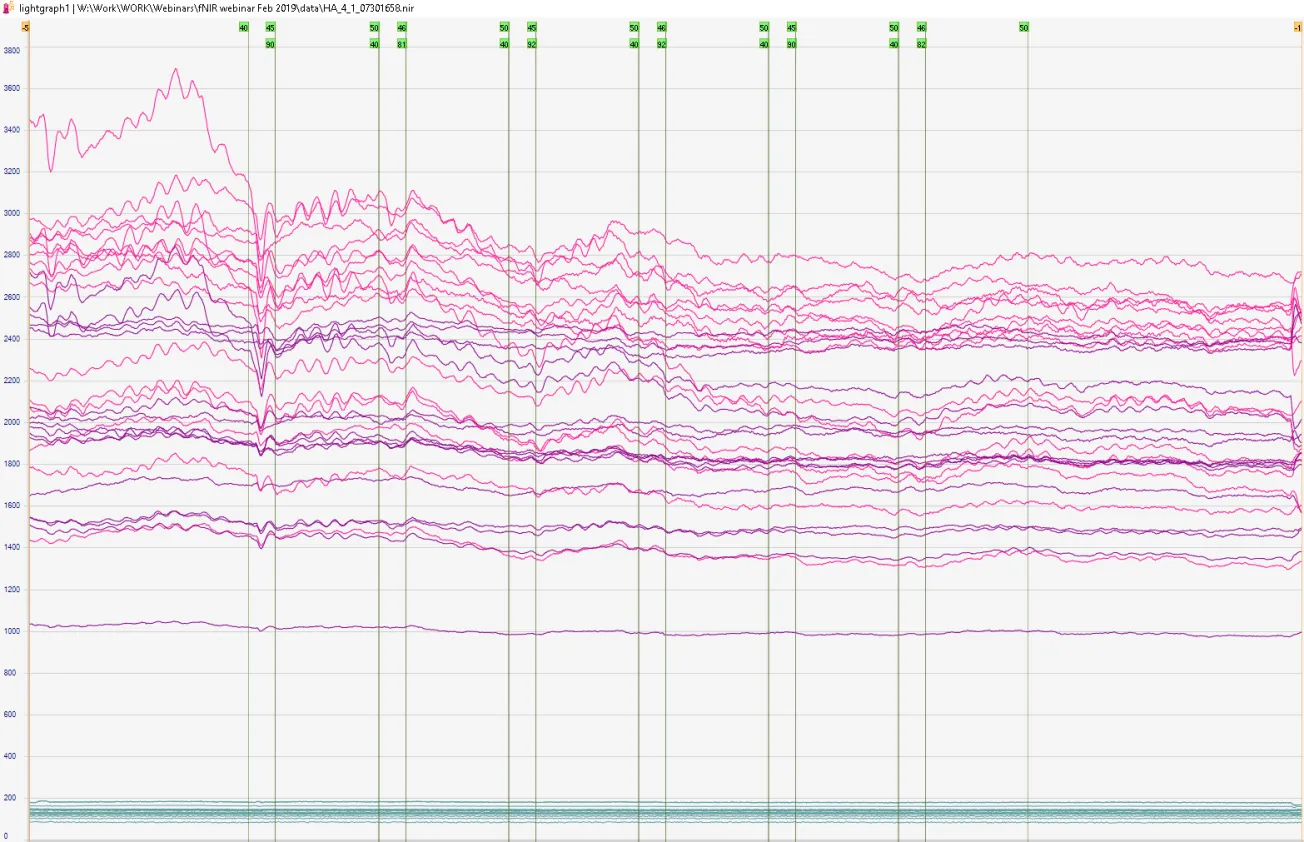
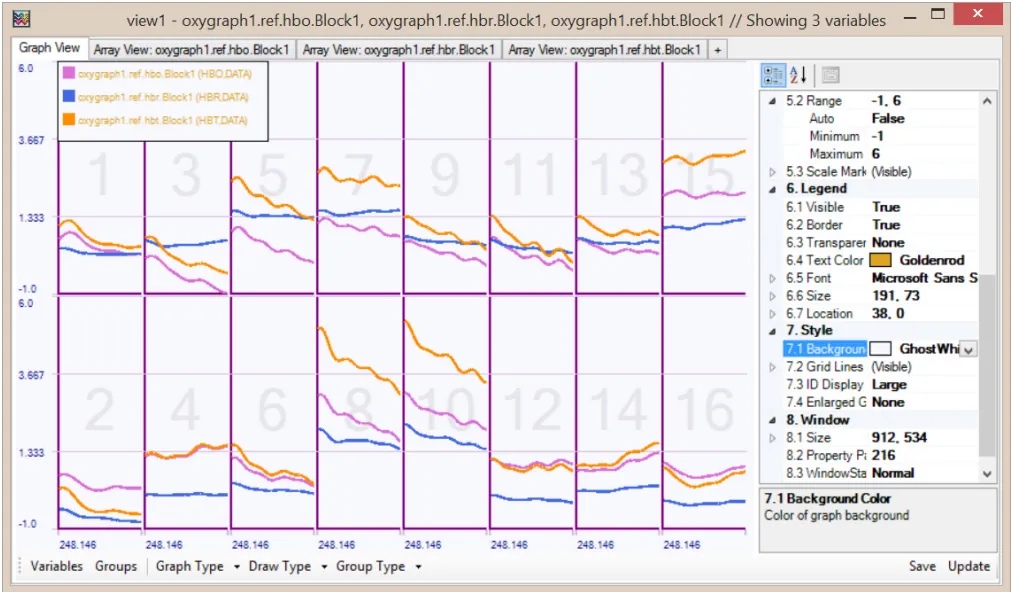
The program that controls the Imager and saves everything in one organized format.
Analysis through the program’s windows or scripts — apply the same steps to subsequent participants.
automatic channel quality control, motion artifact removal, advanced feature extraction and statistical comparisons — e.g. t-test and ANOVA.
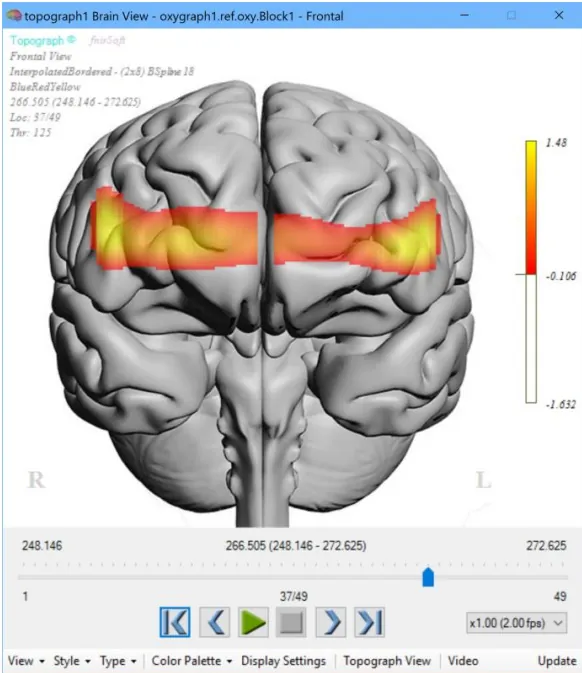
Shows which parts of the prefrontal cortex worked harder, and when.
map on a brain surface image, left, right and top views, thresholds, animation and averages per group, participant or condition.
C-Series kits include fNIRSoft Standard; fNIR304C — the Pro version. For the other kits, Pro is available as an upgrade — we confirm the contents in the quote.
fNIRSoft and COBI licenses with every system. One year of updates and fixes included, then optional renewal. Additional analysis workstations — licenses for 4 or 9 users.
COBI Modern runs on Windows 10, fNIRSoft on Windows. The manufacturer recommends an Intel i5 processor or better. The programs do not run on macOS.
A popular route to multimodal research is subscription platforms to which further modules are added. The C-Series is a different approach: an fNIRS system with recording and analysis software included, and we add physiology and eye tracking from BIOPAC and Tobii — configured together.
| Feature | fNIRS C-Series from Interlab | Subscription platform |
|---|---|---|
| fNIRS software | COBI Studio + fNIRSoft included — recording, live view and analysis | mandatory core module, further modules purchased separately |
| Fees after purchase | one year of updates included, optional renewal | annual renewal, paid upfront |
| Physiology and eye tracking | BIOPAC MP200 and Tobii from one supplier, synchronized with TTL triggers | further paid platform modules |
Subscription platform: license terms according to its manufacturer’s website, as of 2026-10. C-Series: biopac.com, fNIR Devices catalog.
We match the configuration to your research question, install the system and train your team — from the first baseline to block analysis.
fNIRS shows how the prefrontal cortex is working. The eye tracker — what the participant was looking at. Physiological signals — how the body responded: heart rate, skin conductance, breathing. The manufacturer describes combining fNIRS with eye tracking, ECG and stimulus presentation; we build one workstation from these elements.
fNIRS is recorded by COBI, physiology and gaze — by AcqKnowledge; the recordings are aligned by shared TTL markers. We prepare a configuration of these elements for your study. Data: biopac.com (fNIRS C-Series, fNIRS FAQ, AcqKnowledge 6, MP200), fNIR Devices catalog.
The Imager 3000C controls the sensor, collects measurements 20 times per second and sends them to the computer — via a USB-C cable that also powers it, or wirelessly. Click the points on the photo.
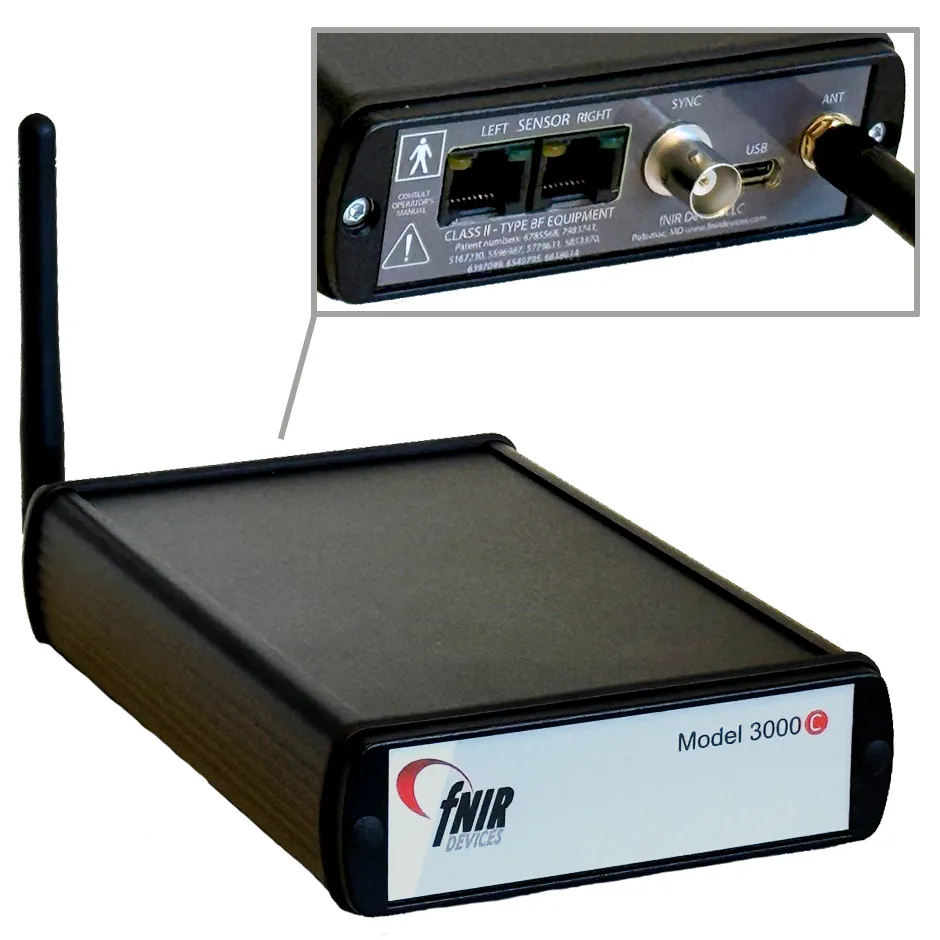
Each Imager 3000C supports up to 18 channels. COBI shows several C-Series Imagers as one large virtual device — for high-density channel studies.
Both systems come from fNIR Devices and use the same forehead sensors and the COBI and fNIRSoft software. They differ in where they work best.
| Feature | fNIRS C-Series (Imager 3000C) | fNIRS 2000M |
|---|---|---|
| Intended use | laboratory and multimodal workstations, combining multiple Imagers | research on the move and in the field |
| Sampling rate | 20 Hz | up to 4 Hz |
| Channels | up to 18 per Imager; several Imagers as one device | up to 18 |
| Connection | USB-C (data and power) or wireless | wireless, Bluetooth 4 |
| Power | via USB-C; optional 12 V 3000 mAh battery pack | built-in battery — approx. 1 h of recording, approx. 3 h charging |
| Synchronization | TTL via BNC — sends and receives triggers | TTL via JST PH connector |
| fNIRSoft | Standard (Pro in fNIR304C) | Pro |
Working mainly outside the lab? See the fNIRS 2000M System. Not sure which to choose — ask us.
Data: fNIR Devices catalog (BIOPAC), BIOPAC fNIRS Systems product sheets.
Wherever mental effort in a realistic task matters — at a desk, in a simulator, in VR. BIOPAC reports more than 1,000 publications citing fNIRS systems.
Working memory (n-back), attention, problem solving, ergonomics of workstations and interfaces — mental effort measured, not just declared in a questionnaire.
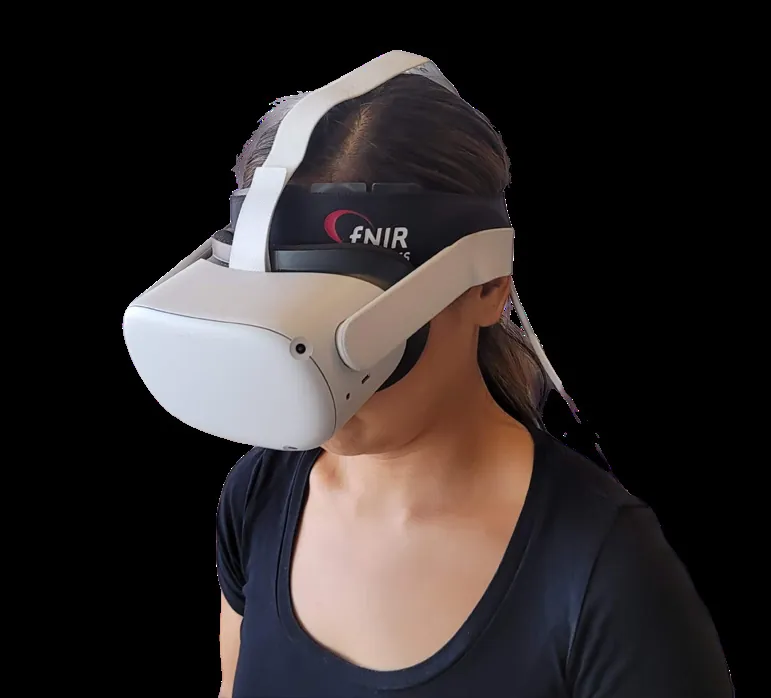
Sensor under the headset: how a VR environment affects attention, memory, decisions and emotions — together with eye tracking and physiology.
Operators, drivers, pilots: workload in a simulator and during complex tasks. BIOPAC runs webinars on topics such as fNIRS in helicopter pilots.
Each kit includes the Imager, sensor or sensors, cables, headband, power adapter and the COBI and fNIRSoft software. They differ in the number and type of sensors and in accessories.
| Kit | Sensors | Software and accessories |
|---|---|---|
| fNIR104C | 1 × 6-channel sensor | fNIRSoft Standard, COBI — a good start and for teaching |
| fNIR154C | 1 × 18-channel sensor | fNIRSoft Standard, COBI |
| fNIR204C | 3 × 18-channel sensors | fNIRSoft, COBI — spare sensors for study series |
| fNIR304C | 3 × 18-channel sensors | fNIRSoft Pro, COBI, Surface computer with caddy |
Contents according to the BIOPAC fNIRS Systems sheet (12.2024) and the product page; the fNIRSoft version in the kit is confirmed in the quote.
According to the BIOPAC product sheet, the fNIR Devices catalog and biopac.com.
| Parameter | Value |
|---|---|
| Method | continuous-wave fNIRS |
| Sampling rate | 20 Hz (20 frames/s) |
| Number of channels | up to 18 per Imager; multiple Imagers combined in COBI |
| Connection | USB-C (data and power) or wireless |
| Synchronization | TTL input/output (BNC); pulses at the start and end of the baseline and of the recording |
| Mobile power | optional 12 V, 3000 mAh battery pack |
| Data | raw light intensity, HbO₂, HbR in real time |
| Warranty | Imager 12 months, sensor 3 months |
| Parameter | Value |
|---|---|
| Light sources | LEDs, 730 nm and 850 nm |
| Detectors | silicon photodiodes with integrated preamplifier |
| 18-channel sensor | 4 sources, 10 detectors, 25 mm separation; shielded and VR headset versions |
| Other sensors | 6- and 5-channel |
| Material | silicone, headband blocking ambient light |
| Measurement area | prefrontal cortex (forehead) |
| Software | COBI Studio (recording), fNIRSoft Standard or Pro (analysis) |
| Operating system | Windows (COBI Modern: Windows 10); no macOS |
Yes — it is a non-invasive method. The sensor uses LEDs, not a laser, and near-infrared light is invisible. The participant does not lie in a scanner and does not hear noise as in fMRI.
The manufacturer states that the sensor can be fitted and recording started within five minutes. Calibration, baseline and sensor positioning usually take the researcher no more than 10 minutes.
No. The sensor works on hairless skin, so it measures the prefrontal cortex under the forehead — areas associated with working memory, attention and decisions. The measurement reaches 1–2 cm deep, into the outer layer of the cortex.
No. The system is not a pulse oximeter — it shows changes in the concentration of oxygenated and deoxygenated hemoglobin relative to rest recorded at the start of the session. That is why every session starts with a baseline.
Yes, fNIRS tolerates movement better than fMRI, but it is not completely immune to it. For walking or running the manufacturer recommends an additional accelerometer for artifact removal; fNIRSoft Pro has motion artifact removal algorithms. For research mainly on the move, also consider the fNIRS 2000M.
Yes. The Imager 3000C sends and receives TTL triggers, so a shared marker goes to COBI and to AcqKnowledge, in which you can also record a Tobii eye tracker and BIOPAC physiological signals. The manufacturer also describes recording fNIRS together with EEG. We match the configuration to your study.
No. COBI Modern requires Windows 10, fNIRSoft runs on Windows. The fNIR304C kit includes a Surface computer with a caddy.
Tell us about your research question — we will select the C-Series kit, sensors and any connection with BIOPAC and Tobii. We will show you the system live.