Montage and fitting
- you design the sensor layout in MeMoSoft — EEG, fNIRS or hybrid
- AcqKnowledge Setup guides you when fitting over regions of interest
- calibration and signal quality check before starting

A wearable headset that measures brain activity in two ways at once: with light (fNIRS — changes in blood oxygenation in the cortex) and with electrodes (EEG — electrical activity). You record it in BIOPAC AcqKnowledge together with heart rate, respiration or skin conductance — all on a common clock.
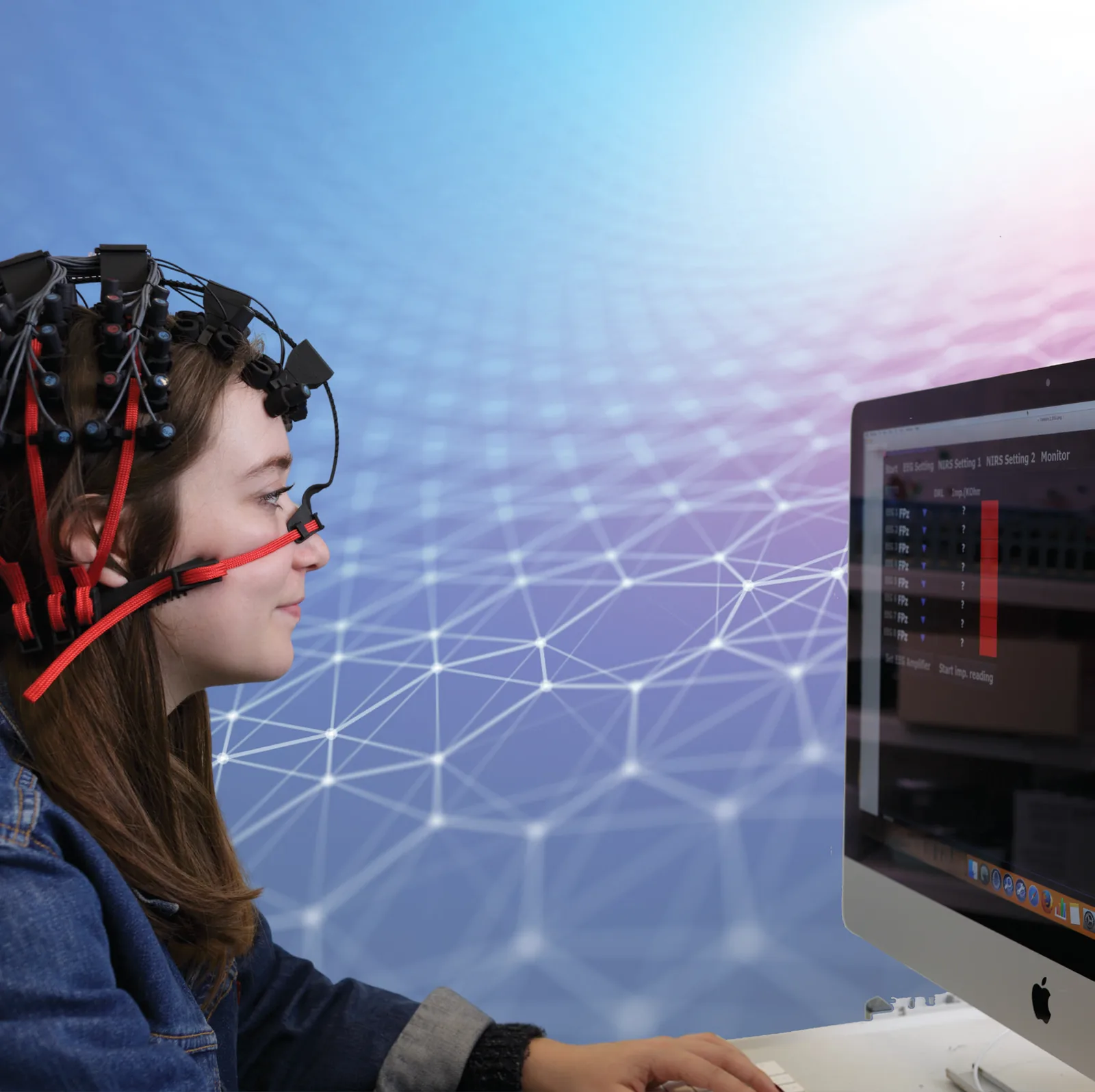
When a part of the cerebral cortex is working, two things happen: neurons send tiny electrical impulses, and shortly afterwards more oxygenated blood flows to them. EEG measures the first, fNIRS — the second. MedelOpt+ has sensors of both types in one headset, so both signals are captured in the same recording.
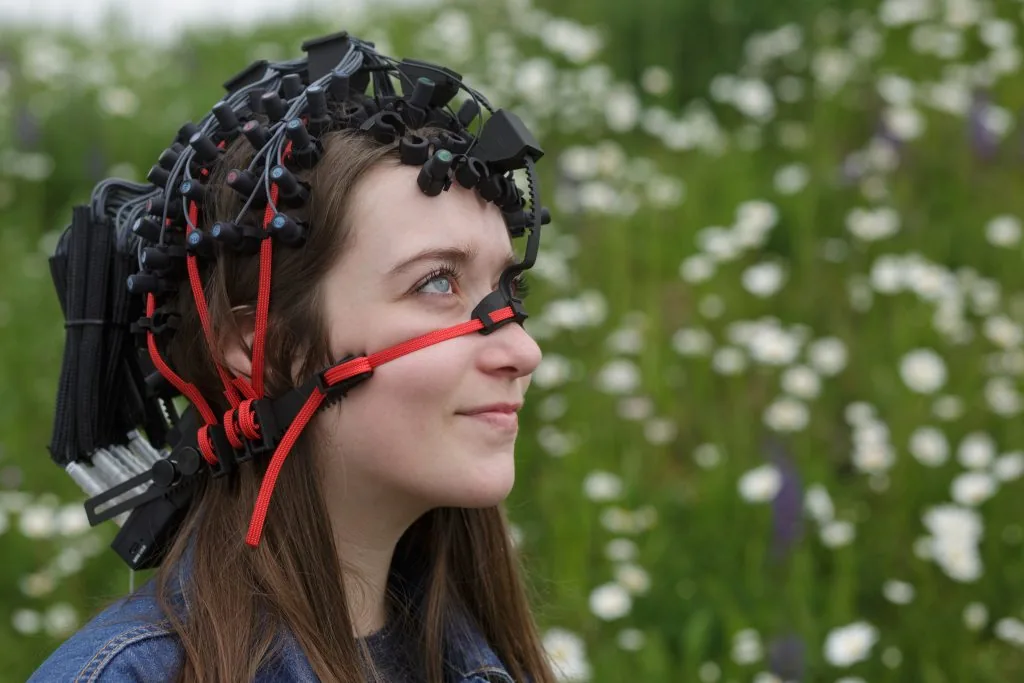
The head cross-section on the photo is an illustration, not a device recording. Photo: Seenel Imaging.
Shows which cortical areas are working: it localizes activity more precisely than EEG and tolerates participant movement well.
Shows when the brain responds — with millisecond precision. It captures fast responses to a stimulus that blood flow cannot keep up with.
Simultaneous recording lets you study how electrical activity translates into blood flow (neurovascular coupling) — e.g. in epilepsy research.
HbOOxyhemoglobinchange in the amount of oxygenated blood under each channelHbRDeoxyhemoglobinblood after releasing oxygen — usually changes in the opposite direction to HbOEEGBrain potentials8 electrodes, 512 samples per secondshort ch.Short channelsblood flow in the skin — to be subtracted from the cortical signaleventsEvent markersstimuli, responses and tasks on the same timelineResolutions according to the comparison in the BIOPAC MedelOpt brochure; parameters: biopac.com (MedelOpt+ Brain-Body Platform), BIOPAC MedelOpt brochure.
Most fNIRS systems mount the sensors in an elastic cap, which sits a little differently on every head. MedelOpt+ has a lightweight, adjustable frame with clipped-in sensors. According to BIOPAC, this gives an average positioning accuracy of ±2.9 mm — about five times better than with a cap — and repeatable measurements across participants and sessions.
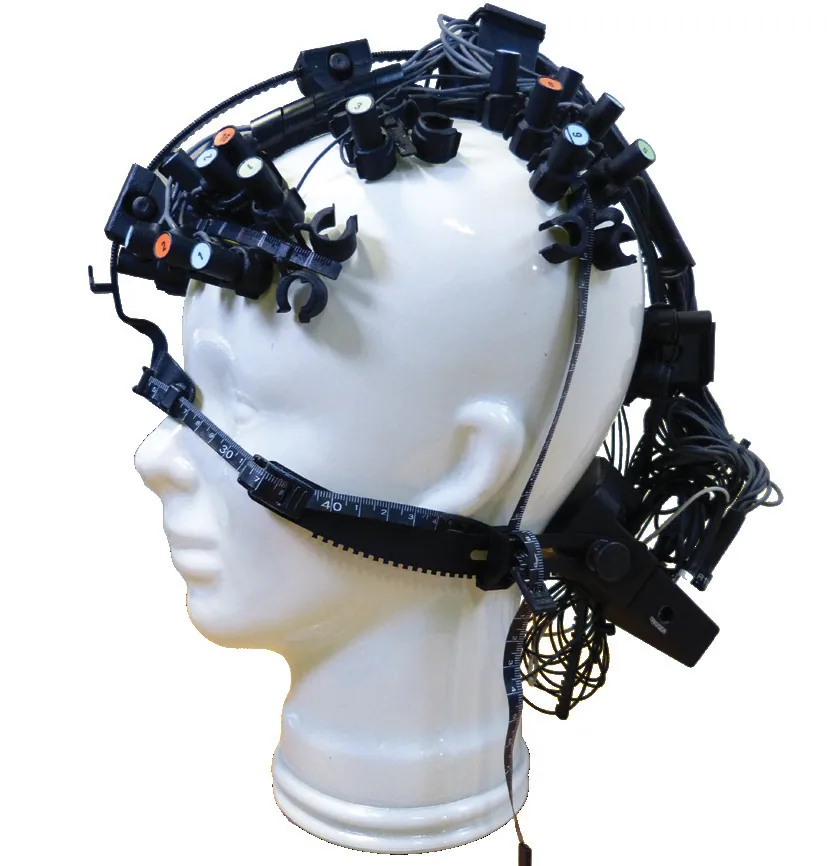
fNIRS emitters and detectors and EEG electrodes are integrated into the headset. You design their layout — the montage — in the MeMoSoft program, and AcqKnowledge guides you to the positions during fitting.
The design leaves access to the scalp: you move hair away from under a sensor without removing the headset. This shortens preparation and lets you improve contact during the session.
An adjustable strap with a scale fits the frame to the head circumference. One headset serves children from age 4 and adults — no set of caps in different sizes.
The system is modular: you add more emitters and detectors to the headset to increase the number of channels, or move from a single modality to fNIRS + EEG. The same frame covers the cortex from frontal to cerebellum.
The sensor cables converge in a small electronics unit (22 × 85 × 48 mm). In the Mobility variant, the headset transmits via Wi-Fi with no range limit, and if the live view drops, it keeps recording to its own memory — with no data loss. The Infinity and Tandem systems connect by cable; with the Mobility Pack (mini PC and battery) they also become mobile.
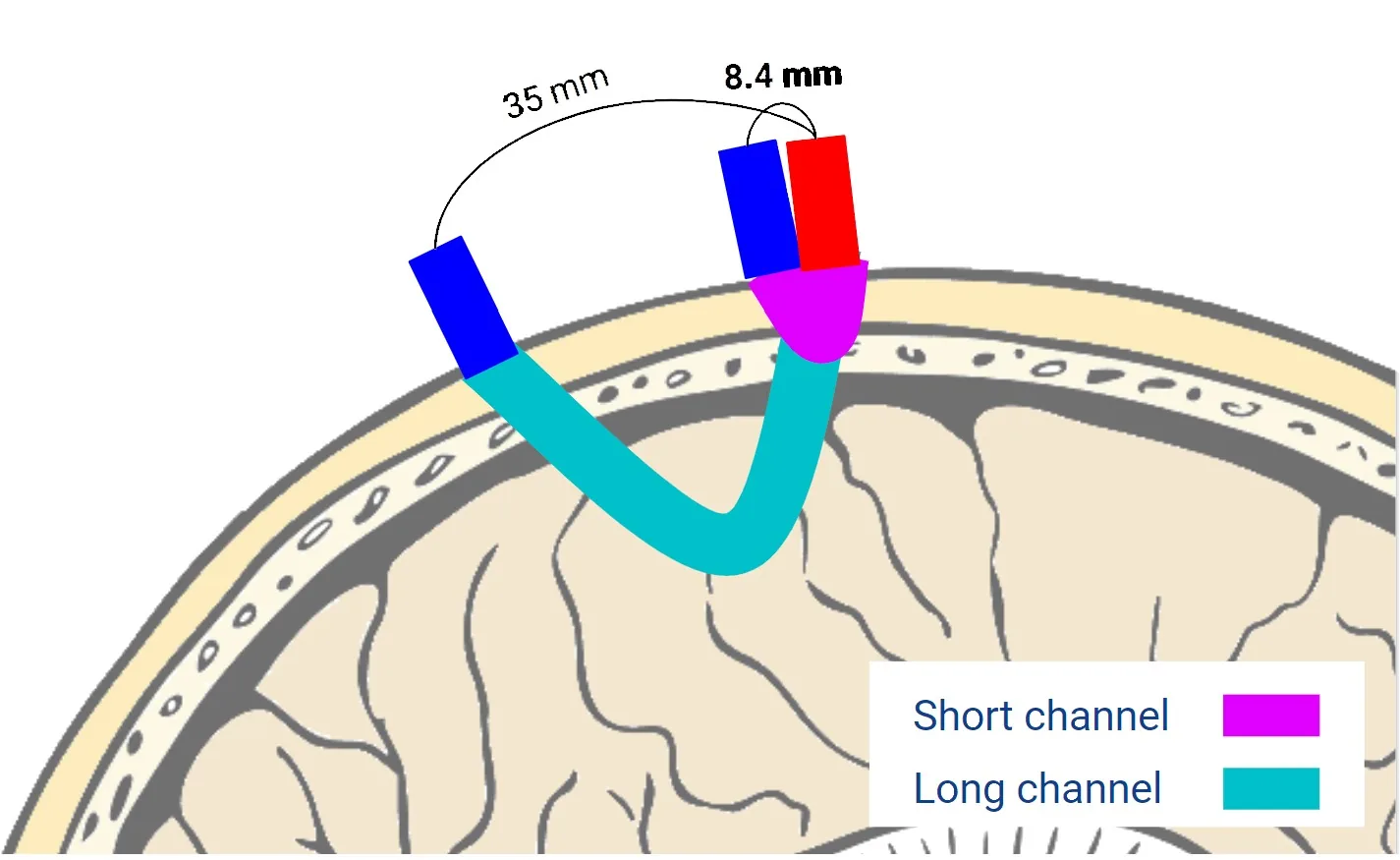
Part of the light passes only through the skin, where blood also circulates — with every heartbeat and breath. A short channel is a pair of sensors placed close together: it sees only the skin. Its signal is subtracted from the long channels so that only the cortical contribution remains. The number of short channels depends on the variant: from 1 in Mobility to 32 in Infinity 16-32.
Data: BIOPAC MedelOpt+ product sheet (11/2025); biopac.com — MedelOpt+ Brain-Body Platform. Photo and diagram: Seenel Imaging / BIOPAC.
MedelOpt+ works in AcqKnowledge — the same program in which BIOPAC records ECG, respiration or skin conductance. An AcqKnowledge license is always included and it is perpetual. Configuration, recording and analysis take place in one window, and one interface controls the headset and all connected BIOPAC amplifiers. You don’t need synchronization scripts or additional tools.
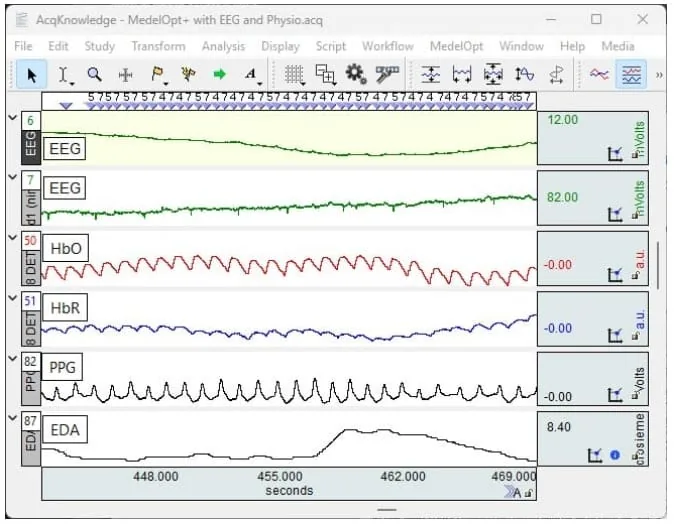
A real MedelOpt+ recording with EEG and physiology. Select a signal:
EEG from the headset. Voltages from the electrodes in microvolts, sampled at 512 Hz. This is where you look for fast responses to a stimulus and brain rhythms.
HbO — oxyhemoglobin. Change in the amount of oxygenated blood under the selected fNIRS channel. It rises a few seconds after a cortical area starts working.
HbR — deoxyhemoglobin. Blood that has released its oxygen. In a typical brain response it falls when HbO rises — this pair of signals is the basis of fNIRS analysis.
Physiology from BIOPAC. The pulse wave (PPG) and skin conductance (EDA) from BIOPAC modules, saved in the same file. They help separate the brain response from changes in the whole body.
A Seenel Imaging application for montage design: “a few clicks” and the headset is configured for your study and your participants.
A library for real-time EEG and fNIRS streams in your own applications — neurofeedback and brain–computer interfaces (BCI). Purchased separately.
Stimulus presentation, stimulator control, video and audio of the session, VR with eye tracking built into the headset — in the same program, on the same timeline.
Sources: biopac.com — MedelOpt+ Infinity product page (Details tab), Brain-Body Platform, AcqKnowledge — new features (6.0.2), MedelOpt+ API; seenel-imaging.com (MeMoSoft). Screenshot: BIOPAC.
A popular route to multimodal research is subscription platforms to which an fNIRS device from another manufacturer is connected. MedelOpt+ is a different approach: the headset, physiological amplifiers and BIOPAC software are designed to work together — and we deliver and set up the whole system.
| Feature | MedelOpt+ from Interlab | Subscription platform + fNIRS from another manufacturer |
|---|---|---|
| Synchronization with physiology | common clock and hardware triggers — no delays, drift or sampling rate mismatch | fNIRS data arrives as an LSL stream from the device manufacturer’s software |
| fNIRS analysis | configuration, recording and analysis in AcqKnowledge; live view of HbO and HbR | data export (CSV, SNIRF) for analysis in external tools |
| License | perpetual AcqKnowledge license included — one program for fNIRS, EEG, physiology and stimuli; only selected features are paid separately, e.g. Network Data Transfer | mandatory core module + separately paid modules with annual renewal; hardware not included in the price |
Subscription platform: a popular multimodal platform with an fNIRS module; values based on its manufacturer’s website, as of 2026-10. MedelOpt+: biopac.com.
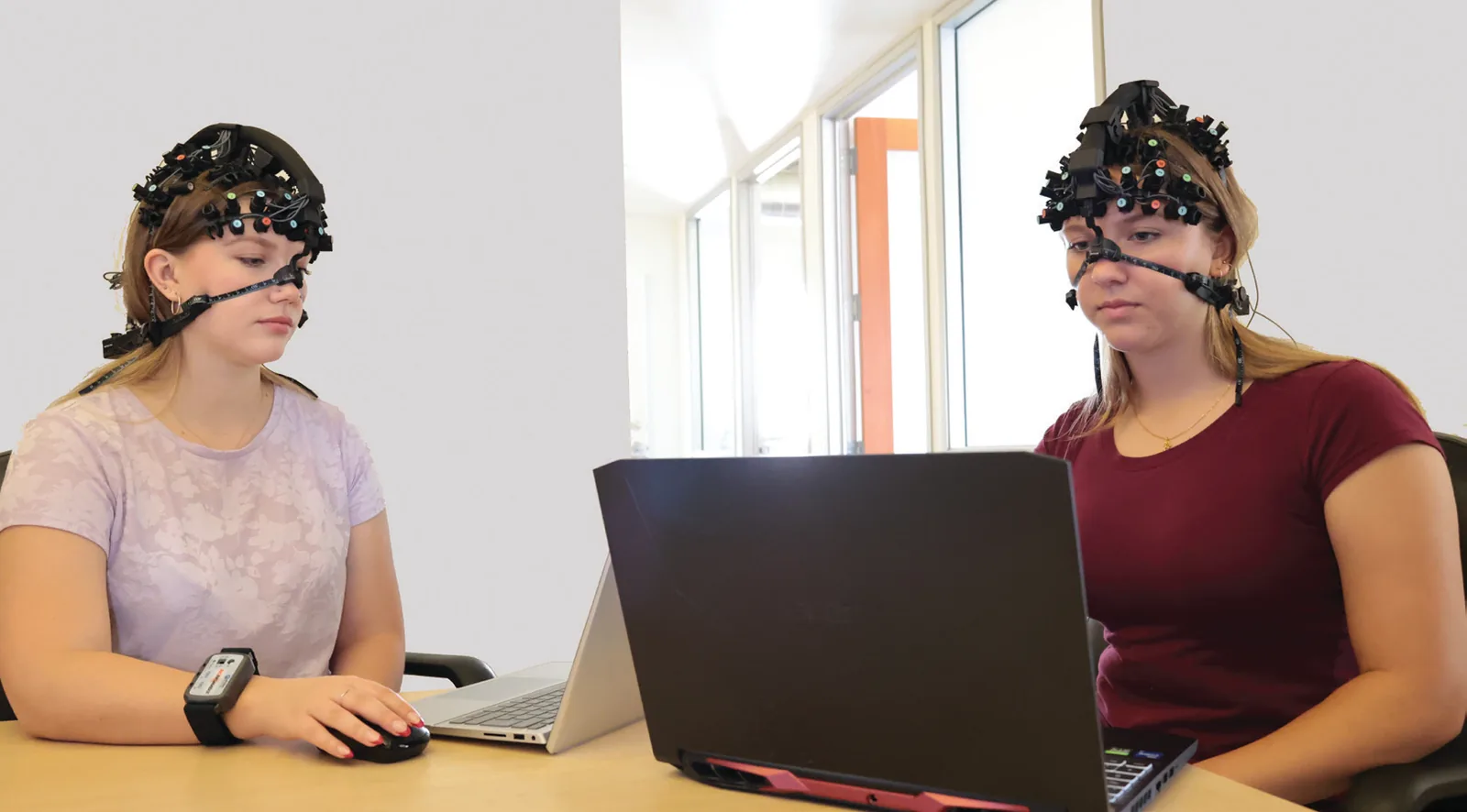
We match the configuration to your research question, install the system and train your team.
Blood flow in the brain also depends on breathing, heart rate and arousal. That is why BIOPAC combines MedelOpt+ with the MP200 system into a “brain–body platform”: fNIRS, EEG, ECG, respiration, EDA, video and stimuli go into one file, on one timeline, hardware-synchronized. In the photo: a dual task — treadmill walking while counting backward.
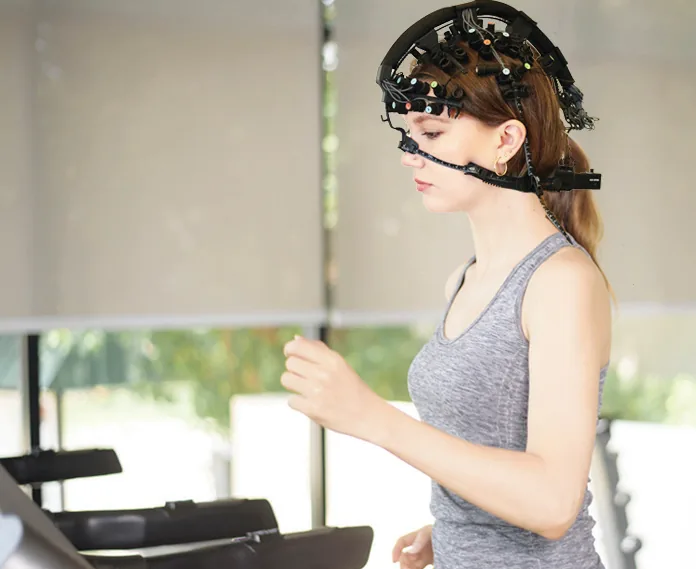
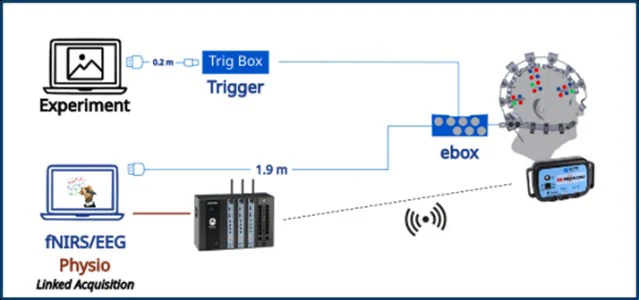
The experiment program sends events via the MedelOpt+ Trigger Box (USB port) directly to AcqKnowledge, so fNIRS and EEG are synchronized with the stimuli. The MP200 and the headset run in one instance of the program thanks to the Linked Acquisition protocol — no extra integration steps.
Trigger latencies: typical propagation delay according to the BIOPAC MedelOpt+ product sheet (11/2025). The signal waveforms on the photo are illustrative. Data: biopac.com — MedelOpt+ Brain-Body Platform, MedelOpt+ Infinity product page, MedelOpt+ for VR, AcqKnowledge — new features; BIOPAC MedelOpt brochure (gait protocol). Photo: BIOPAC.
All MedelOpt+ systems share the same exoskeleton, sensors and software. They differ in the number of sensors, mobility and the number of headsets. Choose what you want to study — we will point you to the right variant.
Whole-head map → Infinity. When you want to cover many cortical areas at once — from frontal to cerebellum — or build montages with different depths. We compare configurations and channel counts on the MedelOpt fNIRS Infinity Systems.
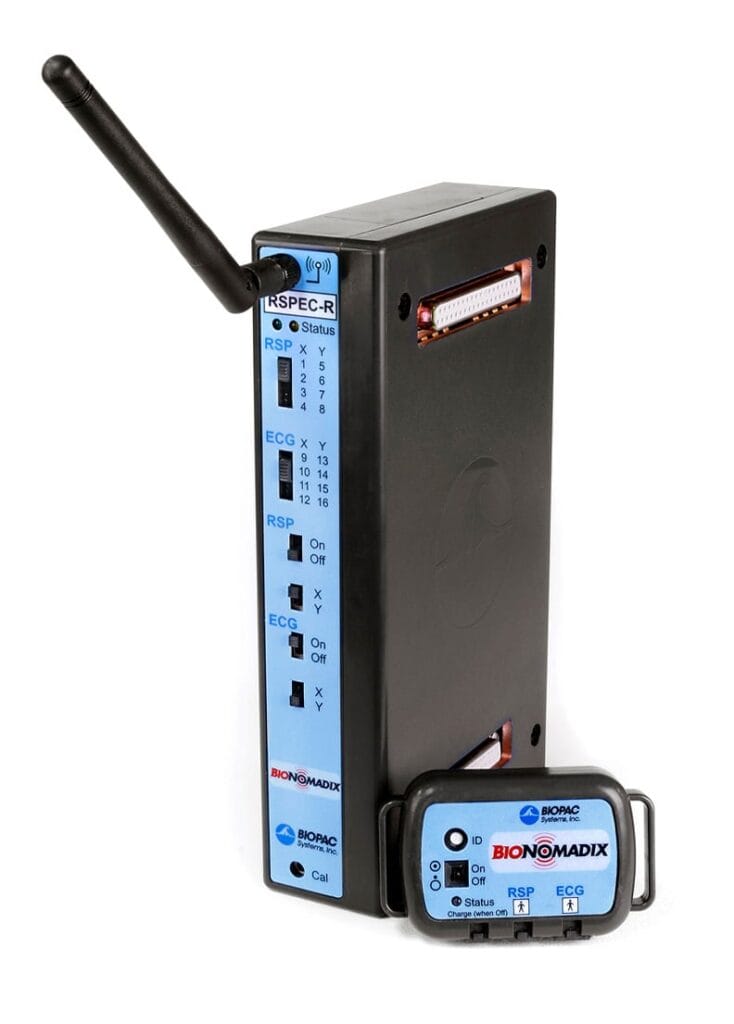
Movement → Mobility. The headset transmits via Wi-Fi with no range limit and also saves data to its own memory, so you can study walking, running or cycling in natural conditions — recordings last up to 8 hours. Add physiology with wireless BIOPAC BioNomadix sensors.
Interaction of two people → Tandem. Two headsets record simultaneously — for research on the neural basis of conversation, empathy, cooperation and conflict.
Virtual environment → VR. AcqKnowledge controls the VR scenario, and VR sends back event markers; HbO, HbR, heart rate or EDA can change the virtual environment in real time. Software for creating VR scenes (e.g. Vizard) is separate.
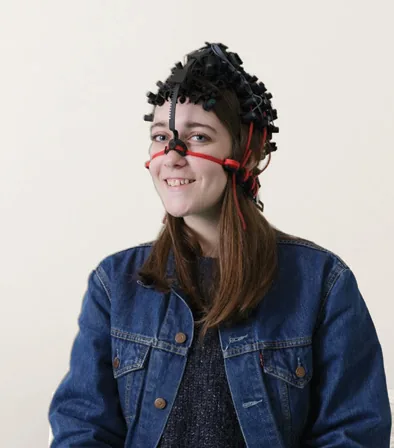
The highest sensor density for laboratory research: whole-head mapping and advanced montages with different depths.

Wireless headset (Wi-Fi) with no range limit: research on the move — walking, running, sport, field work.
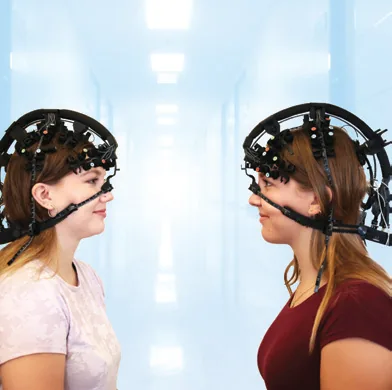
Two synchronized headsets: hyperscanning — the brains of two people in conversation, cooperation or competition.
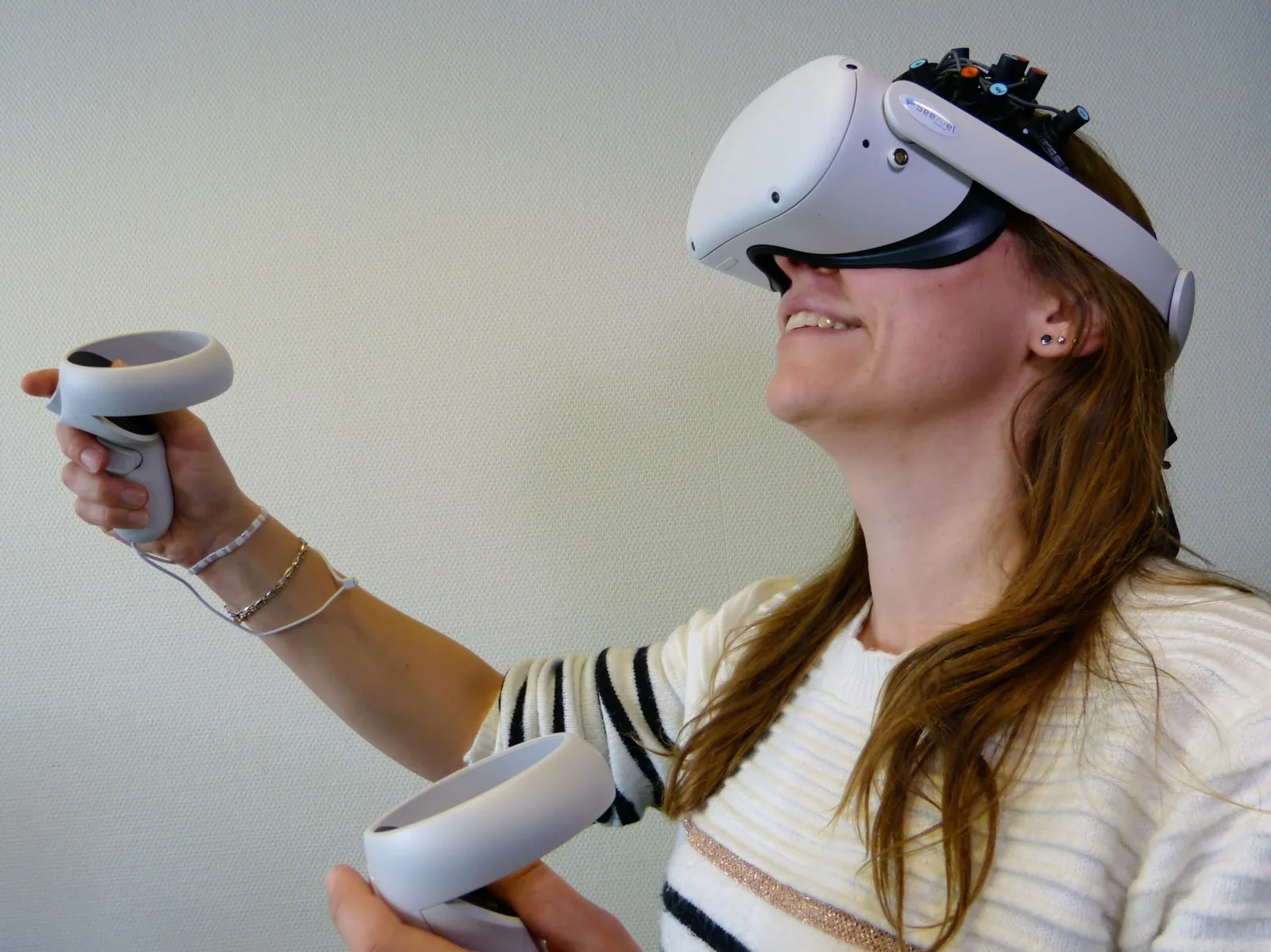
Headset combined with VR goggles: brain activity and physiology in response to a virtual environment.
Sources: biopac.com — MedelOpt+ Infinity, Mobility, Tandem and VR product pages (as of 2026-10).
A headset that tolerates movement and allows long recordings opens up research that is impossible in a scanner: walking, sport, a conversation between two people or a virtual environment.
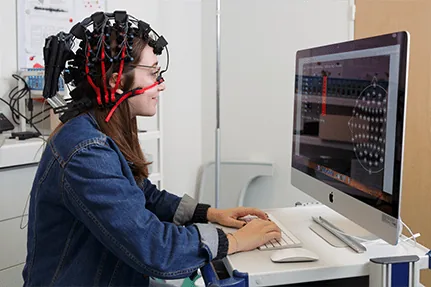
Attention, memory, cognitive workload and stress — in computer tasks.
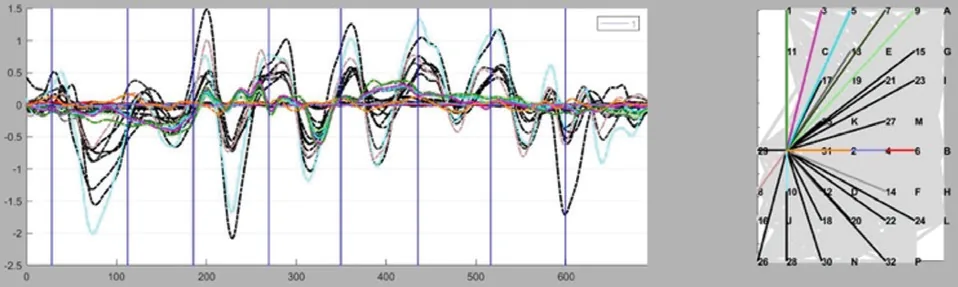
Example protocol from the BIOPAC brochure: treadmill walking at 4 km/h while serially subtracting 7 — measures how the brain engages in gait control.
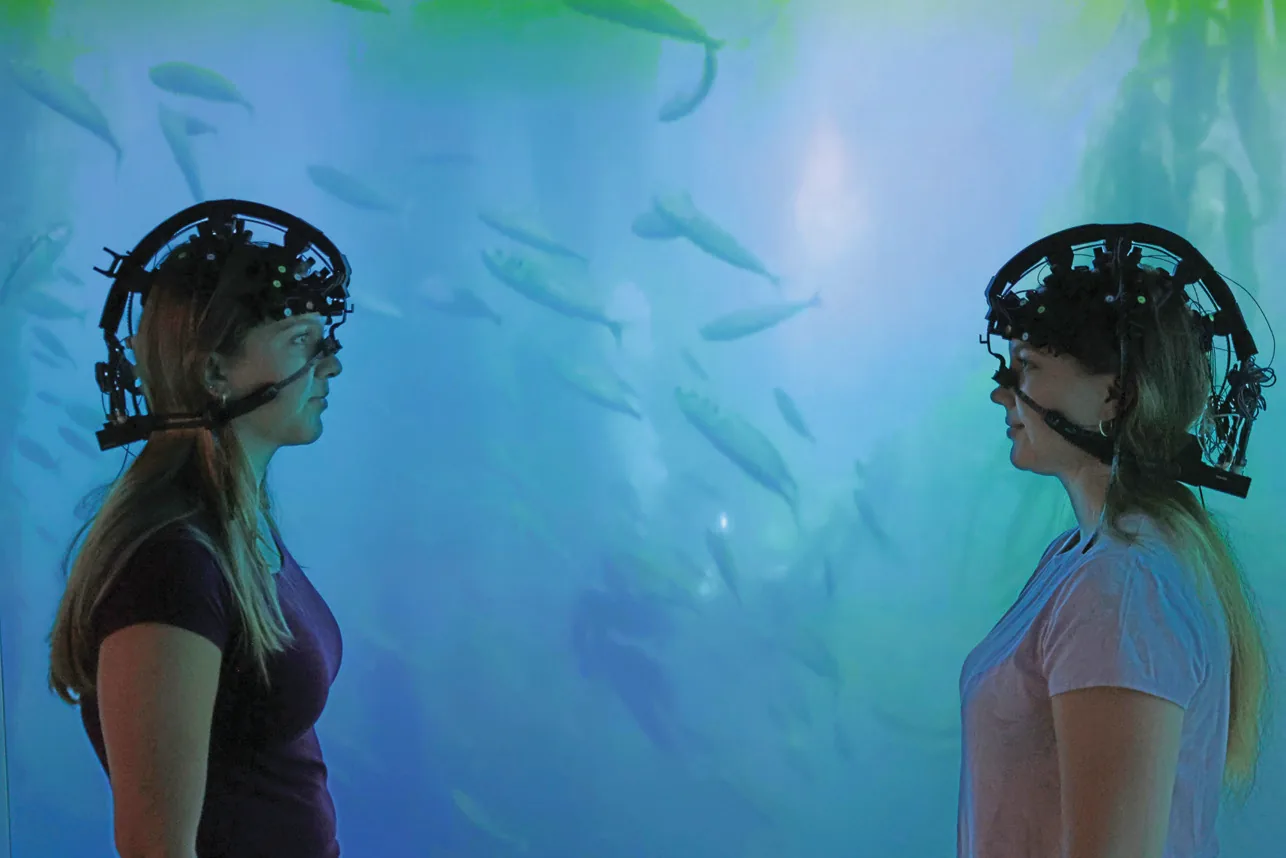
Hyperscanning: brain synchronization of two people in conversation and cooperation.
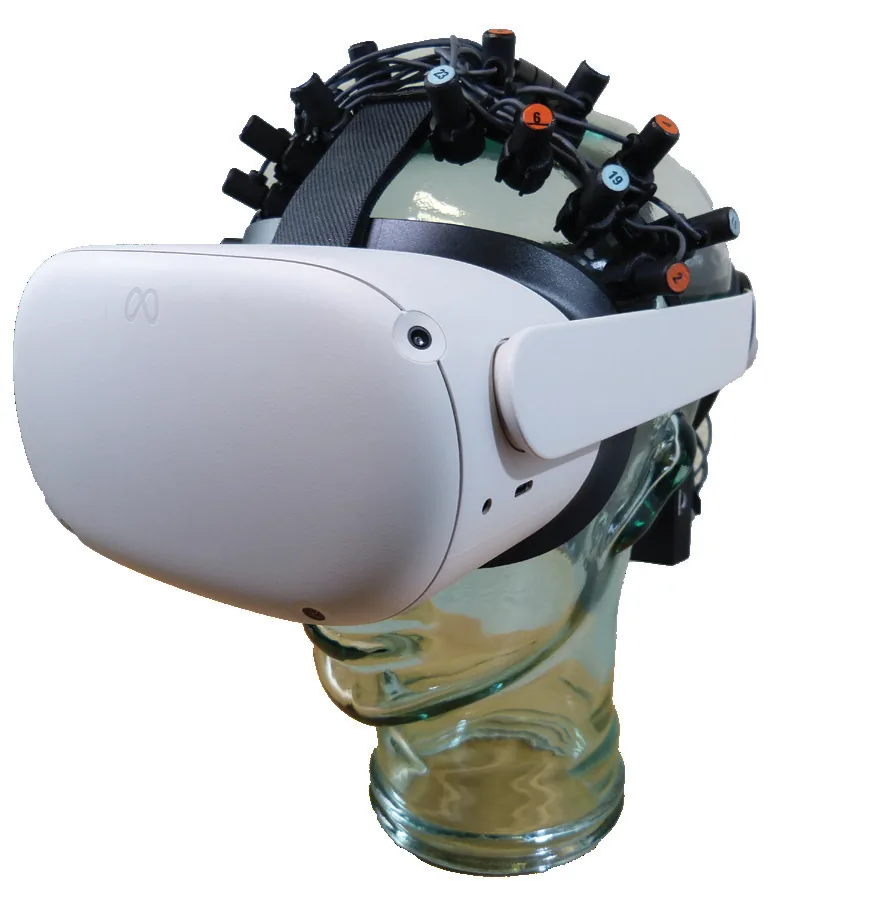
Brain responses to a simulated environment: attention, memory, decisions and emotions.
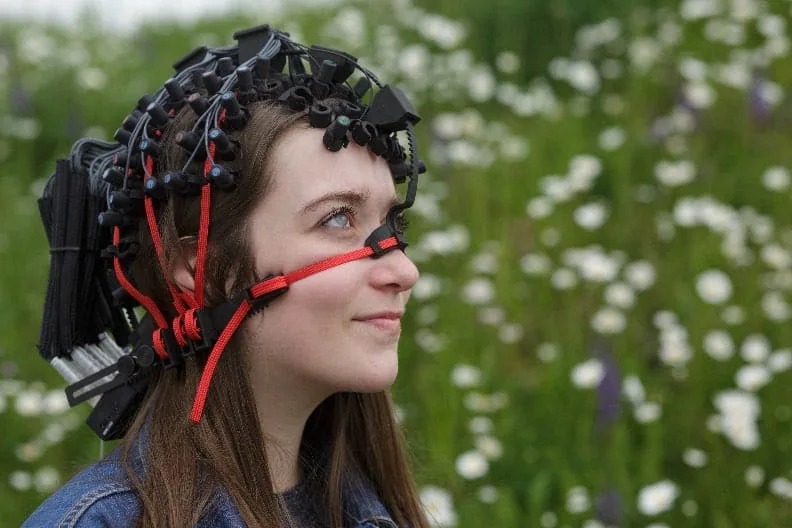
Measurements on the move and outside the lab, with a participant who moves naturally.
Research on language and auditory perception — also in children from age 4, thanks to one adjustable headset.
Epilepsy research (EEG–hemodynamics coupling), deep brain stimulation (DBS) and vagus nerve stimulation (VNS), neurorehabilitation.
List of applications: BIOPAC MedelOpt brochure, seenel-imaging.com, biopac.com. Photos: Seenel Imaging / BIOPAC.
According to BIOPAC and Seenel Imaging for the MedelOpt+ platform. Channel counts for individual Infinity configurations are compared on the MedelOpt fNIRS Infinity Systems.
| Parameter | Value |
|---|---|
| fNIRS | |
| Technique | near-infrared spectroscopy, continuous wave (CW); 660 and 850 nm |
| Sampling | 4 / 8 / 16 / 32 Hz depending on the source duty cycledetectors sampled at 128 Hz, sources up to 32 Hz |
| Source–detector distance | 20–55 mm, adjustable; choice of channel distance and depth |
| Detectors and converter | low-noise silicon photodiodes with preamplifier; 16-bit ADCsources: dual-wavelength LEDs; shielded NIRS cables, > 60 cm |
| Short channels | depending on the variant: Mobility 1, VR 2, Tandem 1 per headset, Infinity up to 16 (16-16) or up to 32 (16-32) |
| Signal quality | noise approx. 0.3% of the sensor’s dynamic range; SNR ≈ 151:16 hours of operation without drift according to MEDPHOT criteria |
| Light sources | LED, peak power up to 20 mW per sourceemitted light +53% and received light +48% compared with the previous generation |
| EEG | |
| Channels and sampling | 8 channels + reference electrode + active ground; 512 samples/sEEG optional — models marked EEG |
| Amplifier | 24-bit ADC; gain 24 V/V; CMRR min. −110 dB; input impedance 500 MΩ ∥ 10 nF |
| Noise and range | input noise 1 µVpp typical (0.01–70 Hz); full scale 187.5 mVintegrated shielding reduces interference |
| Headset | |
| Design | adjustable exoskeleton with integrated sensors; scalp access without removal |
| Positioning accuracy | ±2.9 mm average — approx. 5× better than a cap (MeMoSoft + AcqKnowledge Setup) |
| Size | one headset: from age 4 to adults |
| Recording time | up to 8 hours |
| Measurement areas | from the prefrontal cortex to the cerebellum, parietal and lateral cortex |
| Variants | |
| Infinity | 16 sources / 16 or 32 detectors; INFIN+ 16-16, 16-16 EEG, 16-32 EEGlaboratory research; wireless connectivity optional |
| Mobility | 8 sources / 8 or 16 detectors, up to 128 source–detector pairs; MOBIL+ 8-8, 8-8 EEG, 8-16 EEGWi-Fi with no range limit; recording to device memory if the live view drops |
| Tandem | 2 headsets, 8 sources / 8 or 16 detectors each; TAND+ 8-8, 8-16wired; Trigger Box expandable with further systems |
| VR | 8 sources / 8 detectors, 2 short channels; VR+ 8-8, 8-8 EEGincludes Meta Quest 3 with Elite Strap, control unit, Mobility Pack, mounting accessories; compatible with Quest 2 and HTC VIVE Focus 3 |
| Software and data | |
| Acquisition and analysis | BIOPAC AcqKnowledge included, perpetual license (MedelOpt+ supported from version 6.0.2); MeMoSoft — montage design |
| File formats | ACQ, MAT, EDF, SNIRF |
| Data access | real-time Network Data Transfer (license); AcqKnowledge Cloud (license); MedelOpt+ API (separate) |
| Integration | |
| Physiology | BIOPAC MP200: ECG, HRV, respiration, EDA, PPG, EMG, accelerometry; physiology at 2 kHz |
| Synchronization | common clock and hardware triggers; with the MP200 via the Linked Acquisition protocol in AcqKnowledge |
| Triggers | TRIG BOX+ USB (Infinity, Tandem): latency typically 1.3 ms; wireless MOBIL+ TRIG (Mobility, VR): typically 3.3 ms2 TTL inputs sampled at 512 Hz; 5 kV rms optical isolation; additionally 4 auxiliary TTL inputs in the unit |
| Stimulation and other | visual, auditory, electrical, tactile, olfactory and thermal stimulation; video and audio; VR with eye tracking built into the headset |
| Electronics and standards | |
| Electronics unit | 22 × 85 × 48 mm; 5 V DC power (micro USB), max. 1 A |
| Safety | photobiological IEC 62471 — risk group 0; electrical IEC 60601-1; EMC IEC 60601-1-2; EEG IEC 80601-2-26; RoHS |
| Operating conditions | 10–40 °C; humidity 0–70% non-condensing; up to 3000 m above sea level |
| Manufacturer | Seenel Imaging (France), technology protected by international patents; global distribution: BIOPAC Systems (since 2023) |
Sources: BIOPAC MedelOpt+ product sheet (11/2025); biopac.com — MedelOpt+ Brain-Body Platform, MedelOpt+ Infinity, Mobility, Tandem and VR product pages, AcqKnowledge — new features, Seenel–BIOPAC partnership announcement (2023); as of 2026-10.
EEG measures the electrical activity of neurons and shows when the brain responds — with millisecond precision. fNIRS measures changes in blood oxygenation in the cortex and shows better where this activity takes place. Recording both signals in one headset lets you study their relationship and gives a fuller picture of brain activity than either alone.
Yes — this is one of the main features of MedelOpt+. The headset is lightweight, and the Mobility variant with the Mobility Pack (mini PC and battery) lets you study walking, running or cycling with no range limit. BIOPAC describes, among others, a dual-task protocol on a treadmill.
Yes. According to the manufacturer, one adjustable headset fits heads from age 4 to adults — no set of caps in different sizes.
In the Mobility variant, the headset also saves data to its own memory. If the live view is interrupted, recording continues without data loss — according to the BIOPAC product sheet.
Up to 8 hours of continuous acquisition. BIOPAC also states 6 hours of fNIRS operation without drift according to MEDPHOT criteria.
Yes. AcqKnowledge saves data as ACQ, MAT (MATLAB), EDF and SNIRF — SNIRF is the common file format for fNIRS. Real-time data is available with the Network Data Transfer license, and the MedelOpt+ API lets you plug EEG and fNIRS streams into your own applications, e.g. for neurofeedback.
Here we describe the MedelOpt+ platform — the technology, headset, software and the whole family of variants. On the MedelOpt fNIRS Infinity Systems page we compare specific Infinity configurations for whole-head mapping and help you choose a model.
Yes. The VR variant combines the headset with Meta Quest or HTC VIVE Focus 3 goggles, and AcqKnowledge controls the scenario and receives event markers from VR. Eye tracking then comes from sensors built into the goggles, e.g. HTC VIVE Focus Vision. Describe your study to us — we will select and configure the whole workstation.
Yes — book an online presentation and talk to us about your protocol. Contact us.