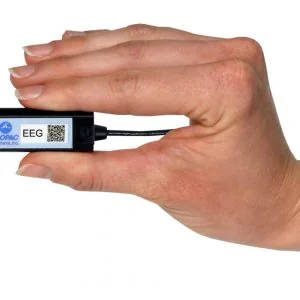
Wired EEG amplifier (BIOPAC EEG100D)

A bipolar, wired EEG amplifier from the BIOPAC Smart Amplifier series — measurement electronics sit directly at the electrode, reducing EMI and motion artifacts. It records one differential EEG channel, and acquisition parameters configure automatically in AcqKnowledge. Requires the AMI100D interface and an MP160 or MP200 unit (not compatible with MP150), plus AcqKnowledge 5.0.4 or newer.

BIOPAC Smart Amplifier · Wired EEG Measurement

EEG100D is a bipolar, wired EEG amplifier from the Smart Amplifier series — measurement electronics placed directly at the electrode, instead of in a module near the acquisition unit.

The module records one differential channel of the EEG signal. The close proximity of the transducer reduces electromagnetic interference (EMI) and motion artifacts, and acquisition parameters configure automatically in AcqKnowledge upon connection.

Part of a larger system

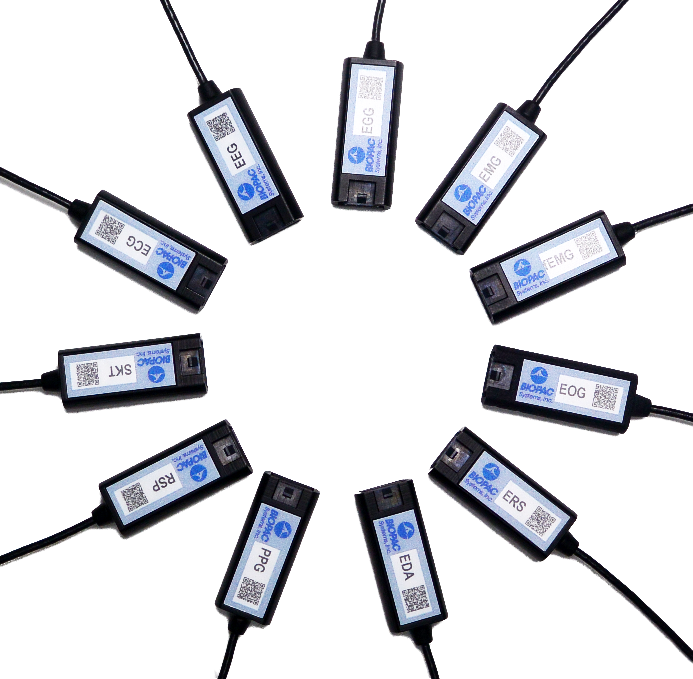
BIOPAC Smart Amplifier 100D module family — illustrative photo of the entire line (EEG100D is one of the modules in this family)

Illustrative photo of the entire Smart Amplifier 100D family — the EEG100D module has an identical housing.

EEG100D is an expansion module, not a standalone system

The EEG100D module alone does not record or save data on its own. It requires connection through the AMI100D interface to an MP160 or MP200 data acquisition unit (Smart Amplifier modules do NOT work with MP150), along with AcqKnowledge software version 5.0.4 or newer.

In addition, EEG100D requires separately ordered electrode cabling — for simple two-electrode setups or for a full multi-channel cap — details in the section below. The module connects via a 3 m RJ12 cable to the AMI100D interface, and the recorded signal is placed on a shared, synchronized timeline together with other modules in the system.

Required electrode cabling

EEG100D is just the amplifier — measurement requires separately ordered electrode cabling. Two paths are available: a simple two-electrode setup or a full multi-channel cap in the 10/20 system.

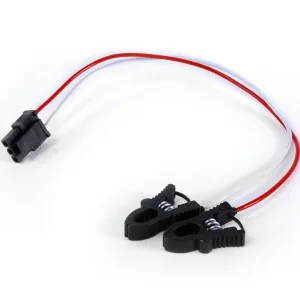
BN-EL biopotential lead (simple setup) with the 100D module Manufacturer photo (BIOPAC) — BN-EL-LEAD2 lead (simple setup). BN-EL*-LEAD2 / LEAD3

Biopotential lead (simple setup)

The same generic biopotential lead from the family also used by the ECG100D, EMG100D and EOG100D modules — for simple two-electrode setups with standard electrodes.

  • Lead shared with other modules in the 100D family (ECG100D, EMG100D, EOG100D)
  • Suitable for one differential channel (2 electrodes)
  • Electrodes: Ag/AgCl only
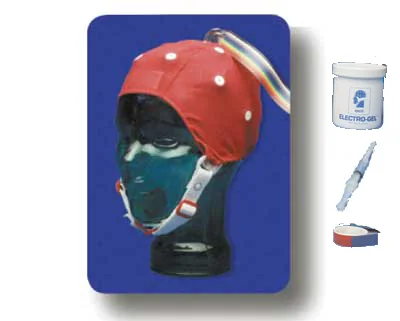
BN-EEGCAP-SYS EEG cap system in the 10/20 layout Manufacturer photo (BIOPAC) — BN-EEGCAP-SYS cap system (10/20 layout). BN-EEGCAP-SYS

19-electrode EEG cap (multi-channel setup)

A dedicated EEG cap in the international 10/20 system, made of Lycra, available in medium size (head circumference 54–58 cm). Connected to EEG100D using BN-ADAPT-TP2 or BN-ADAPT-TP3 touchproof adapters.

  • 19 electrodes, international 10/20 system
  • Material: Lycra; medium size (54–58 cm)
  • Connection: BN-ADAPT-TP2 or BN-ADAPT-TP3 touchproof adapter
  • Cap also shared with the wireless BioNomadix BN-EEG2 amplifier — EEG100D is a confirmed, compatible amplifier option for the same cap

Key features

Electronics close to the electrode

The Smart Amplifier architecture places the amplifier right at the electrode — significantly reducing EMI interference and motion artifacts compared to a traditional module located near the acquisition unit.

Automatic configuration

Once connected, the module automatically configures acquisition parameters in AcqKnowledge — no manual switch settings required.

Highest gain in the family: ×20 000

EEG signals have significantly lower amplitude than other biopotential signals, which is why EEG100D offers a gain of ×20 000 — the highest among all 100D series modules.

Derived frequency band signals

AcqKnowledge automatically calculates separate power channels for the Delta, Theta, Alpha, Beta and Gamma bands — without the need to manually define filters.

×20 000gain
0.1 µV rmsinherent noise (0.5–35 Hz)
0.5–150 Hzmeasurement bandwidth
MP160/200compatibility (via AMI100D)

Full technical specification

Signal
EEG signal, bipolar — one differential channel per module
Gain
×20 000 — highest in the entire 100D family
Inherent noise
0.1 µV rms (measured in the 0.5–35 Hz band)
Bandwidth (wideband)
0.5 – 150 Hz
Derived signals
Power channels for the Delta, Theta, Alpha, Beta and Gamma bands — calculated automatically as separate channels in AcqKnowledge
Output range
±10 V
CMRR
Min. 120 dB
Required accessories
BN-EL*-LEAD2/LEAD3 (simple two-electrode setup) or BN-EEGCAP-SYS + BN-ADAPT-TP2/TP3 adapter (19-electrode cap, multi-channel setup)
Module dimensions / weight
Approx. 1.8×4.6×1.1 cm, approx. 48 g (amplifier alone approx. 9 g)
Cable
3 m, RJ12, to the AMI100D interface
Electrodes
Ag/AgCl only — gold-plated electrodes cause charge build-up and distort the signal
Compatibility
MP160 or MP200 (via the AMI100D interface) + AcqKnowledge 5.0.4 or newer

Where to place the electrodes

When using the BN-EEGCAP-SYS cap setup, electrode positions are determined by the international 10/20 system — the standard convention for scalp electrode placement in EEG studies, shown for illustration below.

Fp1 Fp2 F7 F3 Fz F4 F8 T3 C3 Cz C4 T4 T5 P3 Pz P4 T6 O1 O2

The map above shows the standard international 10/20 system — a widely adopted convention for scalp electrode placement in EEG, consistent with the naming used on the BN-EEGCAP-SYS cap. This is an illustrative diagram: the exact, individual electrode selection (setup and number of channels) depends on the protocol of a specific study and is not a reproduction of the diagram from the BIOPAC datasheet.

How it works

01

Electrodes or cap on the subject

Simple setup (BN-EL*-LEAD2/LEAD3) or BN-EEGCAP-SYS cap in the 10/20 system connected with a BN-ADAPT-TP2/TP3 adapter.

02

EEG100D + AMI100D + MP160/200

The module amplifies the EEG signal (×20 000) right at the electrode and sends it via an RJ12 cable to the AMI100D interface, and from there to the acquisition unit.

03

Analysis in AcqKnowledge

Automatic channel configuration, recording of the raw EEG signal, and derived power channels for the Delta, Theta, Alpha, Beta and Gamma bands.

Experimental applications

Bipolar EEG measurement supports research into cortical activity, cognitive processes and responses to stimuli.

ERP / P300 research

Recording of event-related potentials in response to experimental stimuli.

Cognitive neuroscience

Analysis of cortical activity accompanying cognitive processes in experimental tasks.

Attention and cognitive load research

Assessment of changes in EEG activity related to attention level and task load.

Sleep stage research

Recording of the EEG signal as a basis for analyzing activity patterns characteristic of individual sleep stages.

Frequently asked questions

Download materials click to expand

Interested in this product?

Contact us for a detailed quote and technical advice.

Related products

BiometricsECG (Heart Activity)Research & Scientific InstrumentsRSP (Respiration)

Eye TrackingResearch & Scientific InstrumentsSoftware

Eye TrackingResearch & Scientific InstrumentsSoftware

AccessoriesEye TrackingResearch & Scientific Instruments

Ask about this product

Product: Wired EEG amplifier (BIOPAC EEG100D)