Field test instruments and fusion splicers for network installers and operators.
100 products in this department
Browse the departmentLaboratory instrumentation for photonics, laser technology and R&D.
222 products in this department
Browse the departmentFiber-optic sensing systems: DAS, DTS, DSS, FBG and OFDR.
80 products in this department
Browse the departmentEye tracking, fNIRS, EEG and biometrics for science and business.
46 products in this department
Browse the departmentHome » Products » Research & Scientific Instruments » Biometrics » EMG (Muscle Activity) » BioNomadix 2Ch Wireless EMG Transmitter+Receiver
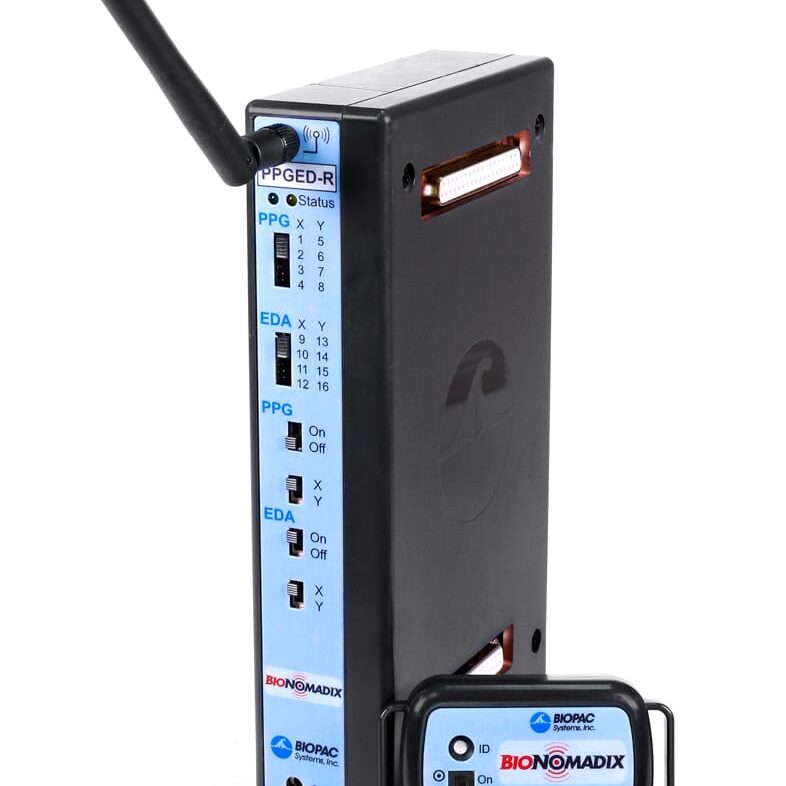
The BN-EMG2 wireless EMG amplifier records the electrical activity of muscles without cable constraints.
Full freedom of movement for the participant while maintaining laboratory-grade signal quality.
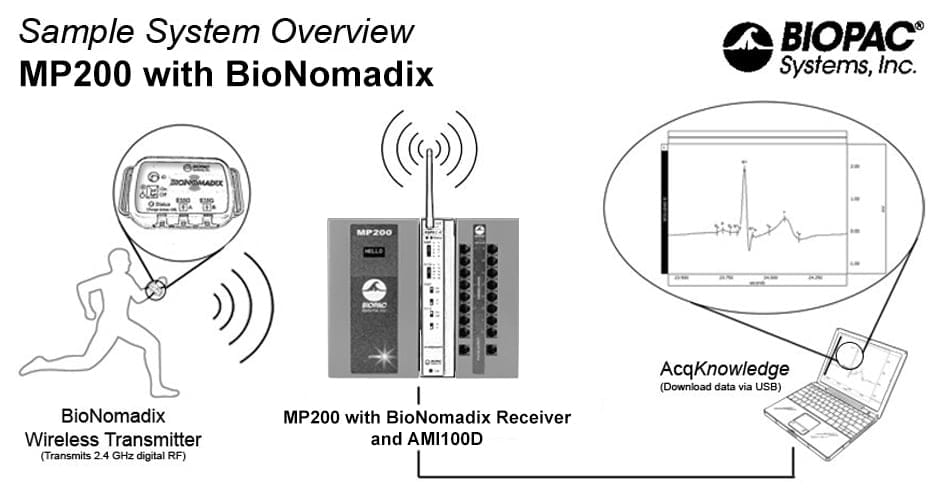
The BioNomadix transmitter and receiver alone do not record or store data. Measurement requires an MP200 data acquisition unit (or the older MP160/MP150) together with AcqKnowledge software.
The BN-EMG2 receiver plugs into a channel input on the MP200, and the recorded signal is added to a shared, synchronized timeline alongside other modules — both wired and wireless.
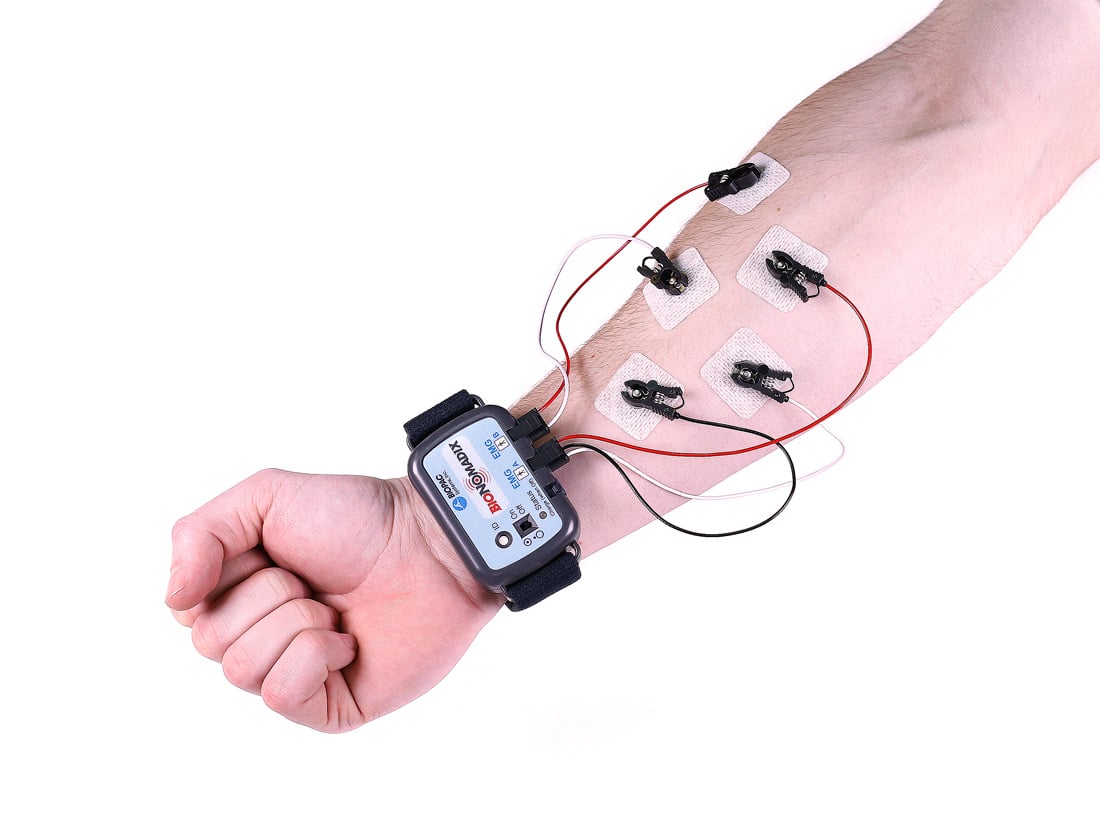
Click the points on the photo to see how the BioNomadix transmitter is worn by the participant and where the cabling connects.
A compact wireless module — mounted close to the measurement site, it transmits the signal to the receiver at the MP200/MP160/MP150.
An adjustable Velcro strap secures the transmitter on the participant's body without restricting natural movement.
A multi-pin connector on the transmitter — this is where the cabling leading to the EMG electrodes is attached.
Color-coded leads connect the transmitter to the surface electrodes placed over the muscle being studied.
No cable between transmitter and receiver — full freedom of movement for the participant during EMG signal recording.
Hardware high-pass and low-pass filters matched to the muscle signal.
Discreet size, secured with a dedicated strap — does not restrict movement or bother the participant.
A clean signal even during dynamic movement (sensitivity <1.5 µV rms).
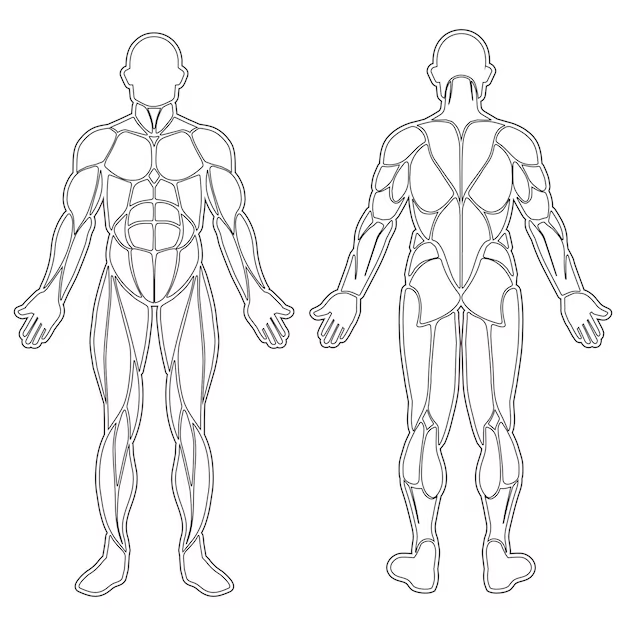
Click the points on the silhouette to see where EMG activity can be measured for the selected muscles.
Locations are based on the publicly available SENIAM project recommendations (Hermens et al., European Recommendations for Surface EMG, 1999) — for illustrative purposes, without reproducing the original diagrams. Each point marks a measurement site — in practice this means an electrode pair (bipolar) per muscle, plus one shared reference/ground electrode placed on an electrically neutral bony landmark (e.g. wrist, elbow) — required in every EMG setup.
Midway on the line between the C7 vertebra and the acromion. A typical indicator of neck tension, often examined in stress psychophysiology.
On the most prominent part of the shoulder muscle, approx. 4 fingers below the acromion.
At 1/3 of the line between the acromion and the cubital fossa, measured from the elbow side.
Midway on the line between the anterior superior iliac spine and the upper edge of the patella (front of thigh).
At 1/3 of the line between the tip of the fibula and the medial malleolus (front of lower leg).
The same point as on the front view — the upper part of the muscle, visible from both sides, between C7 and the acromion.
Approx. 2 cm lateral to the spinous processes of the spine, at the level of L1. Key in posture and ergonomics research.
Midway on the line between the ischial tuberosity and the lateral epicondyle of the tibia (back of thigh) — visible only from behind.
On the most prominent part of the medial head of the calf — visible only from behind.
Secured with a strap or shirt, it records the EMG signal wirelessly.
Transmission at 2000 Hz to the data acquisition system.
Automatic signal integration, frequency-domain analysis (mean/median frequency, power spectrum).
Electromyographic measurements are a non-invasive gold standard in biomechanics and psychophysiology, widely used to study muscle strength, fatigue, and movement patterns.
Synchronous detection of muscle activity during movement. Enables the study of motor unit recruitment, assessing training effectiveness and isometric tension.
Because the system pairs individual wireless modules, tension responses of two or more people can be monitored side by side without difficulty (e.g. during cooperative games).
Without being tethered to a "desk" in the lab, participants can freely navigate VR simulators and have postural tension tested under realistic conditions (ecological validity).
Assessment of skeletal muscle tension at workstations and while driving, as well as a tool for objectively tracking progress in the rehabilitation process.
No — transmission jitter of ±0.5 ms rms rules out this application. For NCV studies, BIOPAC recommends a wired amplifier, e.g. the EMG100C.
MP200, as well as the older MP160/MP150, within the AcqKnowledge environment.
Usually not — the transmitter's battery isolation and narrow transmission band eliminate most mains interference.
Related products
Product: BioNomadix 2Ch Wireless EMG Transmitter+Receiver