Whole-head fNIRS
- Sources / detectors
- 16 / 16
- EEG
- —
- Channels
- 128 theoretically
When the question concerns hemodynamics only, e.g. cognitive workload or task mapping.

A lightweight exoskeleton headset with 16 near-infrared light sources, up to 32 detectors and 8 EEG electrodes. It shows which cortical areas are working during a task — from the prefrontal cortex to the cerebellum. You record in BIOPAC AcqKnowledge, together with signals from the body.
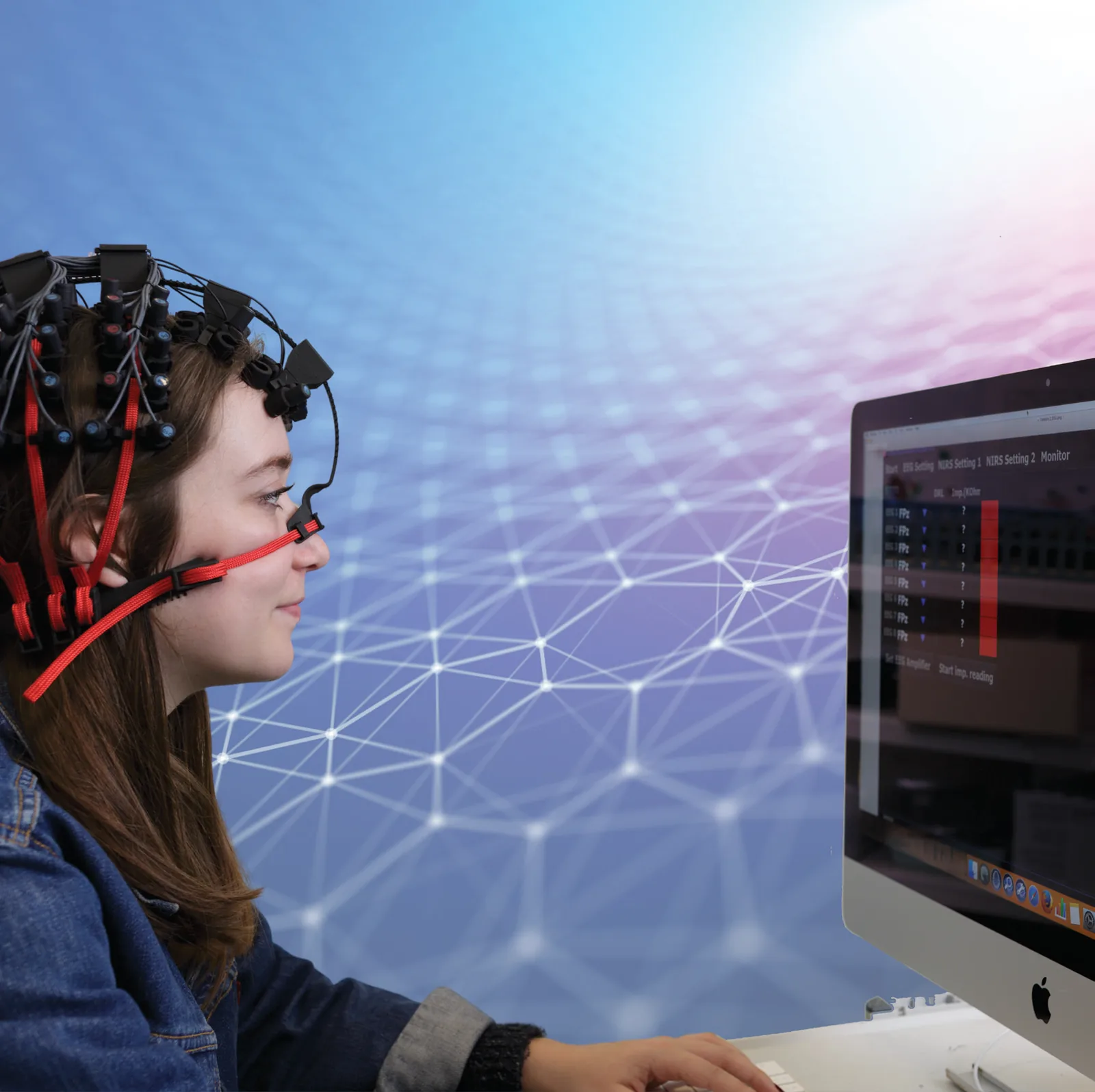
Infinity is the top model in the MedelOpt+ family: up to 16 sources and 32 detectors, i.e. the most channels for whole-head mapping. For comparison, the mobile variant has 8 sources and up to 16 detectors. All Infinity models have 16 light sources; they differ in the number of detectors and the presence of EEG. More detectors mean more channels and denser head coverage. Sources and detectors can be purchased and added to the headset as your research grows.
When the question concerns hemodynamics only, e.g. cognitive workload or task mapping.
Location and timing of activity in one recording — e.g. evoked potential paradigms with an fNIRS map.
Whole-brain mapping and advanced montages with different depths.
the largest number of channelsDots: illustrative layout — red sources, gray detectors, green EEG electrodes. Configurations and channel counts: biopac.com — MedelOpt+ Infinity.
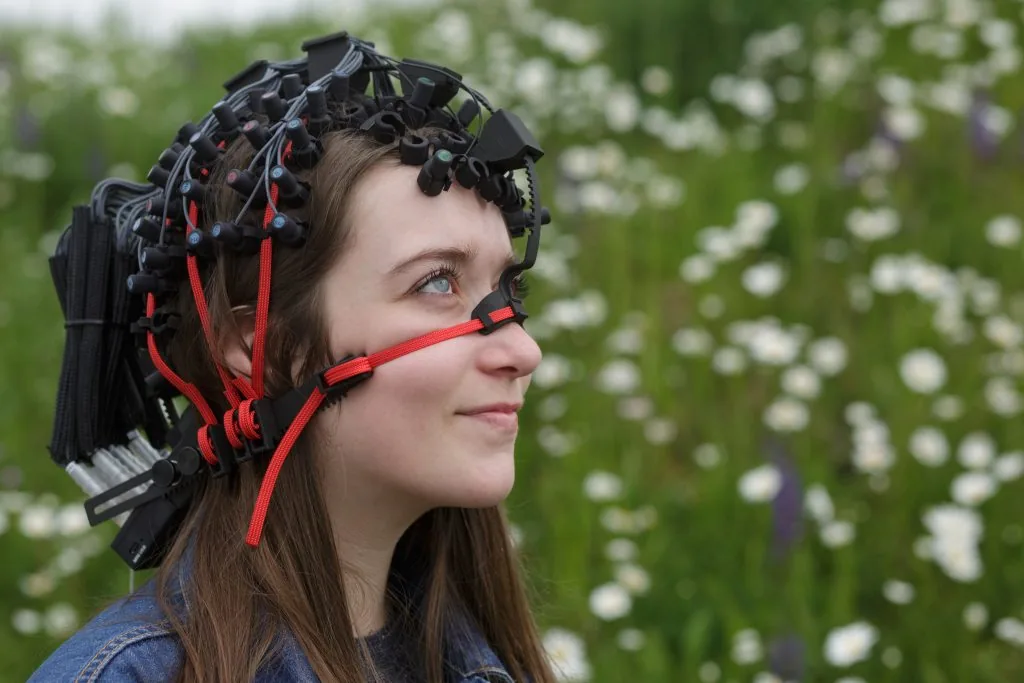
Wireless, 8 sources and up to 16 detectors — for research on the move and in the field.
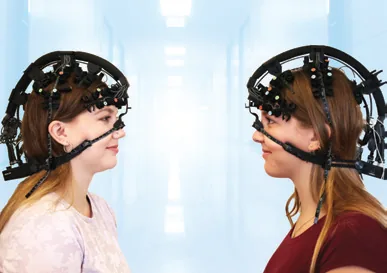
Two synchronized headsets for hyperscanning and interaction research.
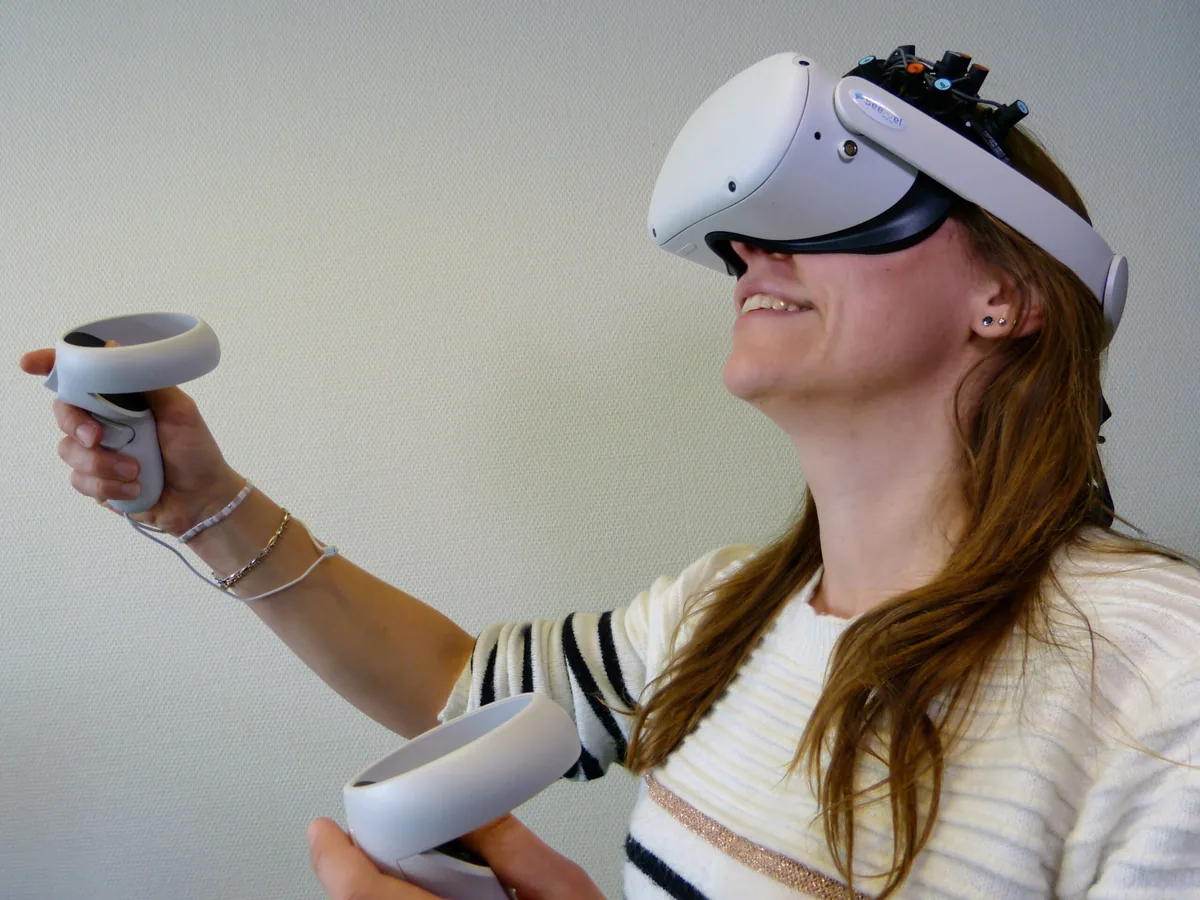
Headset integrated with VR goggles, e.g. Meta Quest 3.
Infinity is the laboratory variant with the largest number of optodes. An overview of the whole MedelOpt+ platform and a comparison of variants: MedelOpt+ — fNIRS platform with EEG.
When an area of the cerebral cortex starts working harder, more oxygen-rich blood flows into it. fNIRS — functional near-infrared spectroscopy — measures this change with light, through the skin and skull, without needles and without a scanner. The MedelOpt+ Infinity headset does this over the whole head at once, and records EEG in the same device.
LEDs in the headset send light at two wavelengths deep into the head: 660 and 850 nm. In this range skin and bone are partially transparent to light.
Light scatters in the tissue, and part of it returns to the surface a few centimeters away. A detector waits there. A source–detector pair is one measurement channel.
Hemoglobin with oxygen (HbO) and without oxygen (HbR) absorbs the two wavelengths differently. From the difference, the software calculates how the amount of each changes at a given location — a trace of the work of the cortex under the channel.
Eight electrodes in the same headset record the electrical activity of the brain 512 times per second. According to BIOPAC, fNIRS better indicates where activity occurs, and EEG — when. MedelOpt+ combines both advantages.
In the Infinity headset you set the source–detector separation from 20 to 50 mm. Move the detector and see how the light path changes.
The light arc reaches the cortex — the channel measures changes in the brain, but also in the skin above it.
Cross-section and light path — illustrative (layer proportions and depths are schematic). Separation range 20–50 mm and wavelengths 660/850 nm: biopac.com — MedelOpt+ Brain-Body Platform.
A typical response under a channel over a working area: within a few seconds of the task onset, the concentration of oxygenated hemoglobin (HbO) rises, and that of deoxygenated hemoglobin (HbR) falls slightly. After the task, both signals return to baseline. Infinity records this time course simultaneously for hundreds of channels across the whole head.
Illustrative graph — the shape of a typical hemodynamic response, no scale. Principle of HbO and HbR measurement: BIOPAC MedelOpt+ (product sheet, 11/2025).
In AcqKnowledge each channel sits on a head map in the 10-10 system. During recording you see where HbO rises, where HbR falls and whether all sources and detectors are working properly — before you waste a session.
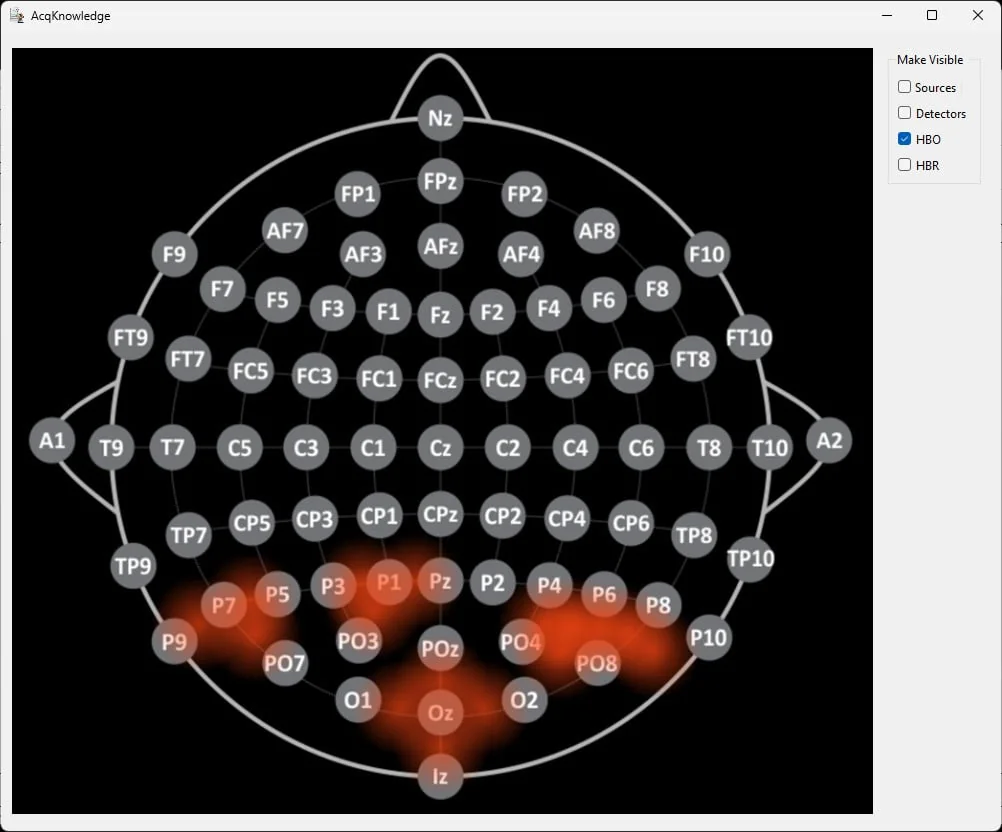
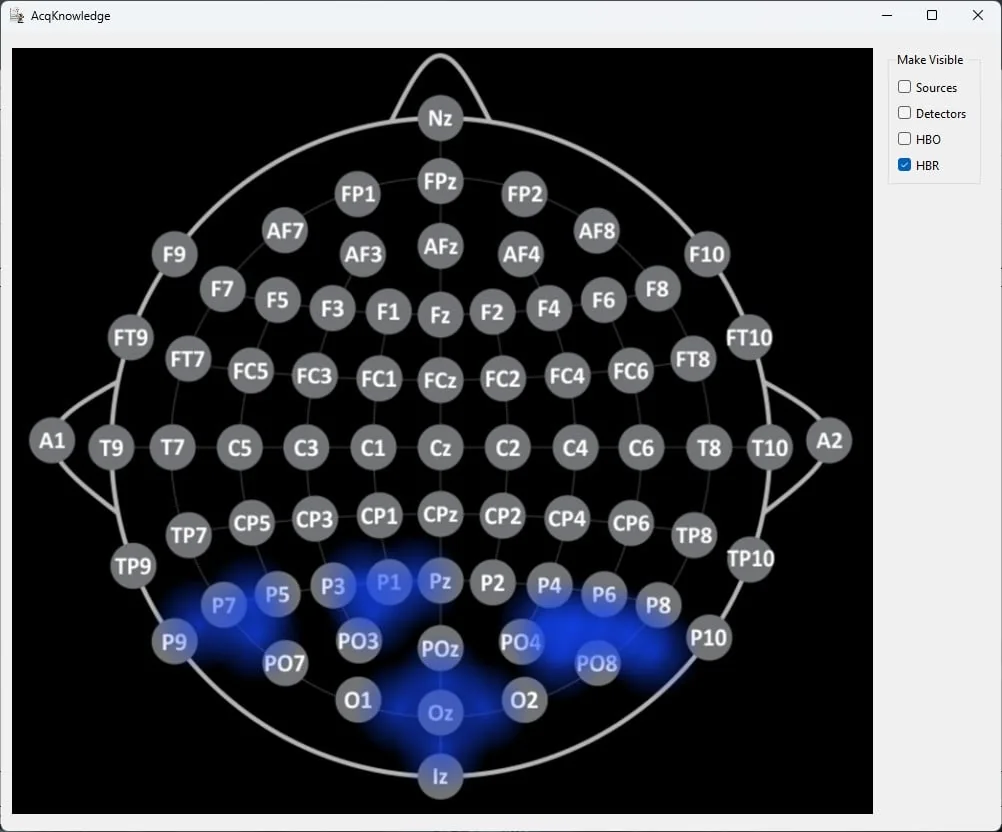
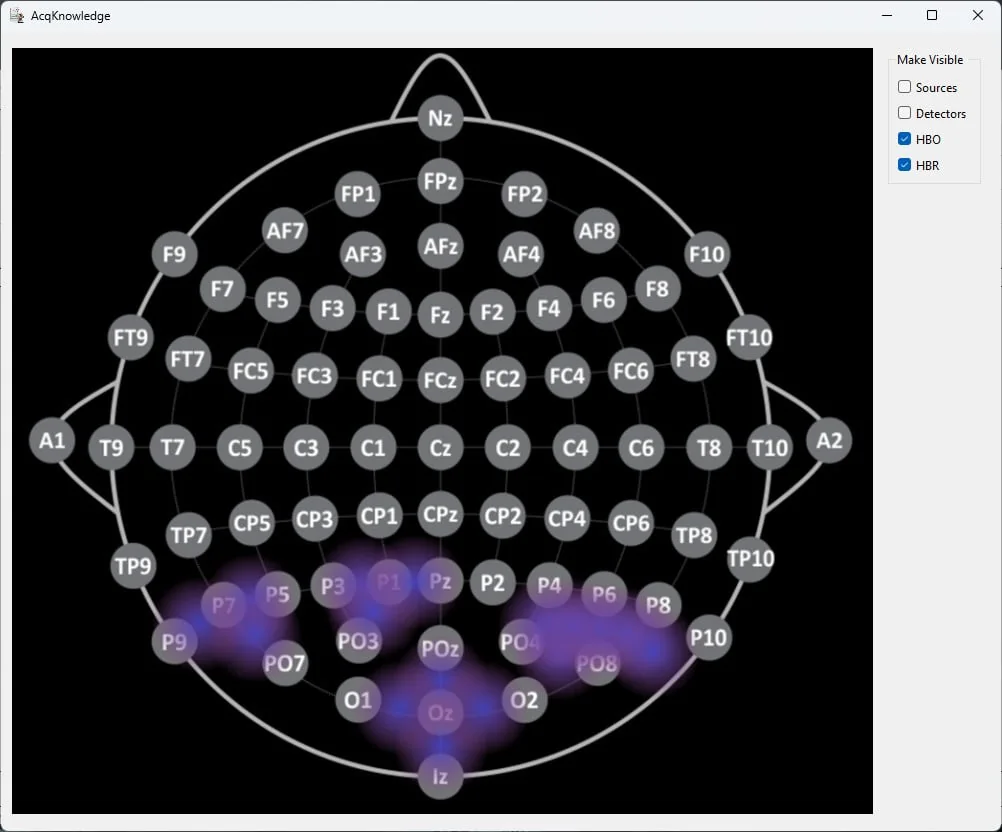
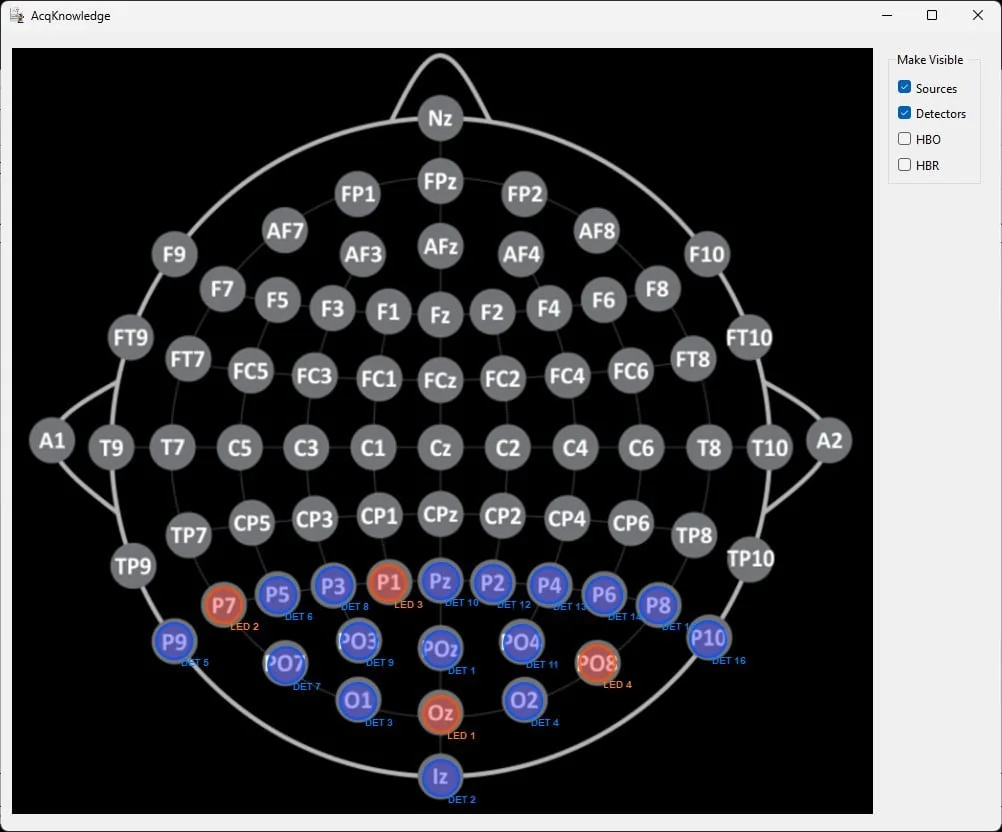
Screenshots: BIOPAC, AcqKnowledge fNIRS Channel Monitor with data from the MedelOpt+ headset (biopac.com — MedelOpt+ Infinity).
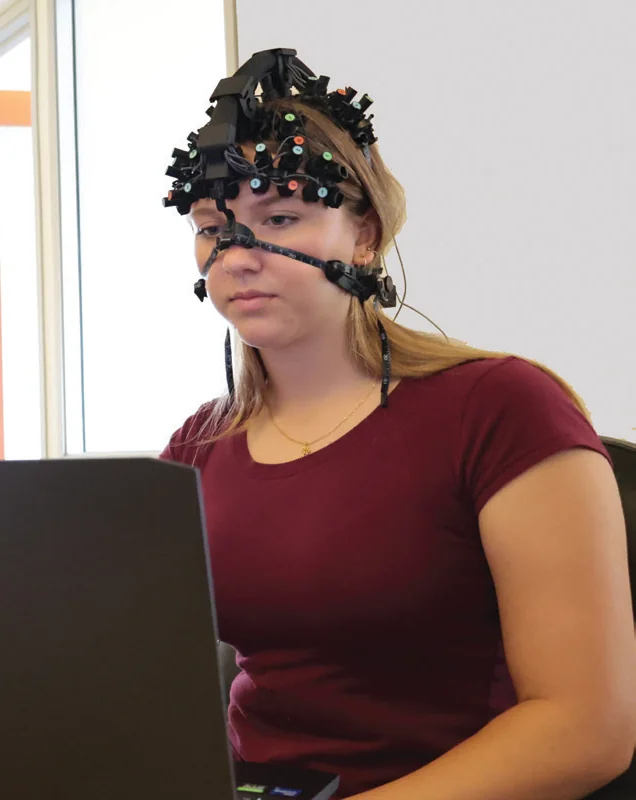
The optodes and electrodes are not sewn into a fabric cap but mounted in a lightweight, adjustable frame. This way they land in the same positions across participants and sessions, and the skin between them remains accessible. Click the points on the photo.
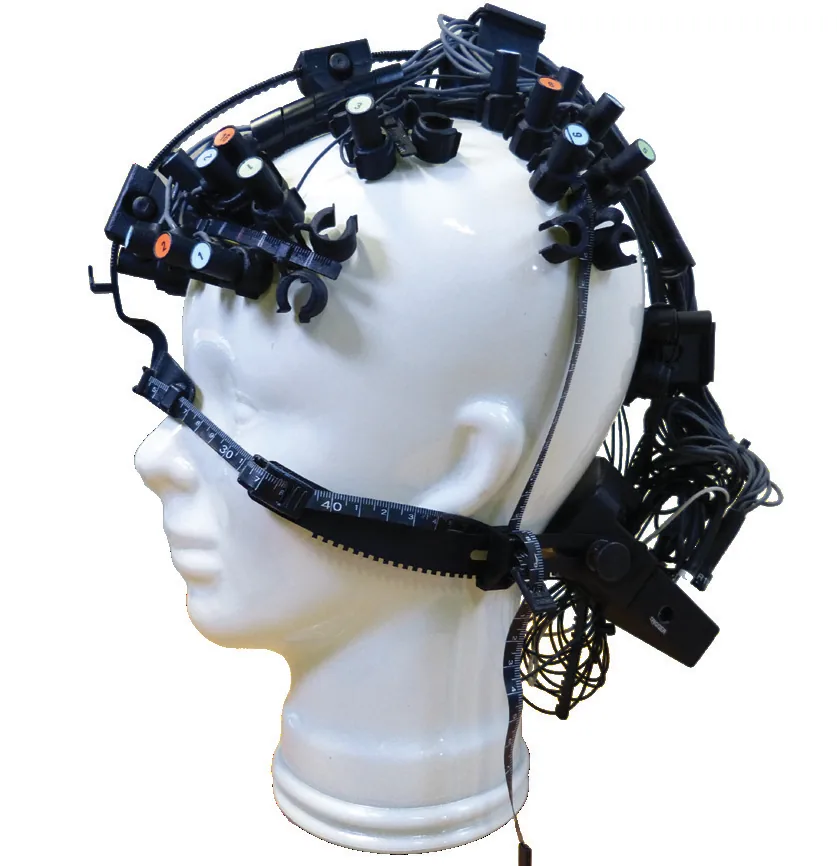
Up to 16 sources — LEDs emitting at 660 and 850 nm — and up to 32 detectors, i.e. sensitive silicon photodiodes with a preamplifier.
You move or add sources and detectors. This changes channel density, the 20–50 mm separations and the measurement area — from the whole head to a selected part of the cortex.
The open design lets you part the hair under the optodes without removing the headset — hair is the most common obstacle in fNIRS research.
Fixed reference points on the face and the top of the head. With the MeMoSoft software, optodes land in the planned positions with an average accuracy of ±2.9 mm — according to BIOPAC, about five times more accurate than with a cap.
A strap with a measuring scale fits the same headset to the head of a child from age 4 and to the head of an adult. You don’t buy separate sizes.
A small 22 × 85 × 48 mm box, powered with 5 V via micro USB. Infinity runs tethered to a computer; with the Mobility Pack (mini PC with battery) it becomes a mobile system.
Sources: BIOPAC MedelOpt+ product sheet (11/2025), biopac.com — MedelOpt+ Brain-Body Platform and MedelOpt+ Infinity, BIOPAC MedelOpt brochure. Photo: BIOPAC / Seenel Imaging.
MedelOpt+ runs natively in AcqKnowledge — the BIOPAC software in which laboratories around the world record physiological signals. One interface controls the headset and all connected BIOPAC amplifiers, and fNIRS, EEG and body signals sit on one timeline.
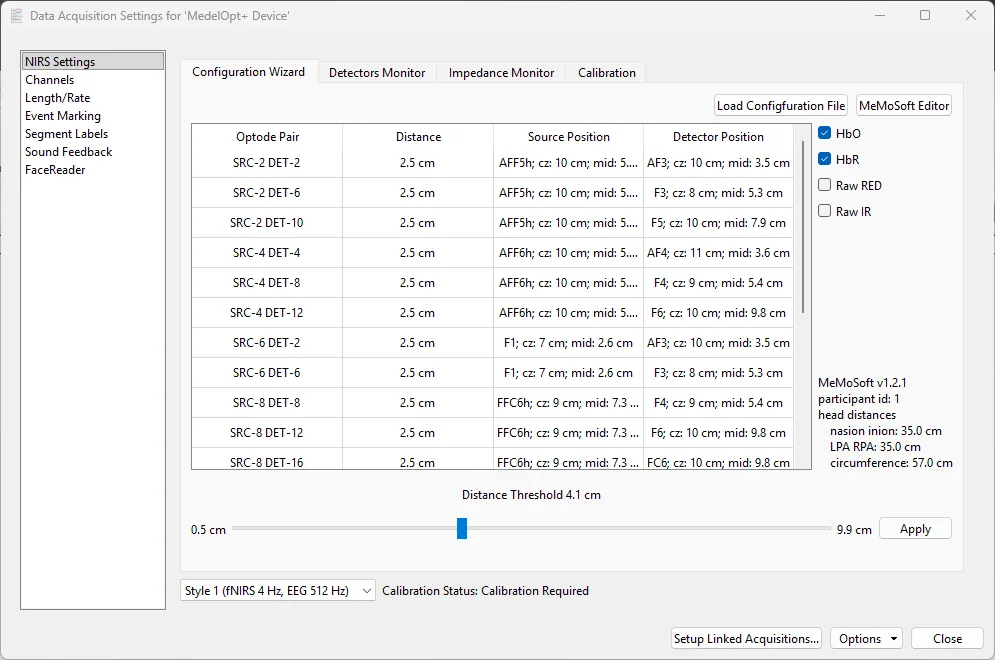
The MeMoSoft program (MedelOpt Montage Software) generates the montage: EEG only, fNIRS only or a hybrid layout — and shows where to plug in each optode.
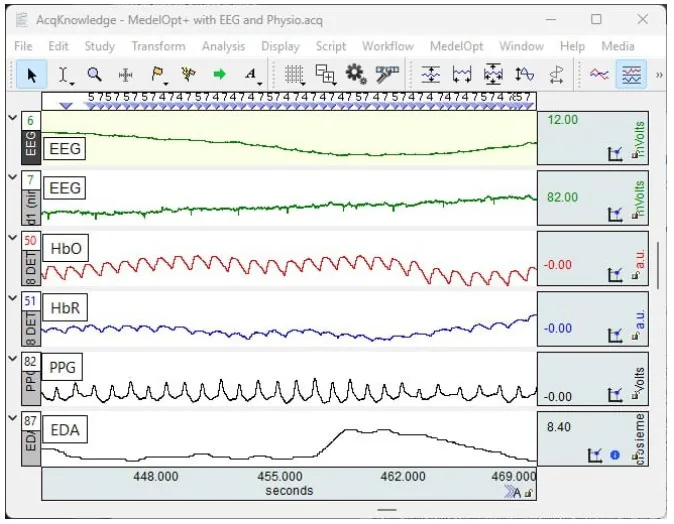
In the AcqKnowledge screenshot: EEG and fNIRS (HbO, HbR) from the headset, plus heart rate from a PPG sensor and skin conductance (EDA) from BIOPAC — in one file, on one timeline.
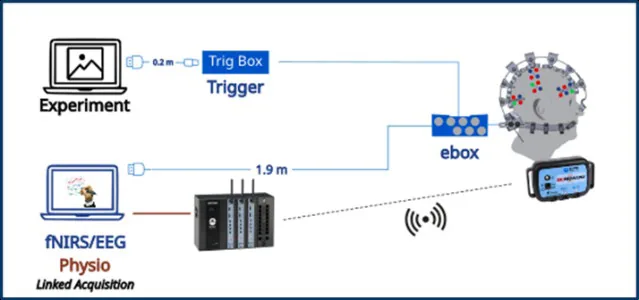
A common clock and hardware synchronization eliminate delays, drift and frequency mismatches between devices — this is how BIOPAC describes the platform.
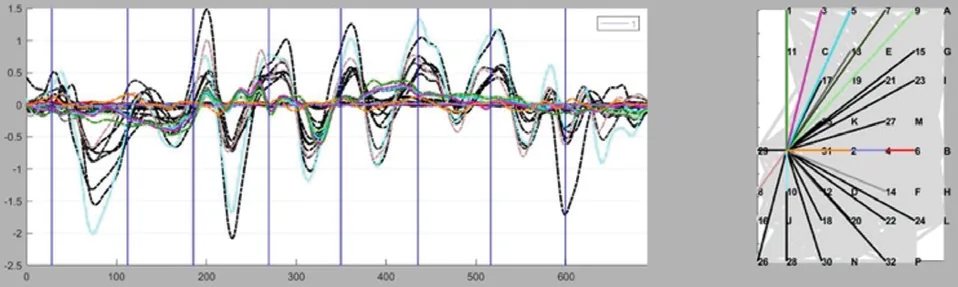
In the graph from BIOPAC materials: channels of one source over the motor cortex in a walking study with counting backward.
What has changed: earlier versions of AcqKnowledge supported fNIR devices only by importing data recorded in a separate program. Since version 6.0.2, MedelOpt+ is controlled and recorded directly in AcqKnowledge. Seenel Imaging, the headset manufacturer, also provides its own acquisition program, ElOpt.
Sources: biopac.com — MedelOpt+ Infinity, AcqKnowledge: latest features (6.0.2), MedelOpt+ product sheet (11/2025); seenel-imaging.com — MedelOpt (MeMoSoft, API, compatibility with Homer 3, NIRSTORM, SPM). Screenshot and diagram: BIOPAC.
fNIRS is sometimes sold as a module of a subscription platform, to which a device from another manufacturer is connected, with EEG and physiology added separately. MedelOpt+ is a different approach: both brain signals in one headset, recorded natively in AcqKnowledge together with the body.
| Feature | MedelOpt+ Infinity from Interlab | Subscription platform + fNIRS from another manufacturer |
|---|---|---|
| fNIRS and EEG | in one headset — 8 EEG channels (512 Hz) integrated with the optodes | an fNIRS device which, according to the platform manufacturer, can be combined with a separate EEG |
| Connection to software | natively in AcqKnowledge — one interface controls the headset and the BIOPAC amplifiers | a data stream from the fNIRS manufacturer’s software, sent via Lab Streaming Layer |
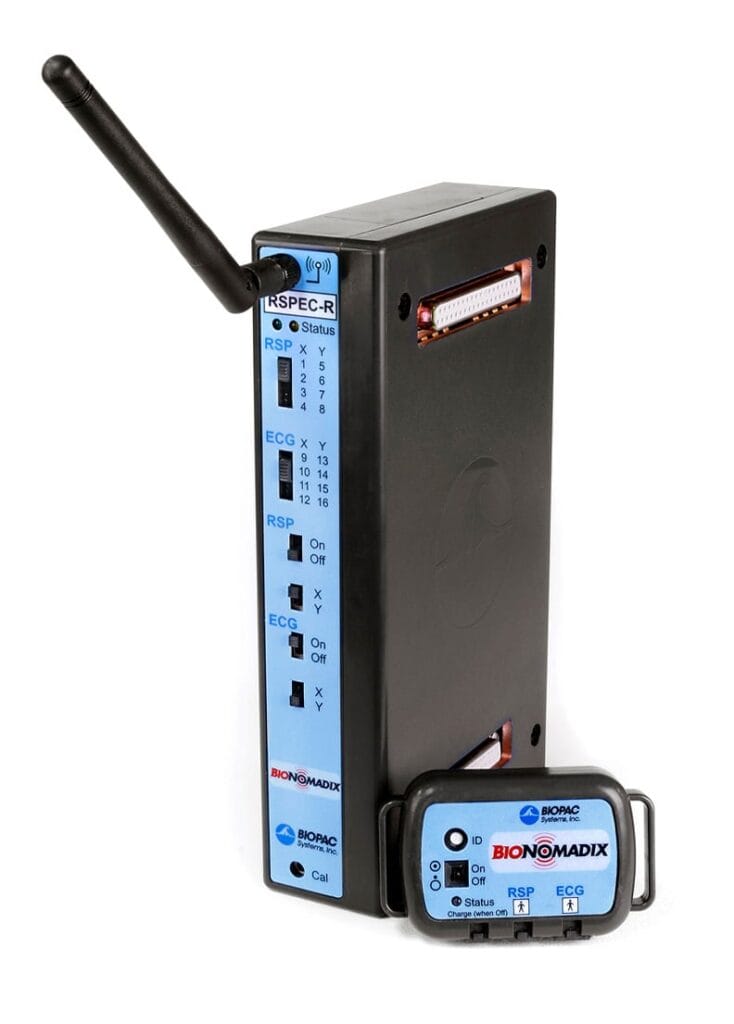
| Physiology | MP200 and BioNomadix in the same recording — ECG, EDA, EMG, respiration and more | further platform modules, paid separately |
| Purchase model | hardware and software from one supplier, with implementation and training | mandatory core module and modules on a subscription with annual renewal |
Subscription platform: a popular multimodal platform with an fNIRS module; description based on its manufacturer’s website (fNIRS module, pricing), as of 2026-10. MedelOpt+: biopac.com and BIOPAC product sheet (11/2025).
We help plan the montage for your research question, install the system and teach you to work with the headset and AcqKnowledge.
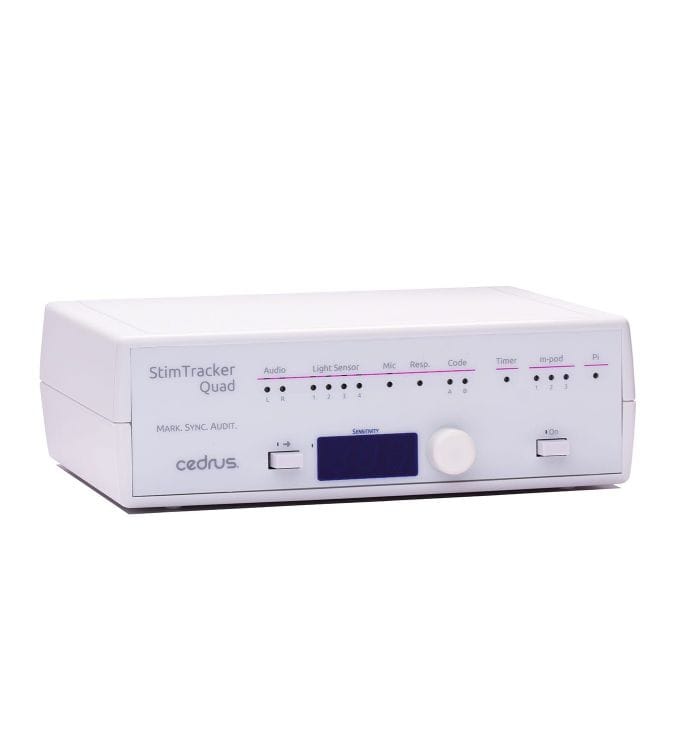
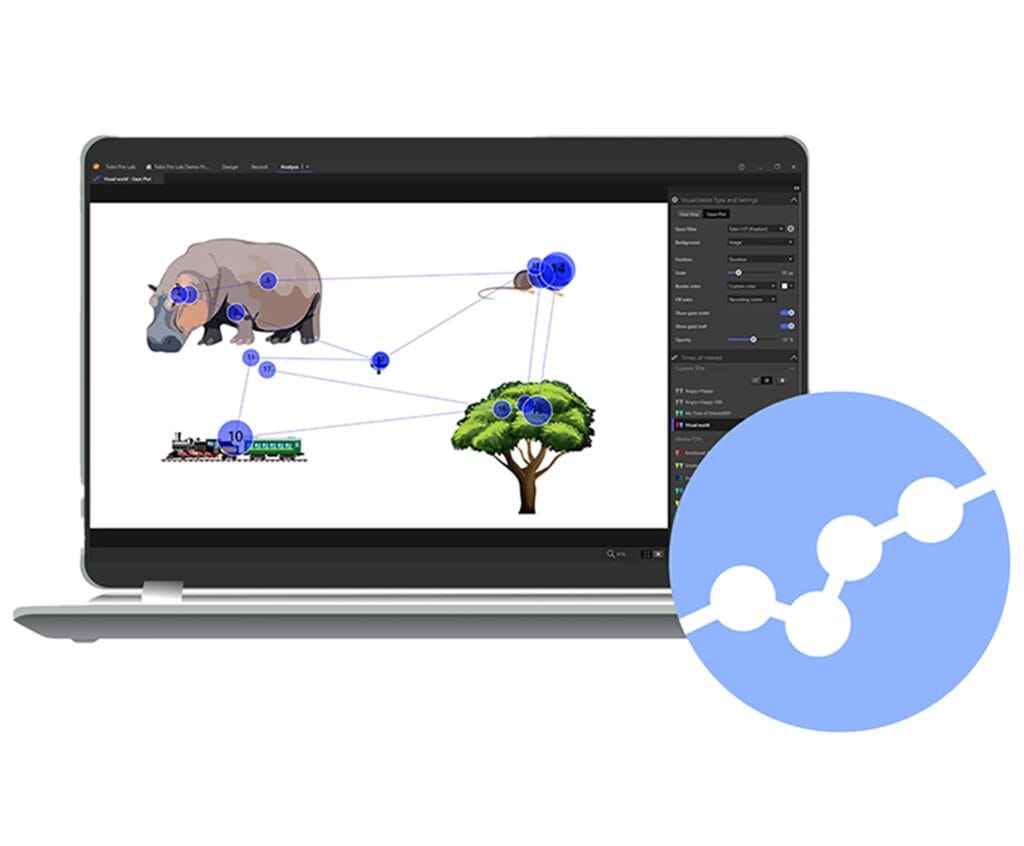
fNIRS and EEG show what is happening in the brain. BIOPAC adds how the body responds at the same moment — heart, skin, breathing, muscles. A Tobii eye tracker shows what the participant was looking at. AcqKnowledge records all of this in one file, and the stimulus marker is visible on every track.
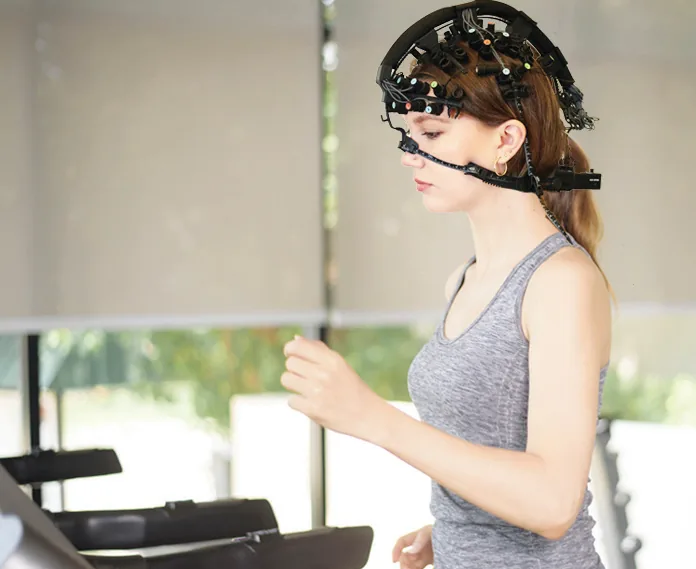
Illustrative waveforms. Yellow lines — the moment a stimulus is shown, visible on every track.
Data: biopac.com — MedelOpt+ Brain-Body Platform (fNIRS, EEG, physiology, stimulation, eye tracking and video in one interface), AcqKnowledge: latest features (Tobii eye tracker support, Windows, Eye Tracking license), MP200 data sheet; MedelOpt+ product sheet (11/2025). Photo: BIOPAC.
According to the product pages on biopac.com; details of the electronics, EEG and standards — from the BIOPAC product sheet (11/2025). Values common to the MedelOpt+ variants unless stated otherwise.
| Parameter | Value |
|---|---|
| System | |
| Models | INFIN+ 16-16 · INFIN+ 16-16 EEG · INFIN+ 16-32 EEG |
| Sources / detectors | 16 / 16 or 16 / 32; sources and detectors can be added to the headset |
| Channels | theoretically 128 (16 / 16) or 252 (16 / 32) |
| Short channels | up to 8 |
| Measurement areas | from the prefrontal cortex to the cerebellum, including parietal and lateral cortex; whole head |
| Recording time | up to 8 hours |
| Headset | exoskeleton, one adjustable size: from age 4 to adults; skin access without removal |
| Placement accuracy | ±2.9 mm (average, with MeMoSoft) |
| Wireless operation | optional — with the Mobility Pack (mini PC + battery) |
| fNIRS | |
| Technology | continuous wave |
| Wavelengths | 660 and 850 nm; dual-wavelength LED sources, risk group 0 per IEC 62471 |
| Source–detector separation | adjustable, 20–50 mm |
| Sampling | detectors 128 Hz; sources up to 32 Hz; fNIRS recording at 4 / 8 / 16 / 32 Hz depending on the source duty cycle |
| Detectors | low-noise silicon photodiodes with preamplifier |
| Converter | 16-bit |
| Signal quality | SNR ≈ 151:1; noise approx. 0.3% of the sensor range; 6 h without drift (MEDPHOT criteria)biopac.com — MedelOpt+ Brain-Body Platform |
| Source power | up to 20 mW per source (peak) |
| EEG (models with EEG) | |
| Channels | 8 + 1 reference + 1 active ground |
| Sampling / converter | 512 Hz / 24-bit |
| Input noise | 1 µVpp typical (0.01–70 Hz) |
| CMRR / input impedance | min. −110 dB / 500 MΩ ∥ 10 nF |
| Synchronization and software | |
| Auxiliary inputs | 4 TTL channels (0/+5 V), 512 Hz |
| Event markers | TRIG BOX+ USB with USB isolator: 2 TTL channels, latency typ. 1.3 ms (1.2–1.5 ms) |
| Software | BIOPAC AcqKnowledge (6.0.2 or later), MeMoSoft; ElOpt (Seenel Imaging); MedelOpt+ API (Windows) |
| Data formats | ACQ, MAT, EDF, SNIRF; Network Data Transfer (license) |
| Electronics and safety | |
| Electronics module | 22 × 85 × 48 mm; 5 V DC via micro USB, max. 1 A |
| Standards | IEC 60601-1; EMC IEC 60601-1-2; EEG IEC 80601-2-26; IEC 62471 (grupa ryzyka 0); RoHS |
| Operating conditions | 10–40 °C; humidity 0–70% non-condensing; up to 3000 m above sea level |
Source: BIOPAC — MedelOpt+ Product Sheet (11/4/2025), biopac.com (MedelOpt+ Infinity, MedelOpt+ Brain-Body Platform), seenel-imaging.com. Seenel Imaging technology protected by international patents.
Both measure changes in blood flow and oxygenation associated with brain activity. fNIRS does this with light through the skin and skull, so it reaches the outer layers of the cortex rather than deep brain structures. In return, the participant sits at a desk, talks and even walks — the study takes place under ordinary conditions, not in a scanner.
Infinity is the laboratory variant with the largest number of optodes: 16 sources and 16 or 32 detectors, for whole-head mapping. Mobility has 8 sources and up to 16 detectors and is wireless — for research on the move. Infinity can also work in mobile mode with the Mobility Pack (mini PC with battery). Comparison of variants: MedelOpt+ platform.
Yes — according to the manufacturer, sources and detectors can be added to the headset to increase the number of channels. We will confirm the scope of expansion for a specific configuration in the quote.
Yes. The same adjustable headset fits heads from age 4 to adults. You don’t need to remove the headset to part the hair under the optodes — which shortens preparation.
Hair absorbs and scatters light, so in fNIRS the optode must touch the skin. The open design of MedelOpt+ lets you part the hair under each optode without removing the headset.
MedelOpt+ is fully integrated with AcqKnowledge (from version 6.0.2), and that is where you can most easily combine fNIRS and EEG with physiology, stimuli and eye tracking. The headset manufacturer, Seenel Imaging, also offers its own program, ElOpt, and for developers — the MedelOpt+ API. We will match the option to your laboratory.
AcqKnowledge saves and exports data to ACQ, MAT (MATLAB), EDF and SNIRF — the standard for fNIRS, which you can open in Homer3, NIRSTORM or SPM, among others. Live data can be streamed to other programs via Network Data Transfer.