BioNomadix Wireless Accelerometer Transmitter+Receiver (Tri-axial)
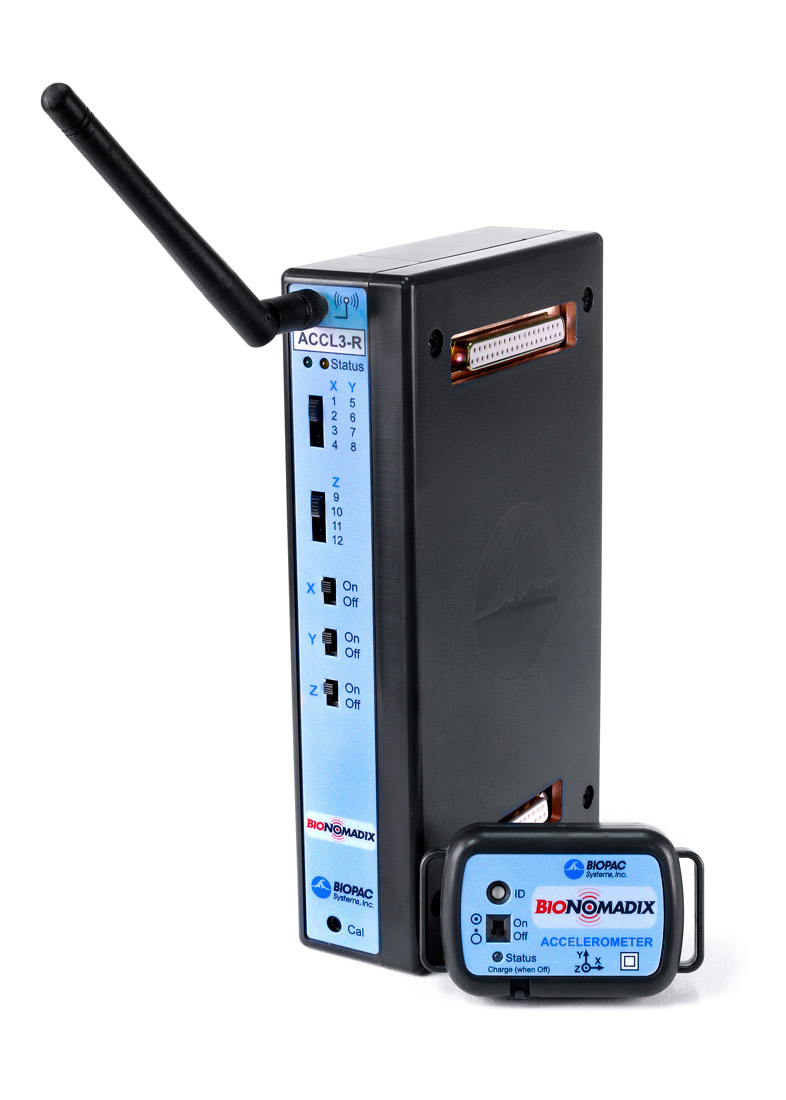
The BN-ACCL3 wireless accelerometer measures acceleration simultaneously along the X, Y, and Z axes, without the cable restrictions typical of wired sensors.

BioNomadix · Wireless acceleration measurement

The BN-ACCL3 wireless accelerometer measures acceleration simultaneously along the X, Y, and Z axes, without the cable restrictions typical of wired sensors.

A complete, ready-to-use module for mobile (ambulatory/wearable) applications — it records both calm body tilts and dynamic movements of a subject moving freely.

Part of a larger system

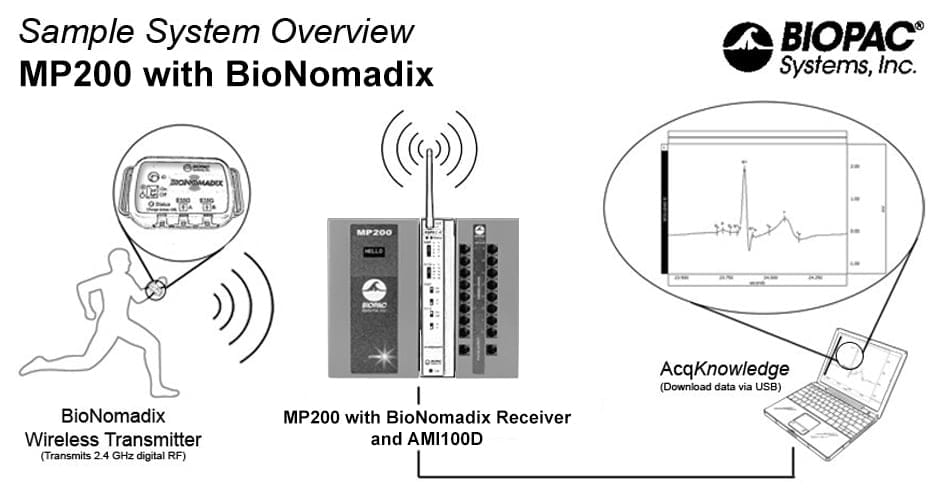
System diagram: BioNomadix transmitter on the subject, receiver in the MP200 unit, analysis in AcqKnowledge

BN-ACCL3 is an expansion module, not a standalone system

The BioNomadix transmitter and receiver on their own do not record or store data. Measurement requires an MP200 data acquisition unit (or the older MP160/MP150) together with AcqKnowledge software.

The BN-ACCL3 receiver plugs into an MP200 channel input, and the recorded signal is placed on a shared, synchronized timeline alongside other modules — both wired and wireless.

Get to know the module up close

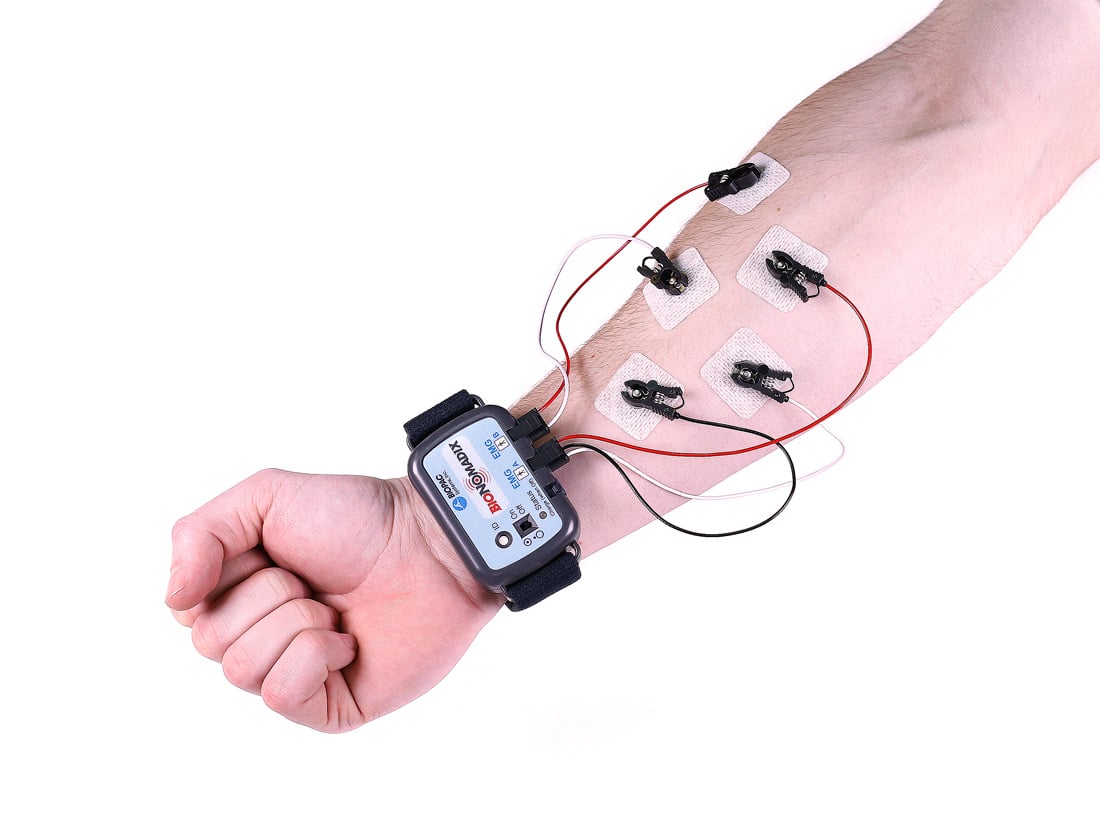
Click the points on the image to see how the BioNomadix transmitter is worn on the subject and where the cabling connects.

BioNomadix transmitter worn on the wrist, connected to electrodes on the skin — interactive diagram

Key features

Freedom of movement, no cable restrictions

No cable between the subject and the acquisition system — the transmitting module moves with the subject or monitored object, within range of the receiver, without the restriction typical of wired sensors.

Tri-axial measurement

A single module records acceleration simultaneously along all spatial axes, making it possible to reconstruct the full direction and character of the object's movement.

Tap detection as event markers

The tap detection function recognizes single and double taps on the module, which are recorded as event markers — with no need for additional cabling or a separate button.

Static and dynamic acceleration

The same module records both slow tilts and changes in orientation relative to gravity, as well as rapid, dynamic movements — with no need to switch measurement modes.

X / Y / Zmeasurement axes
2000 Hztransmission frequency
72-90hbattery life
10 mrange (line of sight)

Full technical specification

Measurement axes
Tri-axial acceleration measurement — simultaneously along the X, Y, and Z axes
Measurement type
Static acceleration (tilt — orientation relative to gravity) and dynamic acceleration (movement)
Tap detection
Tap detection function — single and double taps recorded as event markers in the data
Transmission frequency
2000 Hz between transmitter and receiver
Wireless range
Up to 10 m line of sight, typically under laboratory conditions
Transmission latency
Fixed component of 15.6 ms + variable component of ±0.5 ms rms
Battery life
72-90h of continuous operation, full charge in approx. 1h
Transmitter weight / dimensions
Approx. 54 g, approx. 6×4×2 cm
Receiver dimensions
Approx. 380 g, approx. 4×11×19 cm
Mounting
137 cm Velcro strap (BN-STRAP-137) included
Module design
Accelerometer built into the transmitter — a complete, standalone module, with no separately ordered transducer required
Compatibility
MP200 (and the older MP160/MP150) + AcqKnowledge

How it works

01

Transmitter with built-in accelerometer

A complete module mounted on the subject or monitored object with a Velcro strap — no separate transducer required.

02

Wireless transmission to the MP200

Data from the X, Y, and Z axes plus tap events transmitted at 2000 Hz to the acquisition system, within a range of up to 10 m line of sight.

03

Motion analysis in AcqKnowledge

Assessment of orientation, movement dynamics, and event markers (taps) synchronized with other signals recorded in the MP system.

Experimental applications

Wireless acceleration measurement supports mobile studies where freedom of movement for the subject and precise event synchronization matter most.

Exercise physiology

Recording the intensity and character of the subject's movement during physical activity, synchronized with other exercise parameters.

Sleep research

Tracking changes in body position and movement activity of the subject under ambulatory conditions, without cable restrictions.

Remote activity monitoring

Continuous recording of movement and orientation data in data-logging applications, outside a classic laboratory setting.

Psychophysiology and event synchronization

The tap detection function makes it possible to mark moments in the recording that are important for the experiment, synchronizing them with physiological signals recorded in parallel.

Frequently asked questions

Download materials click to expand

Interested in this product?

Contact us for a detailed quote and technical advice.

Related products

BiometricsECG (Heart Activity)Research & Scientific Instruments

BiometricsEMG (Muscle Activity)Research & Scientific Instruments

BiometricsMain UnitsResearch & Scientific Instruments

Ask about this product

Product: BioNomadix Wireless Accelerometer Transmitter+Receiver (Tri-axial)