Field test instruments and fusion splicers for network installers and operators.
100 products in this department
Browse the departmentLaboratory instrumentation for photonics, laser technology and R&D.
222 products in this department
Browse the departmentFiber-optic sensing systems: DAS, DTS, DSS, FBG and OFDR.
80 products in this department
Browse the departmentEye tracking, fNIRS, EEG and biometrics for science and business.
46 products in this department
Browse the departmentHome » Products » Research & Scientific Instruments » Biometrics » Kinematics (Motion & Goniometry) » BioNomadix 2Ch Wireless Goniometry Transmitter+Receiver
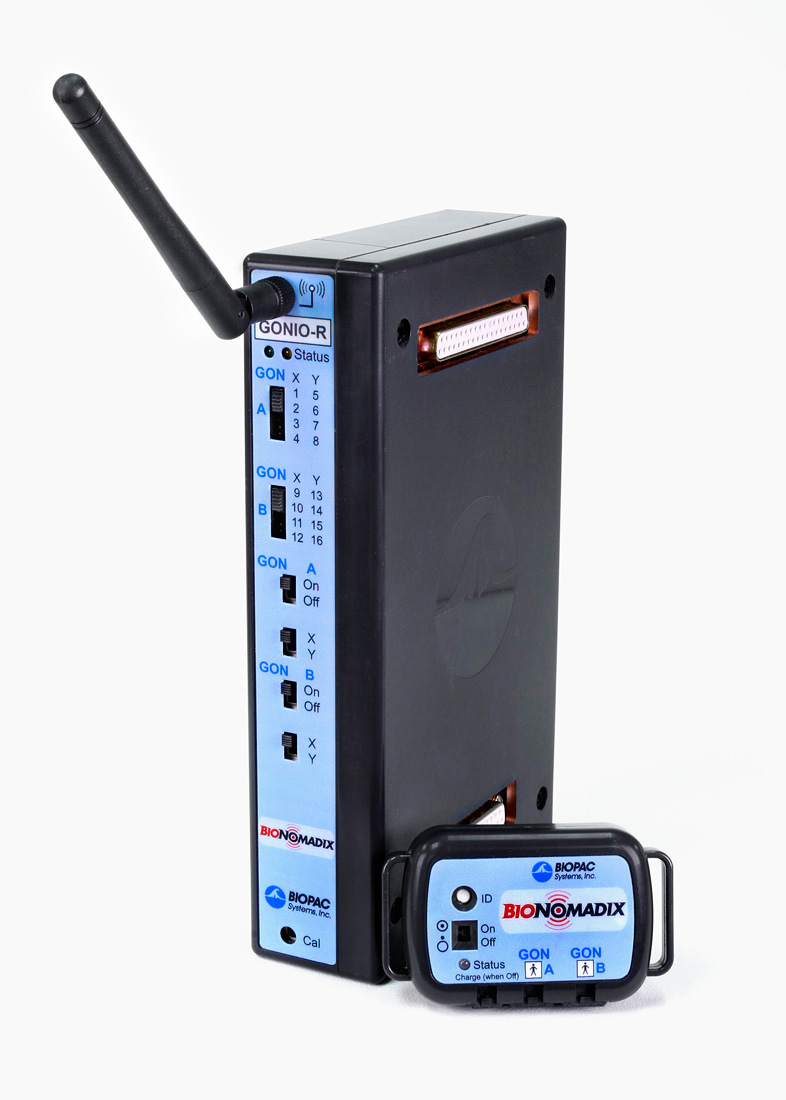
The wireless, two-channel BN-GONIO goniometry amplifier measures joint angles along two rotational axes at once, with no cable constraints.
Two independent angle channels — e.g. wrist flexion/extension and radial/ulnar deviation — in a single module, compatible with the whole BioNomadix family of goniometer, torsiometer, and finger goniometer sensors.
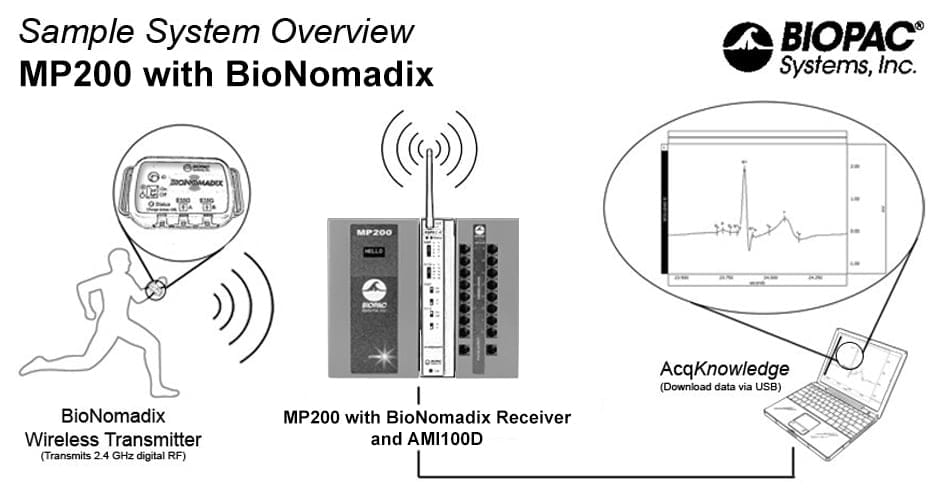
The BioNomadix transmitter and receiver alone do not record or store data. Measurement requires an MP200 data acquisition unit (or the earlier MP160/MP150) together with AcqKnowledge software.
In addition, the BN-GONIO requires a separately ordered goniometer, torsiometer, or finger goniometer sensor, connected via the BN-ADAPT-GON adapter — details in the section below. The receiver (GONIO-R) connects to an MP200 channel input, and the recorded signal is placed on a shared, synchronized timeline together with the system's other modules.
The BN-GONIO is just the amplifier/transmitter-receiver (GONIO-R) with two independent outputs — each requires its own adapter and sensor. Both outputs can be used for one twin-axis sensor, or for two independent single-axis sensors in any combination.
Connects a goniometer, torsiometer, or finger goniometer sensor to an output of the BN-GONIO wireless transmitter. Included with BioNomadix sensors; for BIOPAC sensors purchased separately or third-party sensors, it can be ordered on its own.
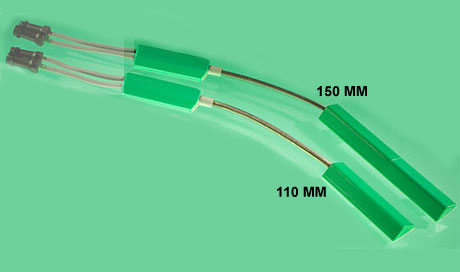
A wireless, dual-plane angle sensor — measures two joint angles at once, e.g. wrist flexion/extension and radial/ulnar deviation. Available in two cuff sizes.
A transducer for measuring axial rotation — e.g. forearm pronation/supination. Single-axis, uses one transmitter output.
A single-axis sensor for measuring flexion/extension of a single finger or toe joint.
Click the points on the photo to see the GONIO-R receiver and BioNomadix transmitter up close.
The GONIO-R receiver's antenna — picks up the 2.4 GHz wireless transmission from the BioNomadix transmitter.
Switches on the housing configure the GON A and GON B outputs (X/Y axes for each output) and turn individual channels on or off independently.
A multi-pin connector on the receiver — this is where the cable to an MP200/MP160/MP150 channel input connects.
A compact transmitter with two independent outputs (GON A, GON B) — each connects to its own BN-ADAPT-GON adapter and sensor.
The two independent outputs can be used for one twin-axis sensor (e.g. a goniometer), or for two independent single-axis sensors, in any combination.
The BN-GONIO is just the amplifier/transmitter-receiver. A goniometer, torsiometer, or finger goniometer connects separately, via the BN-ADAPT-GON adapter.
The BN-ADAPT-GON adapter enables the connection of compatible angle/torsion sensors from outside the BioNomadix family.
No cable between the joint being studied and the acquisition system — full freedom of movement while measuring range of motion.
Click the point on the silhouette to see an example placement of the goniometer — measuring wrist angle.
Indicative placement — a typical example of a goniometry application (wrist joint). The exact mounting location depends on the joint being studied and the study protocol.
The sensor is mounted across the joint being studied — here: the wrist, to measure flexion/extension and deviation. The exact placement depends on the study protocol.
A goniometer, torsiometer, or finger goniometer mounted at the joint being studied, connected via the BN-ADAPT-GON adapter to the transmitter.
Wireless transmission at 2000 Hz to the data acquisition system.
Recording of the angle profile across two planes of motion, synchronized with the system's other signals.
Wireless angle measurement supports joint range-of-motion research without the constraints typical of wired sensors.
Analysis of joint range of motion (ROM) during movement, with the subject moving freely.
Tracking progress in restoring joint mobility over time, e.g. after an injury or orthopedic procedure.
Assessing working limb angles during job tasks and designing workstations.
Analyzing movement technique and joint range of motion during athletic activity.
No. The BN-GONIO is just the wireless amplifier/transmitter-receiver (GONIO-R). Measurement requires a separately ordered sensor — such as the BN-GON-110-XDCR goniometer — connected via the BN-ADAPT-GON adapter.
A goniometer measures joint flexion angle in two planes (e.g. the wrist), while a torsiometer measures torque/twist (e.g. forearm pronation/supination). Both sensor types connect to the BN-GONIO through the same BN-ADAPT-GON adapter. A single-axis finger goniometer, the BN-GON-F-XDCR, is also available for finger/toe joints.
No — the BN-GONIO supports any combination on its two outputs: one twin-axis goniometer using both outputs, or two independent single-axis sensors (e.g. two torsiometers, two finger goniometers, or different types at once).
Yes — the BN-ADAPT-GON adapter was designed in part for compatibility with existing third-party goniometers and torsiometers that match the connector.
The MP200, as well as the earlier MP160/MP150, within the AcqKnowledge environment.
Related products
Product: BioNomadix 2Ch Wireless Goniometry Transmitter+Receiver