Wired SpO2 amplifier (BIOPAC OXY100E)

A wired amplifier for noninvasive, beat-to-beat measurement of blood-oxygen saturation (SpO2) using two light wavelengths (red ~660 nm, infrared ~910 nm). Built-in calibration; up to 4 modules on a single MP unit. Requires a separately ordered TSD124-series sensor (finger/ear/wrap) and an MP150/MP160/MP200 unit with AcqKnowledge software.

BIOPAC · Noninvasive pulse oximetry

The OXY100E module noninvasively records blood-oxygen saturation (SpO2) on a beat-to-beat basis.

Red and infrared LEDs shine through a translucent piece of tissue (a fingertip, earlobe or another site), and the difference in light absorption measured by the photodiodes is used to compute the ratio of oxy- to deoxyhemoglobin.

Part of a larger system

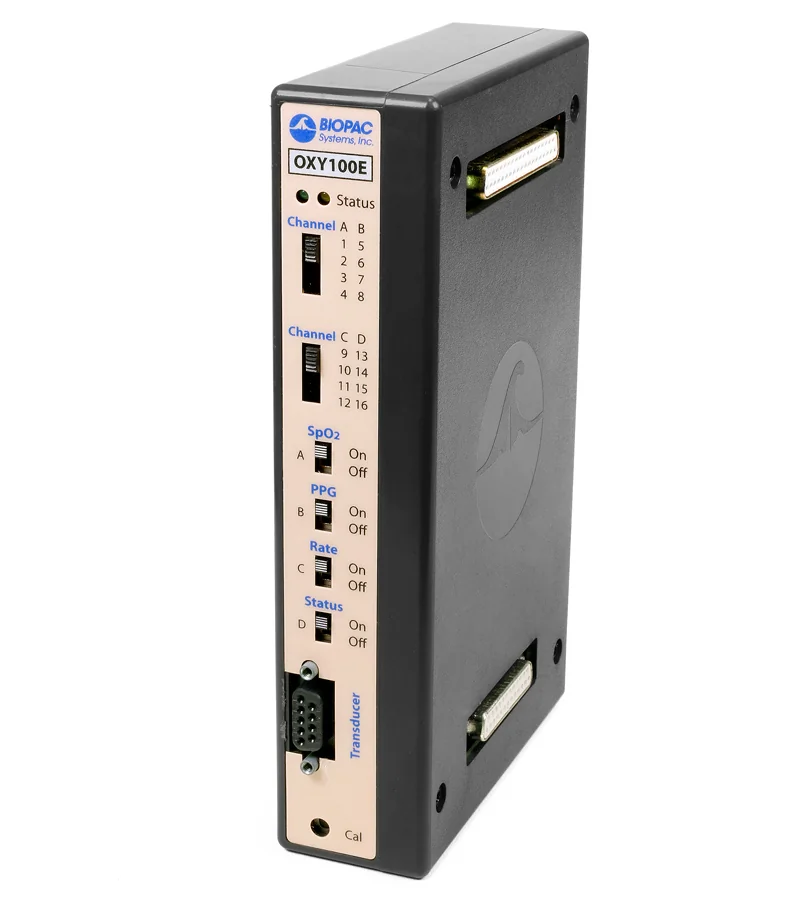
OXY100E set: amplifier module with a connected pulse oximetry sensor

Manufacturer photo (BIOPAC) — OXY100E module with a connected TSD124-series sensor.

The OXY100E is an expansion module, not a standalone system

The OXY100E module does not record or store data on its own. It must be cabled to an MP150/MP160/MP200 data acquisition unit together with AcqKnowledge software.

In addition, the OXY100E requires a separately ordered TSD124-series sensor — see the section below. The module plugs into a channel slot on the MP unit, and the recorded signal is placed on a shared, synchronized timeline alongside the system's other modules.

Required sensor

The OXY100E is the amplifier module only — SpO2 measurement requires a separately ordered TSD124-series sensor chosen for the measurement site.

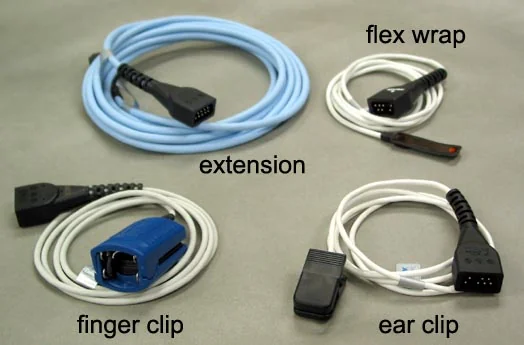
TSD124-series pulse oximetry sensors — finger, ear and wrap variants Manufacturer photo (BIOPAC) — TSD124-series sensor variants: finger clip, ear clip and flexible wrap. TSD124-series

Pulse oximetry sensor — choose by measurement site

A single SpO2 sensor available in three variants differing in form and placement site — the choice depends on the study protocol and the participant.

  • TSD124D — finger clip (transmissive), for adults over 30 kg body weight
  • TSD124B — ear-lobe clip (Nonin PureLight)
  • TSD124C — flexible wrap sensor for alternative measurement sites on a limb (Nonin PureLight)

Key features

Beat-to-beat measurement

Blood-oxygen saturation recorded with each successive heartbeat, not just as an averaged value.

Two light wavelengths

Red (~660 nm) and infrared (~910 nm) LEDs shine through the tissue, and the difference in light absorption measured by the photodiodes is used to compute the ratio of oxy- to deoxyhemoglobin.

Built-in calibration

The module requires no manual calibration procedure — calibration is built into the device.

Up to 4 modules simultaneously

A single MP unit can run up to 4 OXY100E modules at once — for multi-participant or redundant studies.

SpO2measured parameter
Beat-to-beatmeasurement type
~660/910 nmwavelengths (red/infrared)
4modules at once on a single MP unit

Full technical specification

Signal
Noninvasive blood-oxygen saturation (SpO2), beat-to-beat measurement
Measurement method
Two light wavelengths (red ~660 nm, infrared ~910 nm) passing through the tissue to a photodiode; differential light absorption is used to compute the oxy-/deoxyhemoglobin ratio
Calibration
Built-in — no manual calibration procedure
Number of simultaneous modules
Up to 4 OXY100E modules on a single MP unit
Required transducer
TSD124-series sensor (TSD124D — finger clip; TSD124B — ear clip; TSD124C — flexible wrap)
Compatibility
MP150, MP160, MP200 + AcqKnowledge

Where to place the sensor

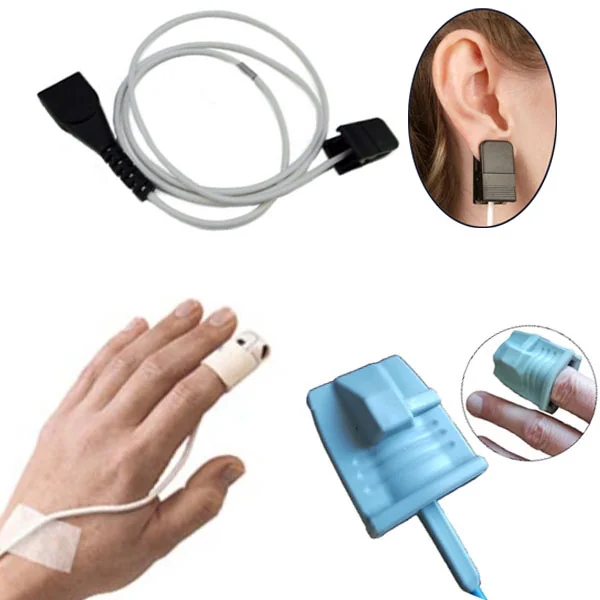
The TSD124D (clip) attaches to a fingertip, the TSD124B (clip) to an earlobe, and the TSD124C (flexible wrap) to an alternative site on a limb — the choice depends on the sensor and the study protocol.

Placement confirmed in BIOPAC materials for the individual sensor variants.

How it works

01

TSD124 sensor on the participant

The sensor is attached at the chosen site — finger, ear or limb, depending on the variant.

02

OXY100E + MP150/160/200

The module converts the optical signal from the sensor into an SpO2 value, sent by cable to the acquisition unit.

03

Analysis in AcqKnowledge

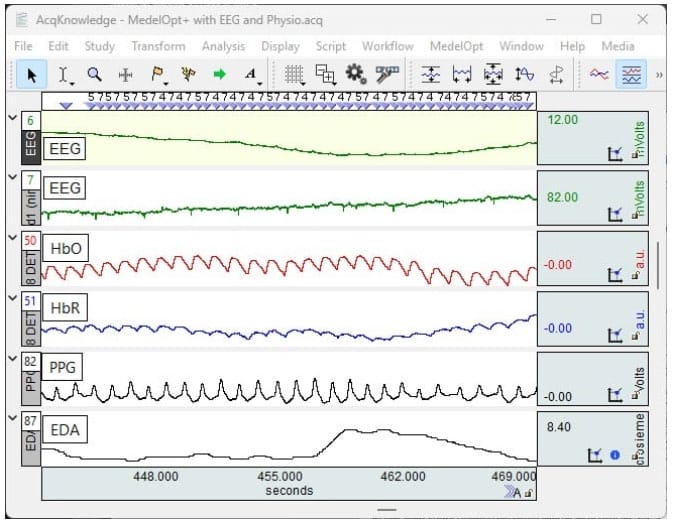
Recording the SpO2 trace beat-to-beat, together with other physiological signals.

Experimental applications

SpO2 measurement supports studies that link blood oxygenation with other physiological signals.

Sleep and respiration research

Monitoring blood-oxygen saturation in studies of sleep architecture and breathing disorders.

Exercise physiology

Tracking SpO2 during physical activity and performance studies.

Cardiorespiratory monitoring

Blood-oxygen saturation as a complement to ECG and respiration signals in general hemodynamic monitoring.

Multi-signal studies

SpO2 as one of the signals in protocols combining ECG, respiration and other psychophysiological parameters.

Frequently asked questions

Download materials click to expand

Interested in this product?

Contact us for a detailed quote and technical advice.

Related products

Eye TrackingResearch & Scientific InstrumentsSoftware

Eye TrackingMobile (Glasses)Research & Scientific InstrumentsSoftware

Eye TrackingResearch & Scientific InstrumentsSoftware

AccessoriesEye TrackingResearch & Scientific Instruments

Ask about this product

Product: Wired SpO2 amplifier (BIOPAC OXY100E)