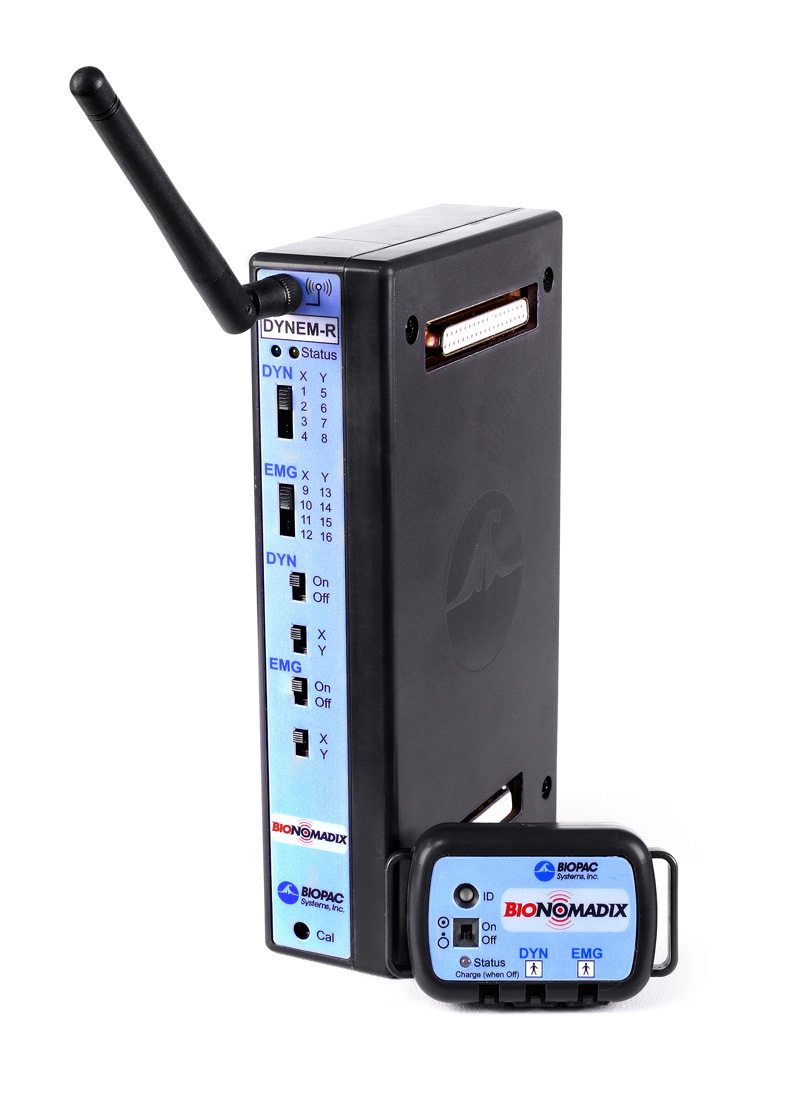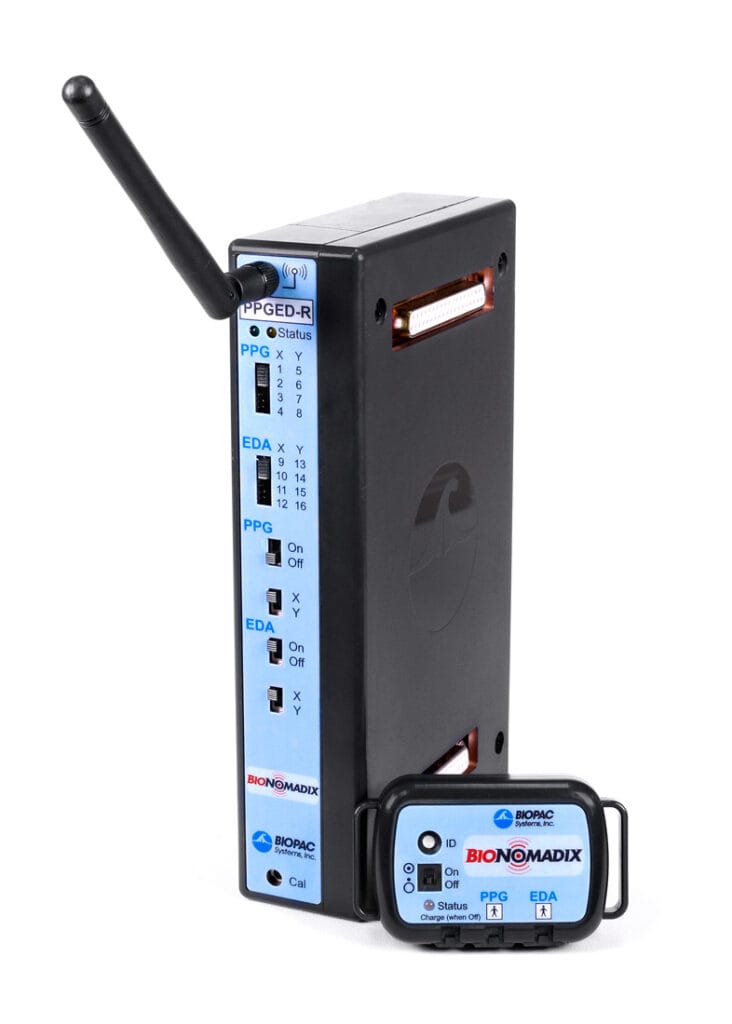
BioNomadix 2Ch Dyno+EMG Wireless Transmitter+Receiver

The wireless BN-DYNEMG set records hand grip force and muscle electrical activity (EMG) simultaneously, with no cable constraints.

BioNomadix · Dynamometry and EMG together

The wireless BN-DYNEMG set records hand grip force and muscle electrical activity (EMG) simultaneously, with no cable constraints.

Combines a grip-force pressure transducer with EMG in a single module — letting you directly relate neuromuscular potential to the actual mechanical force being exerted.

Part of a larger system

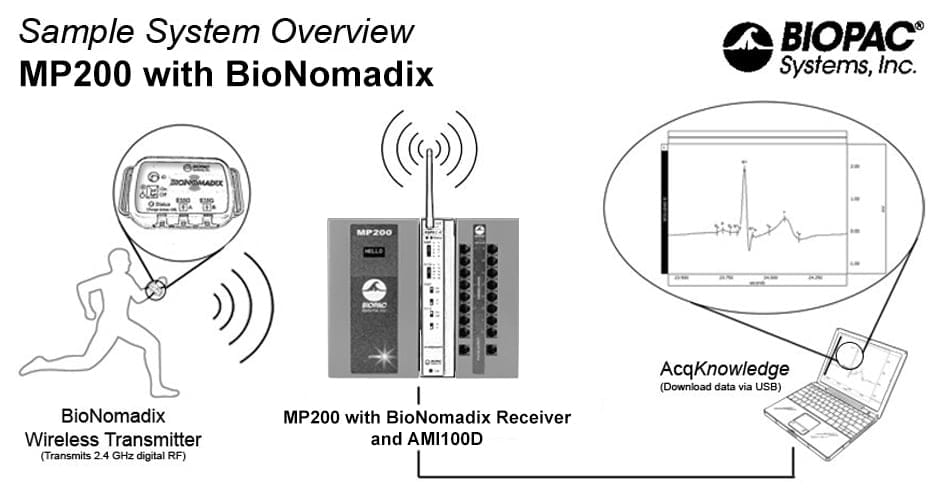
System diagram: BioNomadix transmitter on the subject, receiver in the MP200 unit, analysis in AcqKnowledge

The BN-DYNEMG is an expansion module, not a standalone system

The BioNomadix transmitter and receiver alone do not record or store data. Measurement requires an MP200 data acquisition unit (or the earlier MP160/MP150) together with AcqKnowledge software.

The receiver connects to an MP200 channel input, and the recorded signal (EMG + grip force) is placed on a shared, synchronized timeline together with the system's other modules.

Built-in pressure transducer

Unlike the BN-STRIKE, BN-SKT2, or BN-GONIO, the force transducer in the BN-DYNEMG set is not a separate, individually ordered component — it's part of the module's own architecture.

Built-in

Grip-force pressure transducer (bulb)

The set uses a pressure transducer to measure hand grip force, integrated with the EMG transmitter module. After a normalization calibration procedure, the system provides a precise reading of useful force (e.g. in kg/cm²), synchronized with the EMG signal.

  • Force measured via a pressure-based method (bulb-type transducer)
  • Requires a normalization calibration for a reading in force units
  • Integrated with the EMG transmitter in a single set — no separate order needed, unlike the BN-STRIKE or BN-SKT2

Get to know the module up close

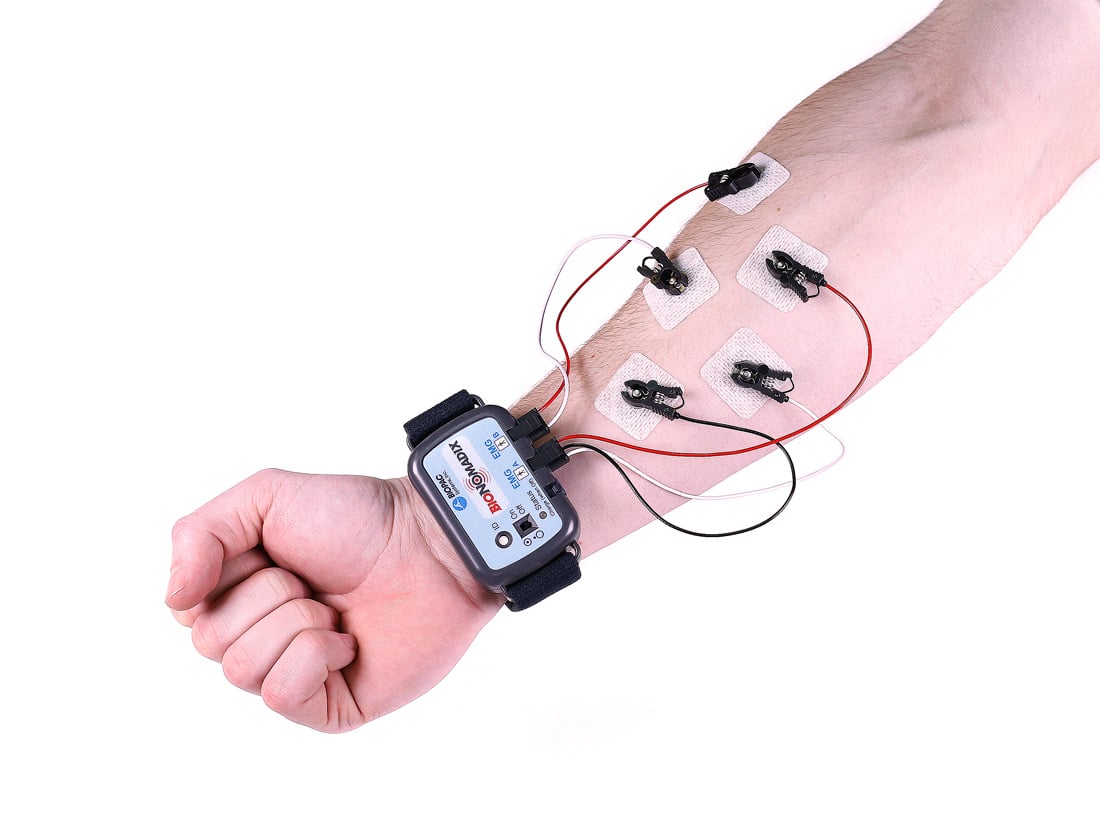
Click the points on the photo to see how the BioNomadix transmitter is worn on the subject and where the cabling connects.

BioNomadix transmitter worn on the wrist, connected to electrodes on the skin — interactive diagram

Key features

Simultaneous force and EMG measurement

Synchronized recording of the electromyographic signal and hand grip force from a single transmitting set.

Integrated pressure transducer

The grip-force measuring bulb is built into the set — no need to separately order an additional sensor, unlike the BN-STRIKE or BN-SKT2.

Normalization calibration

After calibration, the system provides precise readings of useful force in units such as kg/cm².

Wireless operation

Separating the transmitting module from power cabling increases subject safety and resistance to external interference.

EMG + forcesignals recorded simultaneously
DC-100 Hzbandwidth for grip force
72hbattery life
54 gtransmitter weight

Full technical specification

Signal
EMG (muscle electrical activity) and hand grip force (pressure transducer) — recorded simultaneously
Bandwidth for grip force
DC to 100 Hz
Force measurement range
Depends on the selected unit and transducer configuration — requires a normalization calibration for a reading in force units (e.g. kg/cm²)
Resolution / inherent noise
Depends on configuration
Power
Li-ion battery, up to 72h of continuous operation
Transmitter weight
Approx. 54 g
Wireless range
Up to 10 m (line-of-sight), typically in laboratory conditions
Compatibility
MP200, MP160, MP150 + AcqKnowledge

Where to place the electrodes and transducer

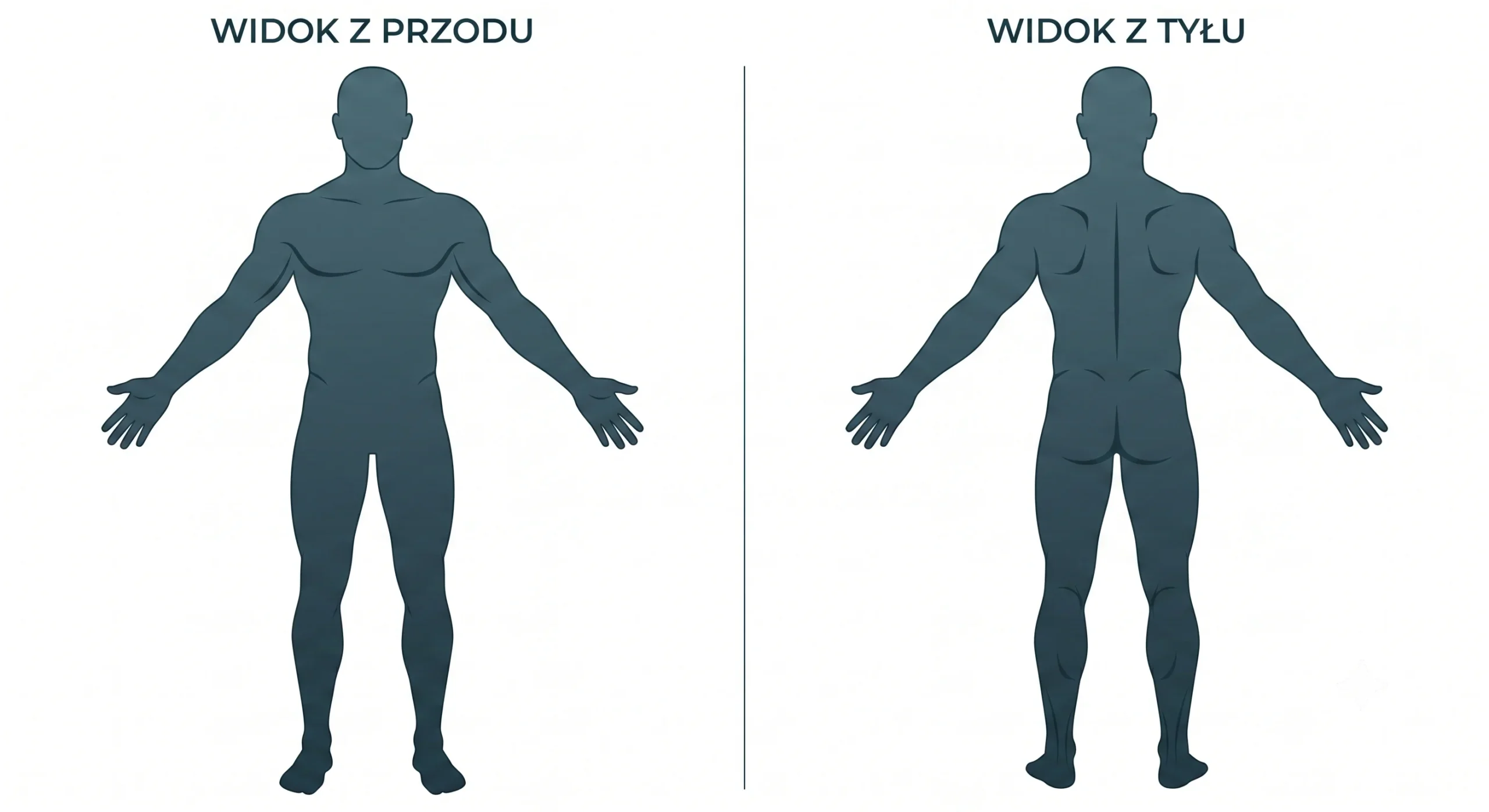
Click the points on the silhouette to see the indicative placement of the EMG electrodes and the grip-force transducer.

Indicative placement — a generally accepted convention for grip-force-related measurements (forearm flexor muscles), not explicitly confirmed in BIOPAC materials for this specific set. A ground electrode (GND) is required in every biopotential connection.

General body silhouette — front view, indicative placement of the EMG electrodes and force transducer on the forearm

How it works

01

Electrodes and transducer on the subject

EMG electrodes on the forearm and a pressure transducer squeezed in the hand, connected to the transmitter secured with a strap.

02

Transmitter-receiver + MP200

Wireless transmission of both signals (EMG and force) to the data acquisition system.

03

Analysis in AcqKnowledge

After normalization calibration — synchronized analysis of neuromuscular potential and the actual force being exerted.

Experimental applications

Simultaneous EMG and grip-force measurement supports research linking muscle electrophysiology to the actual mechanical force being exerted.

Muscle fatigue research

Correlating the decline in grip force with changes in the EMG signal over the course of exertion.

Rehabilitation and kinesiology

Relating the EMG signal to the force actually exerted while restoring hand function.

Ergonomics

Assessing the physical effort of the hand and forearm during work tasks.

Sport physiology

Assessing neuromuscular coordination and grip strength in the context of athletic performance.

Frequently asked questions

Download materials click to expand

Interested in this product?

Contact us for a detailed quote and technical advice.

Related products

AccessoriesResearch & Scientific Instruments

BiometricsECG (Heart Activity)Research & Scientific InstrumentsRSP (Respiration)

AccessoriesEye TrackingResearch & Scientific Instruments

Eye TrackingResearch & Scientific InstrumentsSoftware

Ask about this product

Product: BioNomadix 2Ch Dyno+EMG Wireless Transmitter+Receiver