A broader participant pool
You don't turn away candidates just because they wear glasses — your sample better reflects the population you study.

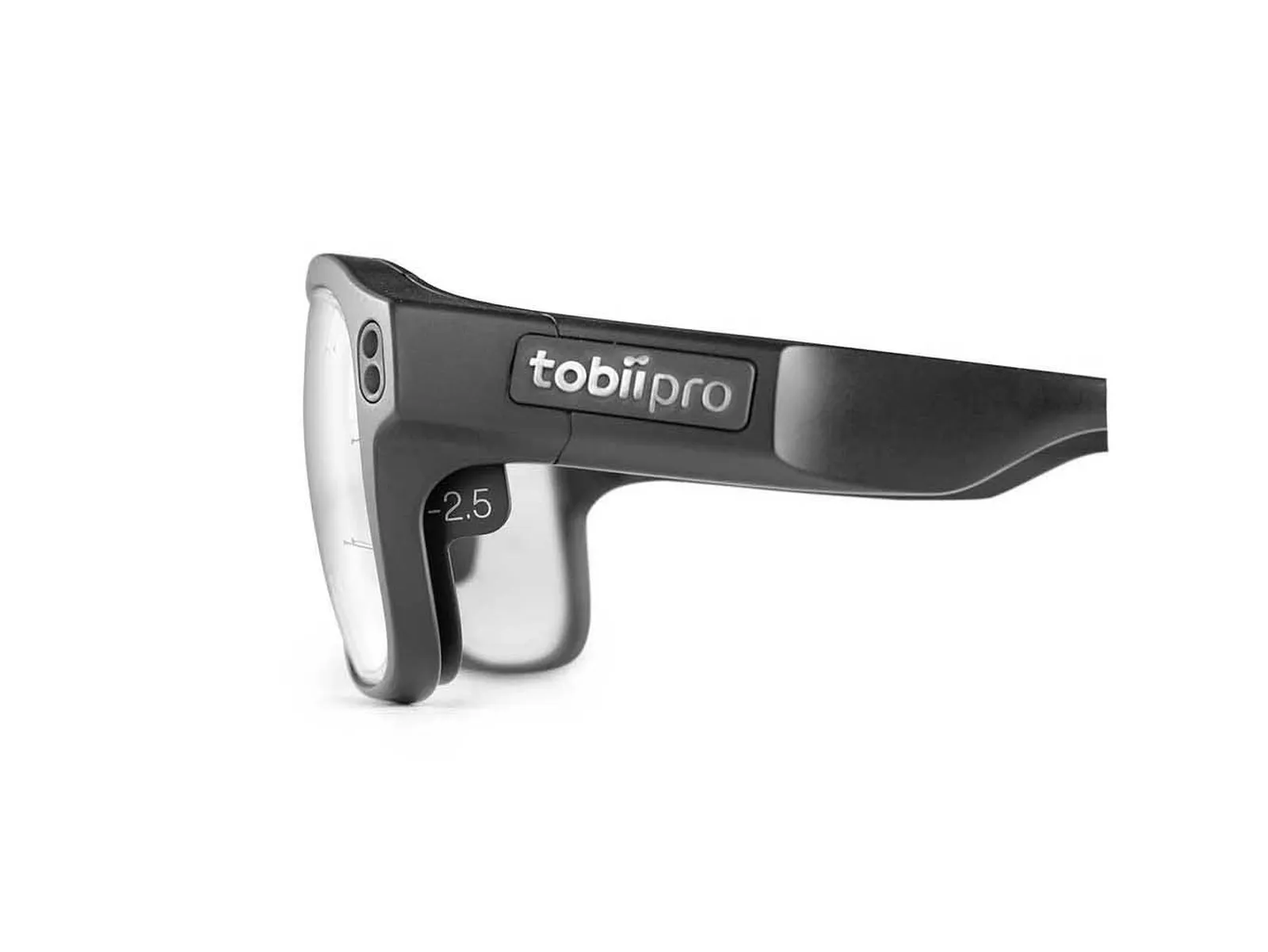
A kit of snap-on lenses for the Tobii Pro Glasses 3 wearable eye tracker. A participant who normally wears glasses takes them off for the recording, and you snap lenses of their prescription onto the research glasses — separately for each eye. They see sharply, and you record complete data.


Eye tracking glasses are worn like ordinary glasses: small cameras in the frame observe the eyes, and a front-facing camera records what the participant sees. A person who normally wears corrective glasses takes them off for the recording — the kit case has a separate compartment for them.
To keep their vision sharp, you attach lenses of their strength to the research glasses, separately for the left and right eye. Tobii designed the kit for the most common refractive errors: nearsightedness and farsightedness.
You don't turn away candidates just because they wear glasses — your sample better reflects the population you study.
According to Tobii, the lenses let you record data without vision loss — the participant clearly sees the shelf, the screen or the road.
The lenses stay securely attached to the glasses even in studies with natural movement, such as sports research.
Tobii's guide for the kit walks you through it: a starting point from the participant's prescription, a test with the vision testing card, and adjustment in 1.0 and finally 0.5 diopter steps. Try it in the simulation.
 Participant's view · illustration
BlurryThe participant's refractive error is −3.5 dpt. Attach a lens and change the strength in 1.0 steps.
The simulation simplifies the optics: blur grows with the difference between the refractive error and the lens strength. The strength range matches the Tobii kit: −8.0 to +3.0 dpt in 0.5 steps.
The strength from the participant's prescription is the starting point. If they don't know it: if distant objects look blurry (nearsightedness), start at −1.0; if near objects look blurry (farsightedness), start at +1.0.
Snap in the inner notch first, then the outer one; remove in the reverse order. A tilted or not fully seated lens impairs the data.
The participant covers one eye and reads a row of letters on the card held at the distance of the study objects (1.2–4.5 m). The card is in the kit case.
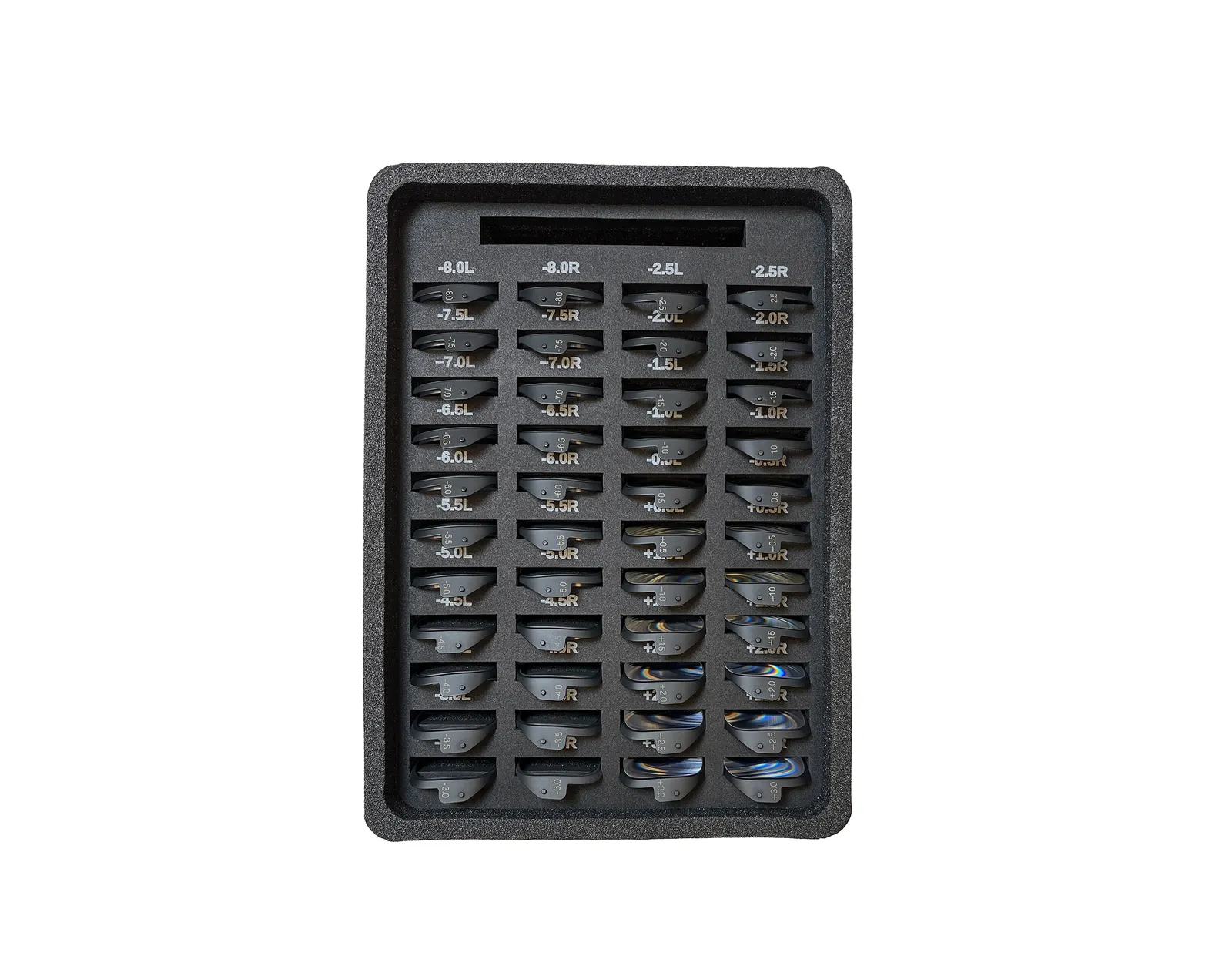
If they read with difficulty — a stronger lens by 1.0. If they can almost read the row — by 0.5. The strength is printed on the side of the lens and labeled in the case.
There are separate lenses for the left and right eye, so you fit each eye independently.
Source: Tobii Pro Glasses 3 Corrective Lenses — Quick Start Guide.
The kit fits in a single case: the lenses sit in a custom foam insert, each labeled with its strength and eye. The participant puts their own glasses in it for the duration of the recording.
Photos: Tobii. Source: tobii.com — “Tobii corrective lenses”; Quick Start Guide; as of 2026-10.
The lenses are a small item that decides whether a person who wears glasses can take part in a study. We help you plan them together with the whole setup — before the first participant comes in for a recording.
According to Tobii's product page and guide.
| Parameter | Value |
|---|---|
| Lenses | |
| Purpose | correcting the study participant's nearsightedness and farsightedness |
| Strength range | −8.0 to +3.0 dpt, in 0.5 dpt steps |
| Number of lenses | 44 — 22 for the right eye, 22 for the left |
| Material | optical-grade plastic with hard coating |
| Mounting | snap-on — inner notch first, then the outer one |
| Marking | strength printed on the side of the lens and labeled in the case |
| Kit | |
| Contents | lenses, quick start guide, vision testing card, cleaning cloth, carrying case with foam insert and a compartment for the participant's glasses |
| Dimensions (H × W × D) | 80 × 270 × 370 mm |
| Weight (complete kit) | 1250 g |
| Compatibility | Tobii Pro Glasses 3; can be combined with Tobii protective lenses |
Source: tobii.com — “Tobii corrective lenses”; Tobii Pro Glasses 3 Corrective Lenses — Quick Start Guide; as of 2026-10.
This kit is for Pro Glasses 3, with snap-on lenses. For Glasses X, Tobii offers a separate kit with slide-on lenses, from −6.0 to +3.0 dpt.
The starting point is the strength of the participant's glasses. Then — following Tobii's guide — the participant covers one eye and reads the card at the distance of the study objects; you change the strength in 1.0 and finally 0.5 diopter steps, separately for each eye. We demonstrate the procedure during training.
Tobii describes the kit as correcting nearsightedness and farsightedness and does not mention astigmatism correction. If your participant group includes people with astigmatism, ask us — we'll check with the manufacturer.
Yes — Tobii states that the corrective lenses can be combined with protective lenses, clear or tinted, for indoor and outdoor studies.
They are a separate Tobii accessory. We include them in a quote together with Pro Glasses 3 or as an addition to glasses you already have.