Tunnels and metro systems
A continuous temperature profile locates the anomaly zone without distributing measurement electronics throughout the protected area.

Field test instruments and fusion splicers for network installers and operators.
101 products in this department
Browse the departmentLaboratory instrumentation for photonics, laser technology and R&D.
224 products in this department
Browse the departmentFiber-optic sensing systems: DAS, DTS, DSS, FBG and OFDR.
80 products in this department
Browse the departmentEye tracking, fNIRS, EEG and biometrics for science and business.
47 products in this department
Browse the departmentHome » Products » Monitoring Systems » DTS - Temperature Monitoring » LIOS DE.TECT – fibre-optic linear heat detection
Use the relevant guide to qualify the sensing principle and its limits. INTERLAB can then shortlist the interrogator, sensing cable or sensors and channel configuration for the stated measurement requirement.
For equipment selection, send the measured quantity, route or test length, required spatial granularity, update rate, channel count, available fiber and target data interface.
Discuss the hardware configuration* Manufacturer maxima refer to specific products, operating modes and channel counts; they are not necessarily available simultaneously. Final coverage, spatial granularity, rate and uncertainty are confirmed for the selected configuration and application conditions.
Linear heat detection · DTS · LIOS DE.TECT
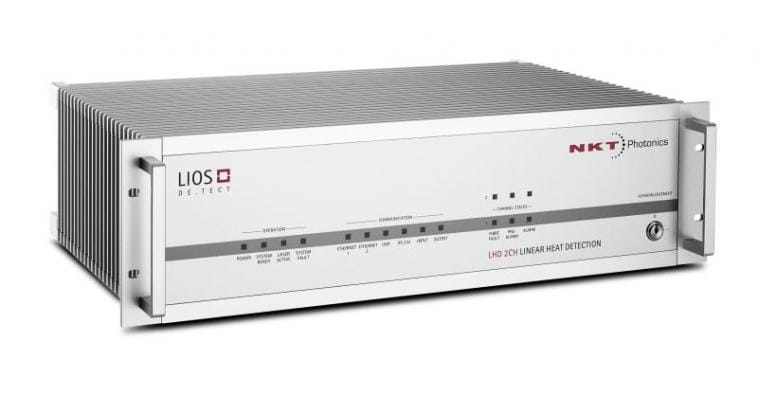
LIOS DE.TECT uses a sensing cable as a continuous line of heat detection in tunnels, metro systems, industrial facilities and other extensive spaces.
The system does not “see” flames or smoke. It measures a thermal phenomenon along the optical fibre and assigns the anomaly to a position on the route. Alarm logic can consider temperature, rate of rise and defined zones.
A fire-protection solution must be assessed as a complete configuration: readout unit, cable, topology, interfaces, documentation, tests and required approvals. Product information is not a substitute for fire-safety design.
Where a hazard can arise at any point along a long or difficult-to-access route.
A continuous temperature profile locates the anomaly zone without distributing measurement electronics throughout the protected area.
The sensing cable covers long sections where individual point detectors could leave gaps.
Zoning allows different alarm criteria to be applied to different parts of the site.
Optical fibre is immune to electromagnetic interference, but its sheath and mounting method must suit the environment.
Each layer has a separate function and its own acceptance requirements.
| Phenomenon / objective | Technology | What it provides | INTERLAB portfolio |
|---|---|---|---|
| temperature value | DTS / LHD | temperature profile along the cable | LIOS DE.TECT |
| rate of rise | alarm logic | alarm based on change over time | LIOS DE.TECT with zone configuration |
| anomaly location | route mapping | position and assigned zone | LIOS software |
| process temperature without a fire-alarm function | process DTS | process monitoring, not a substitute for fire detection | LIOS PRE.VENT, Silixa DTS |
For a linear heat-detection function, we identify equipment intended for that application.
An optical linear heat-detection system for rapid location of thermal events in extensive facilities.
View equipment →Distributed process-temperature monitoring; it is not presented as a substitute for a fire-detection system.
View equipment →Current distributed temperature-sensing equipment in the INTERLAB portfolio.
Explore the category →Selecting the readout unit is only one part of the system.
Sheath, temperature range, chemical exposure, mounting and bend radii must match the site.
Cable distance is assigned to physical sections and alarm scenarios.
Alarms are passed to the host system according to the agreed cause-and-effect matrix.
Acceptance verifies location, thresholds, circuit-fault response and configuration behaviour.
Initial configuration requires:
No. The system measures a temperature profile and locates a thermal phenomenon. Smoke detection is a different function.
The sensing cable is optically passive. The measurement electronics are located in the readout unit.
No. It is one element of a fire-protection solution and must be correctly integrated and accepted.
The configuration can consider absolute temperature, rate of rise and zone assignment. Thresholds follow the project design.
No. Equipment intended for process measurement does not automatically become an approved fire-detection system.
Send us the route lengths, zones, environmental conditions, required approvals and host-system interface.
Technical sources: Luna LIOS DE.TECT · Luna LIOS PRE.VENT
Related products
Product: LIOS DE.TECT – fibre-optic linear heat detection