Field test instruments and fusion splicers for network installers and operators.
100 products in this department
Browse the departmentLaboratory instrumentation for photonics, laser technology and R&D.
222 products in this department
Browse the departmentFiber-optic sensing systems: DAS, DTS, DSS, FBG and OFDR.
80 products in this department
Browse the departmentEye tracking, fNIRS, EEG and biometrics for science and business.
46 products in this department
Browse the departmentThe BN-EOG2 wireless EOG amplifier records eye movements — horizontal, vertical, and radial — with no cable constraints.
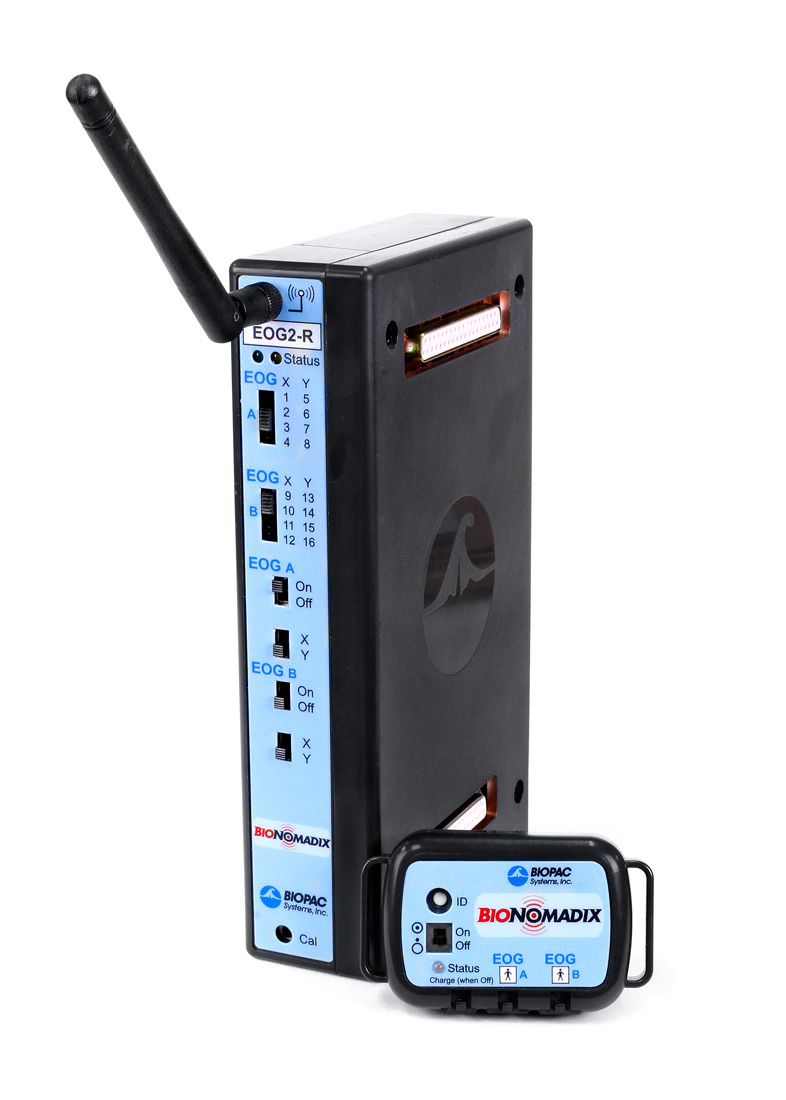
The BN-EOG2 wireless EOG amplifier records eye movements — horizontal, vertical, and radial — with no cable constraints.
Two independent measurement channels and a hardware Derivative mode for saccade detection, while preserving full freedom of movement for the subject.
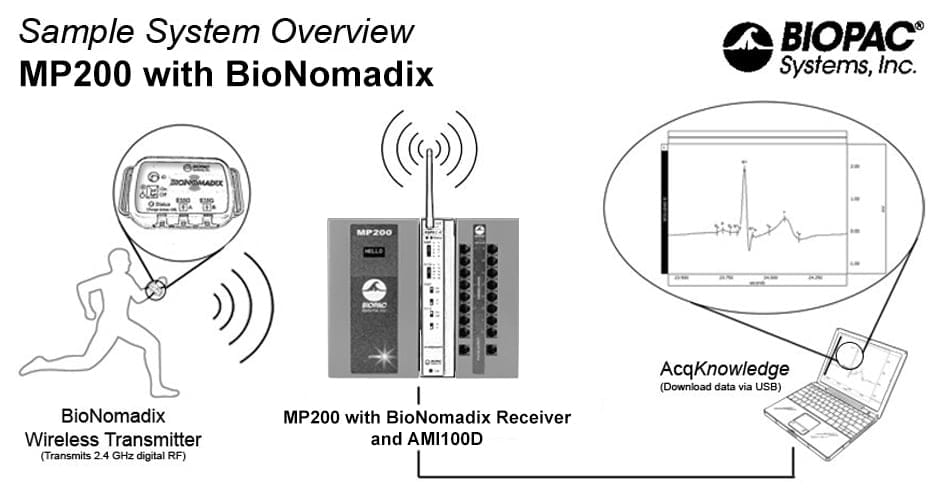
The BioNomadix transmitter and receiver alone do not record or store data. Measurement requires an MP200 data acquisition unit (or the earlier MP160/MP150) together with AcqKnowledge software.
The BN-EOG2 receiver connects to an MP200 channel input, and the recorded signal is placed on a shared, synchronized timeline together with other modules — wired and wireless.
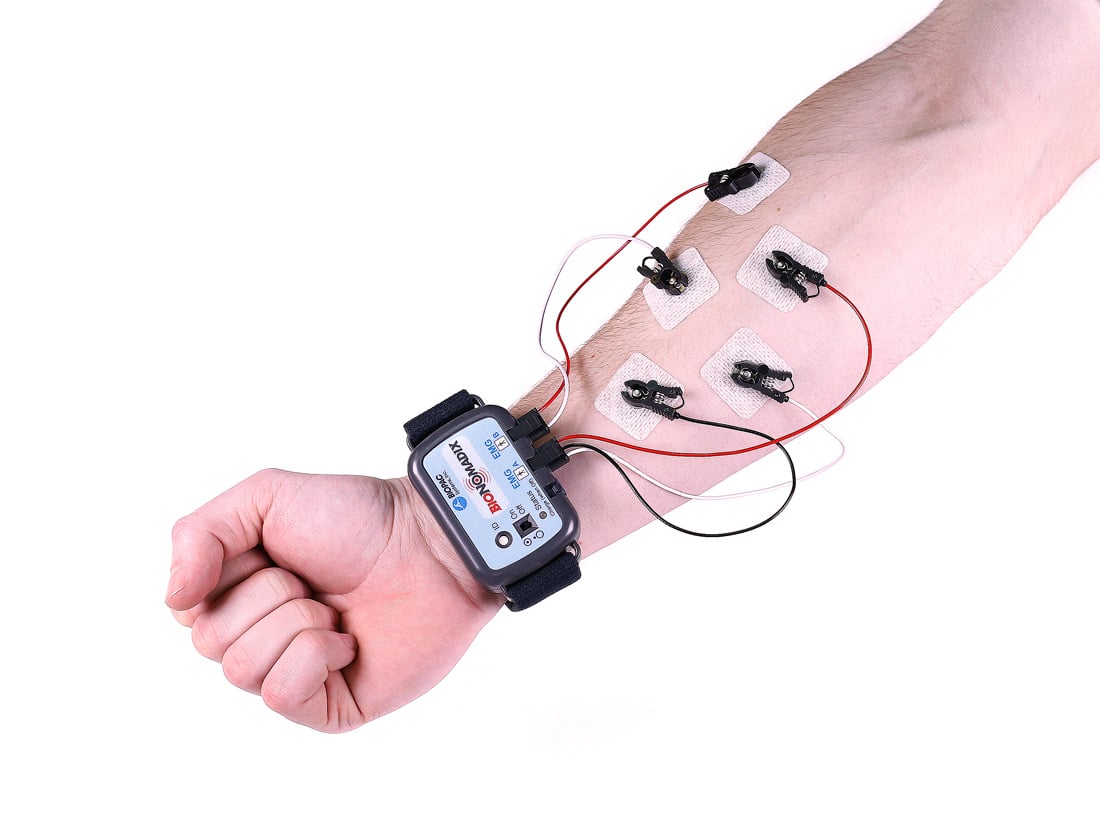
Click the points on the photo to see how the BioNomadix transmitter is worn on the subject and where the cabling connects.
A compact wireless module — worn close to the measurement site, it sends the signal to the receiver at the MP200/MP160/MP150.
An adjustable Velcro strap secures the transmitter on the subject's body without restricting natural movement.
A multi-pin connector on the transmitter — this is where the cabling to the electrodes or transducer connects.
Color-coded leads connect the transmitter to the electrodes or transducer placed at the measurement site.
No cable between transmitter and receiver — freedom of head and body movement for the subject during EOG recording.
A switch on the receiver converts the raw EOG signal into one proportional to eye movement velocity — making it easier to identify saccades.
High common-mode rejection (typically 110 dB at 50/60 Hz, min. 90 dB) — a clean recording despite the low amplitude of the EOG signal.
Secured with a 76 cm strap (BN-STRAP76), sized approx. 6×4×2 cm — does not restrict the subject's head movement.
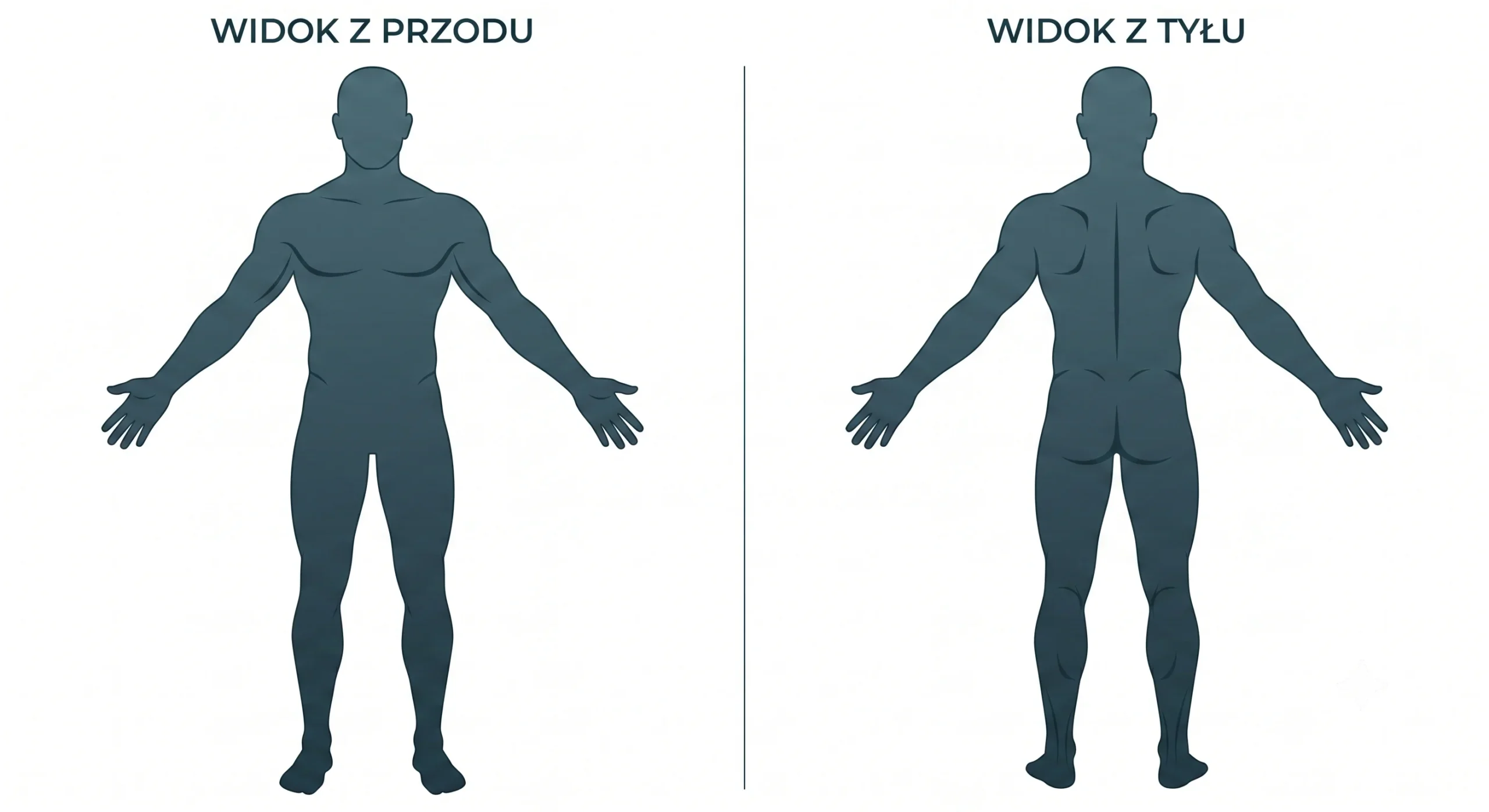
Click the points on the silhouette to see an indicative EOG electrode layout, including the ground electrode.
Active electrodes: indicative, generally accepted physiological convention (near the outer corners of the eyes for horizontal movement) — not explicitly confirmed in BIOPAC materials for this model. The ground electrode (GND) is required — the BioNomadix datasheet explicitly confirms every biopotential transmitter (including the EOG2) requires at least one GND; its exact position is shown indicatively.
Near the outer corner of the left eye — a generally accepted site for recording horizontal eye movements.
Near the outer corner of the right eye — together with the electrode near the left eye, it forms the horizontal-movement recording channel. The exact layout (horizontal/vertical, blinks) is chosen to fit the study protocol.
Required in every biopotential connection — confirmed for the EOG2 in the BioNomadix datasheet. The exact position on the face/forehead is indicative.
Electrodes around the eyes record horizontal, vertical, or radial movements; the transmitter is secured with a strap or vest.
2.4 GHz wireless transmission at 2000 Hz to the data acquisition system.
Raw signal or Derivative mode (eye movement velocity) — the basis for identifying saccades and nystagmus.
Wireless EOG recording enables studying gaze dynamics beyond the classic stationary lab setup, without the constraints of cabling the subject.
Studying eye movements in virtual and augmented reality environments, without cables restricting the subject's head freedom.
Mobile studies of visual responses to stimuli in a natural setting, outside a stationary lab.
Assessing visual load during work tasks, and analyzing locomotor behavior using saccade detection.
Evaluating user interfaces with gaze dynamics recording, without restrictive cabling on the subject.
The BN-EOG2 works wirelessly, but has higher inherent noise than the wired version (0.9 µV rms vs. 0.1 µV rms for the EOG100C). Where maximum sensitivity at a stationary setup is the priority, BIOPAC offers the wired EOG100C.
It's a hardware output mode that replaces the raw EOG signal with one proportional to eye movement velocity, enabled via switch SW5 on the receiver — it makes automatic saccade identification easier.
The MP200, as well as the earlier MP160/MP150, within the AcqKnowledge environment.
Related products
Product: BioNomadix 2Ch Wireless EOG Amplifier