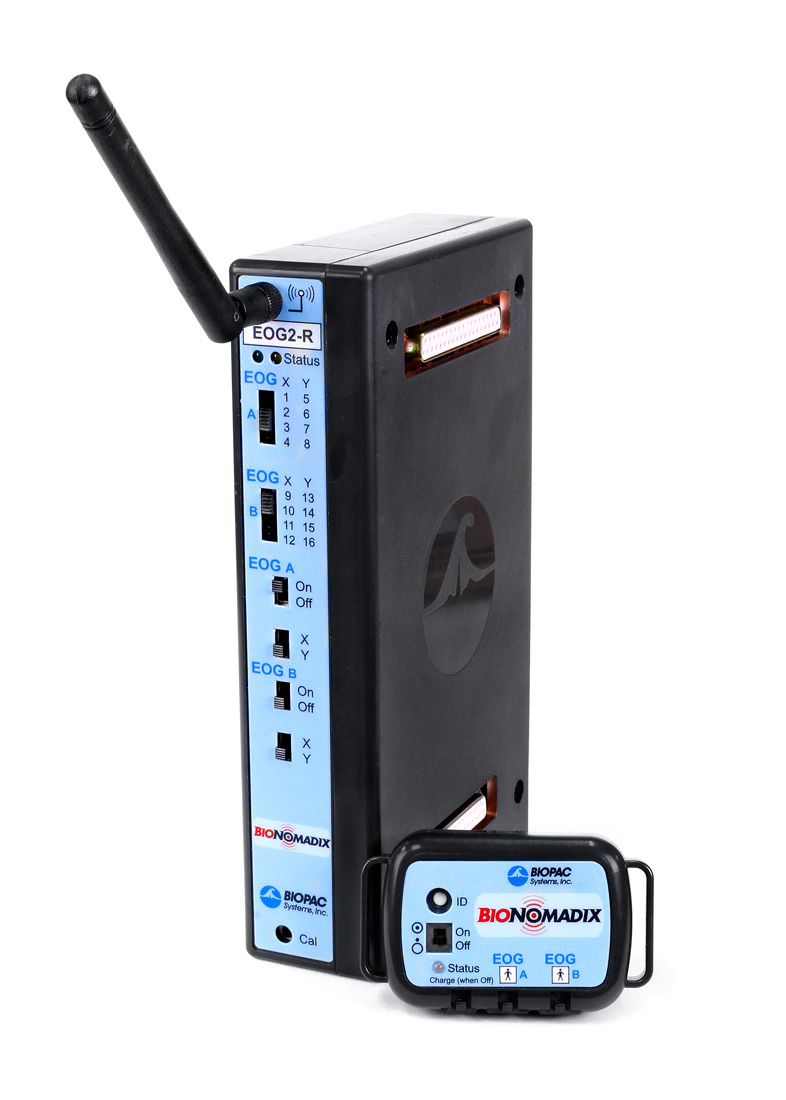
BioNomadix 2Ch Wireless EOG Amplifier

The BN-EOG2 wireless EOG amplifier records eye movements — horizontal, vertical, and radial — with no cable constraints.

BioNomadix · Wireless electrooculography

The BN-EOG2 wireless EOG amplifier records eye movements — horizontal, vertical, and radial — with no cable constraints.

Two independent measurement channels and a hardware Derivative mode for saccade detection, while preserving full freedom of movement for the subject.

Part of a larger system

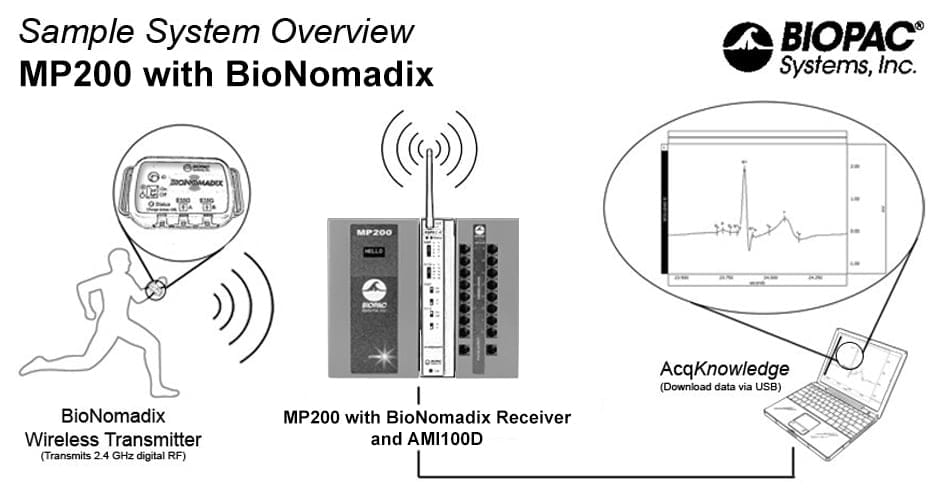
System diagram: BioNomadix transmitter on the subject, receiver in the MP200 unit, analysis in AcqKnowledge

The BN-EOG2 is an expansion module, not a standalone system

The BioNomadix transmitter and receiver alone do not record or store data. Measurement requires an MP200 data acquisition unit (or the earlier MP160/MP150) together with AcqKnowledge software.

The BN-EOG2 receiver connects to an MP200 channel input, and the recorded signal is placed on a shared, synchronized timeline together with other modules — wired and wireless.

Get to know the module up close

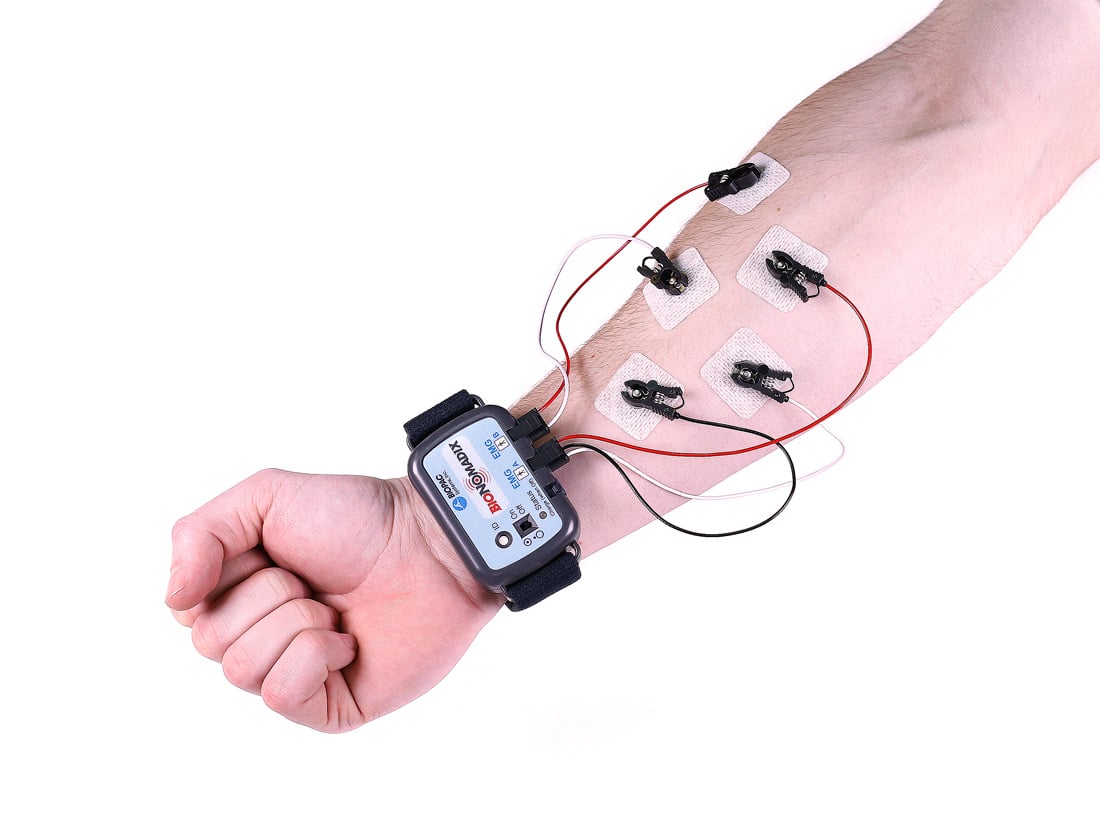
Click the points on the photo to see how the BioNomadix transmitter is worn on the subject and where the cabling connects.

BioNomadix transmitter worn on the wrist, connected to electrodes on the skin — interactive diagram

Key features

Wireless operation

No cable between transmitter and receiver — freedom of head and body movement for the subject during EOG recording.

Hardware Derivative mode

A switch on the receiver converts the raw EOG signal into one proportional to eye movement velocity — making it easier to identify saccades.

CMRR 110 dB

High common-mode rejection (typically 110 dB at 50/60 Hz, min. 90 dB) — a clean recording despite the low amplitude of the EOG signal.

Compact transmitter

Secured with a 76 cm strap (BN-STRAP76), sized approx. 6×4×2 cm — does not restrict the subject's head movement.

0.005-100 Hzmaximum bandwidth
2000 Hztransmission rate
72-90hbattery life
54 gtransmitter weight

Full technical specification

Bandwidth
0.005–100 Hz (max.); factory setting 0.005–35 Hz
Filter options
High-pass: 0.005 or 1 Hz; Low-pass: 35 or 100 Hz (switches on the receiver)
Alternative signal
Derivative mode (signal proportional to eye movement velocity) — switch SW5 on the receiver, replaces the raw signal
Notch filter
50/60 Hz, user switch (SW1/SW2 on the receiver), OFF by default
Noise (shorted inputs)
0.9 µV rms (0.005–100 Hz bandwidth)
Max. measurable input signal
10 mV pk-pk
Output voltage range
±10 V (receiver output)
CMRR
110 dB typical at 50/60 Hz (min. 90 dB)
Gain
Fixed ×2000
Battery life
72–90h of continuous operation
Transmitter weight / dimensions
Approx. 54 g, approx. 6×4×2 cm
Mounting
76 cm Velcro strap (BN-STRAP76)
Transmission range / latency
Up to 10 m (line-of-sight), typically in laboratory conditions; latency: fixed 15.6 ms + variable ±0.5 ms rms
Compatibility
MP200 (and the earlier MP160/MP150) + AcqKnowledge

Where to place the electrodes

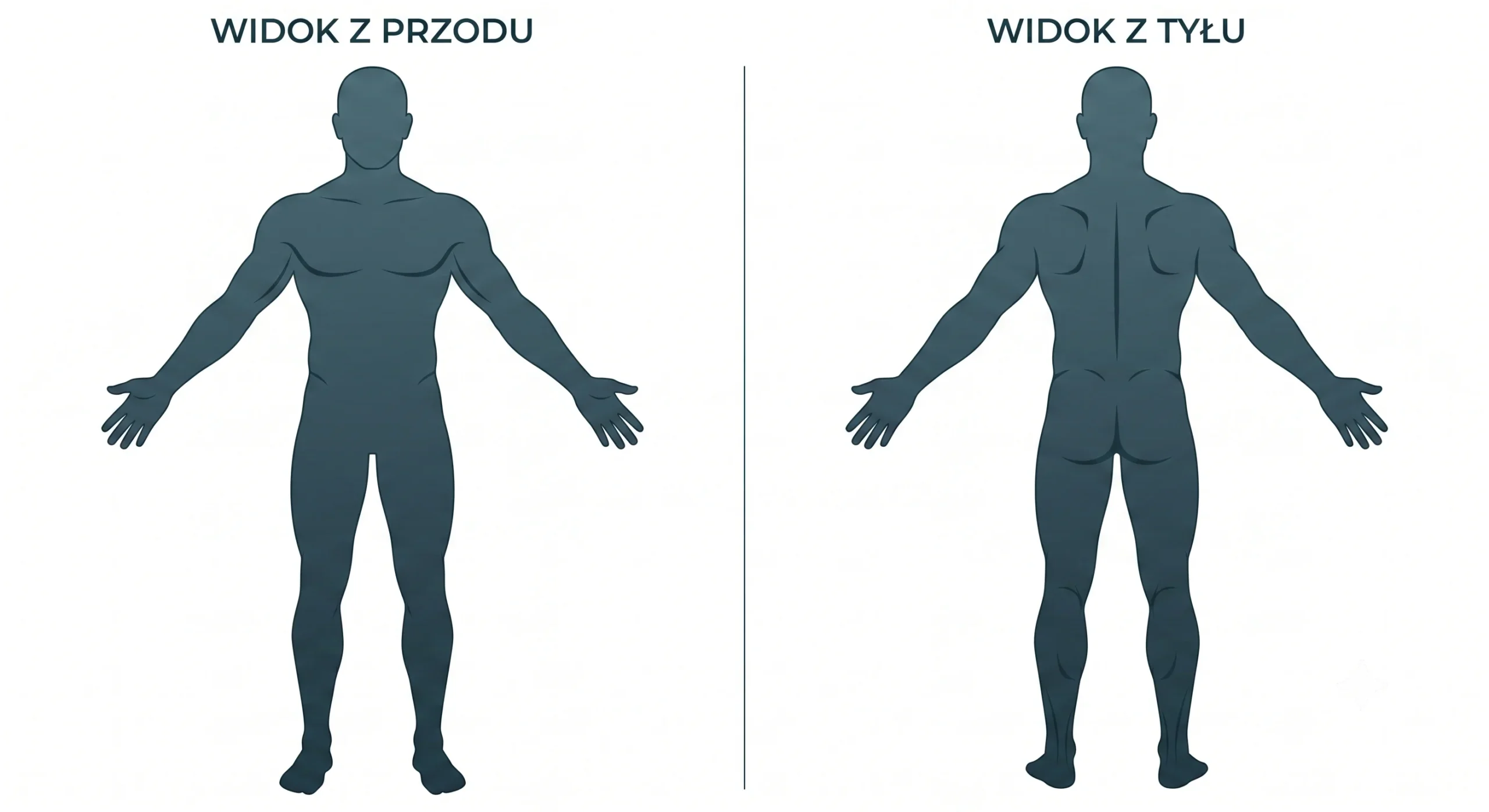
Click the points on the silhouette to see an indicative EOG electrode layout, including the ground electrode.

Active electrodes: indicative, generally accepted physiological convention (near the outer corners of the eyes for horizontal movement) — not explicitly confirmed in BIOPAC materials for this model. The ground electrode (GND) is required — the BioNomadix datasheet explicitly confirms every biopotential transmitter (including the EOG2) requires at least one GND; its exact position is shown indicatively.

General body silhouette — front view, indicative EOG and ground electrode layout

How it works

01

Transmitter on the subject

Electrodes around the eyes record horizontal, vertical, or radial movements; the transmitter is secured with a strap or vest.

02

Receiver + MP200

2.4 GHz wireless transmission at 2000 Hz to the data acquisition system.

03

Analysis in AcqKnowledge

Raw signal or Derivative mode (eye movement velocity) — the basis for identifying saccades and nystagmus.

Experimental applications

Wireless EOG recording enables studying gaze dynamics beyond the classic stationary lab setup, without the constraints of cabling the subject.

VR/AR

Studying eye movements in virtual and augmented reality environments, without cables restricting the subject's head freedom.

Neuromarketing

Mobile studies of visual responses to stimuli in a natural setting, outside a stationary lab.

Biomechanics and occupational medicine

Assessing visual load during work tasks, and analyzing locomotor behavior using saccade detection.

UX/UI

Evaluating user interfaces with gaze dynamics recording, without restrictive cabling on the subject.

Frequently asked questions

Download materials click to expand

Interested in this product?

Contact us for a detailed quote and technical advice.

Related products

Ask about this product

Product: BioNomadix 2Ch Wireless EOG Amplifier