BioNomadix Two-Channel Wireless ECG Amplifier
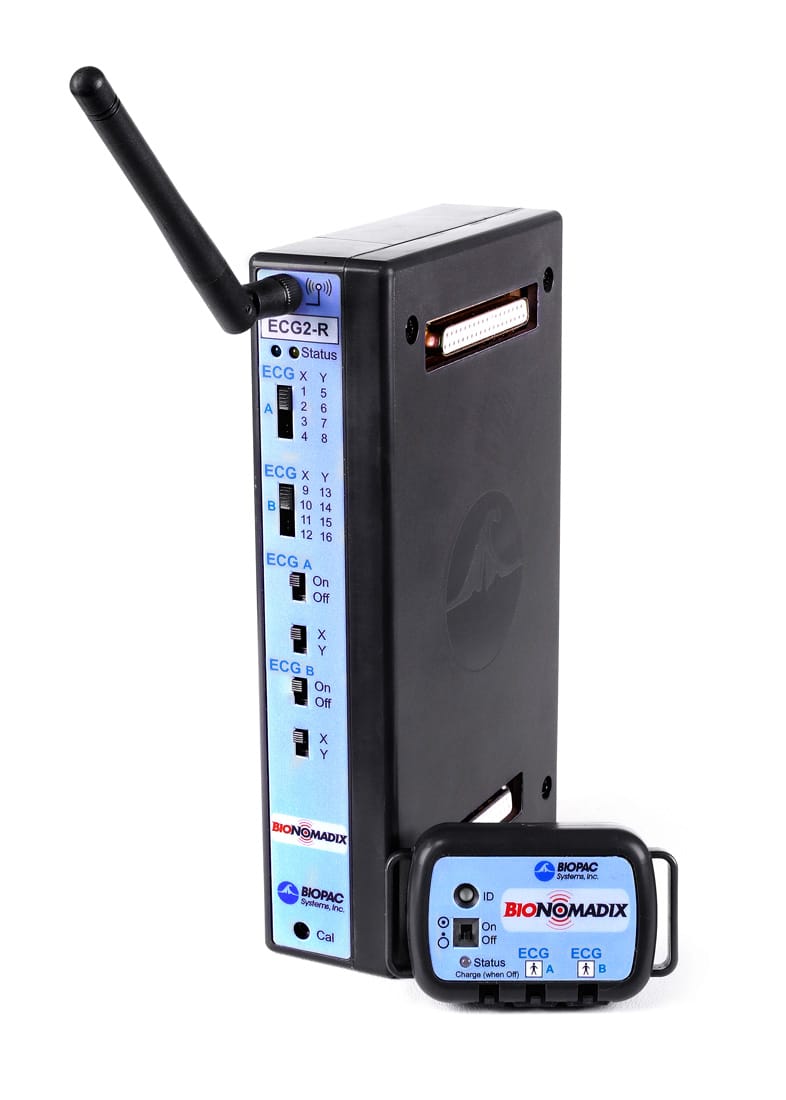
The BN-ECG2 wireless 2-channel ECG amplifier records Leads I and II with no cable restrictions, at a signal quality close to a wired connection.

BioNomadix · Wireless electrocardiography

The BN-ECG2 wireless 2-channel ECG amplifier records Leads I and II with no cable restrictions, at a signal quality close to a wired connection.

Full freedom of movement for the subject while preserving the resolution needed for QRS complex morphology analysis and heart rate variability (HRV).

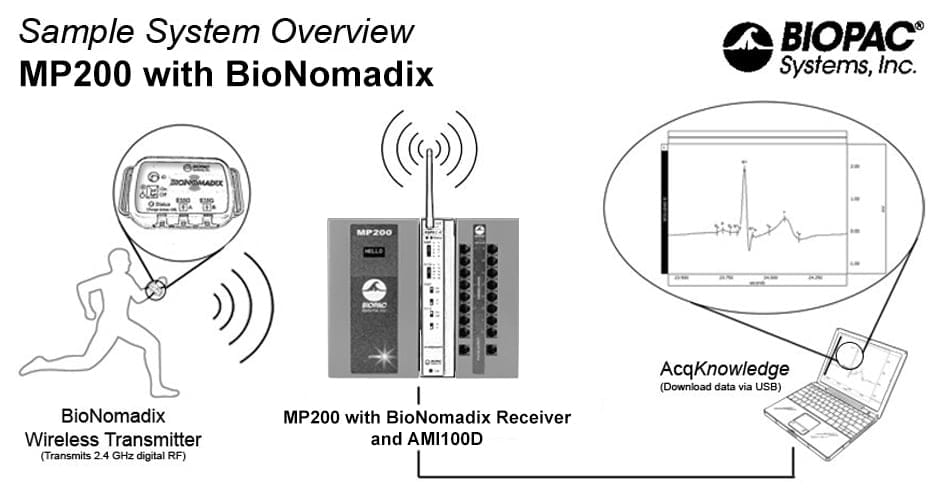
Part of a larger system

System diagram: BioNomadix transmitter on the subject, receiver in the MP200 unit, analysis in AcqKnowledge

BN-ECG2 is an expansion module, not a standalone system

The BioNomadix transmitter and receiver alone do not record or store data. Measurement requires a MP200 data acquisition unit (or an older MP160/MP150) together with AcqKnowledge software.

The BN-ECG2 receiver plugs into an MP200 channel input, and the recorded signal is added to the shared, synchronized timeline together with the system's other modules — wired and wireless.

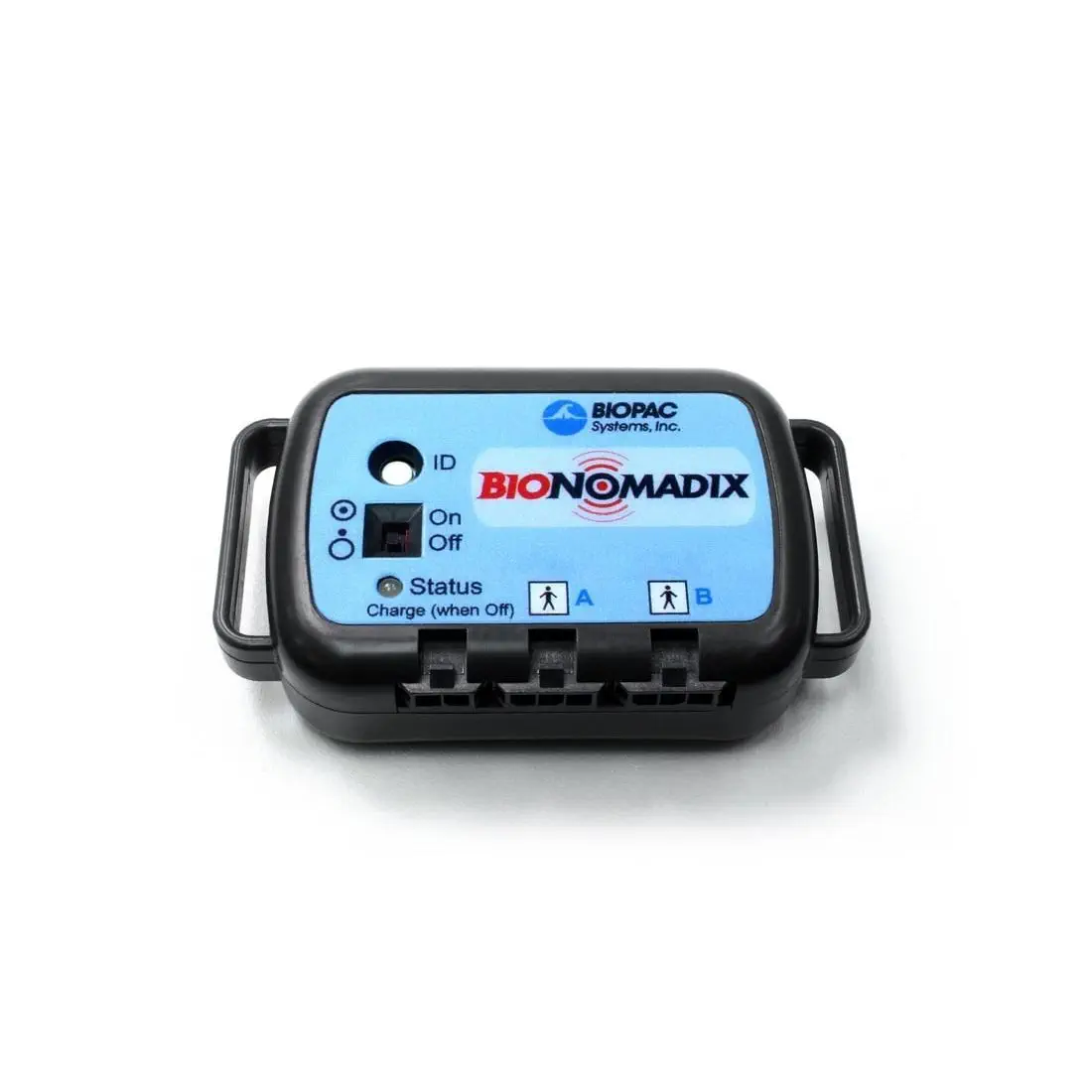
Get to know the module up close

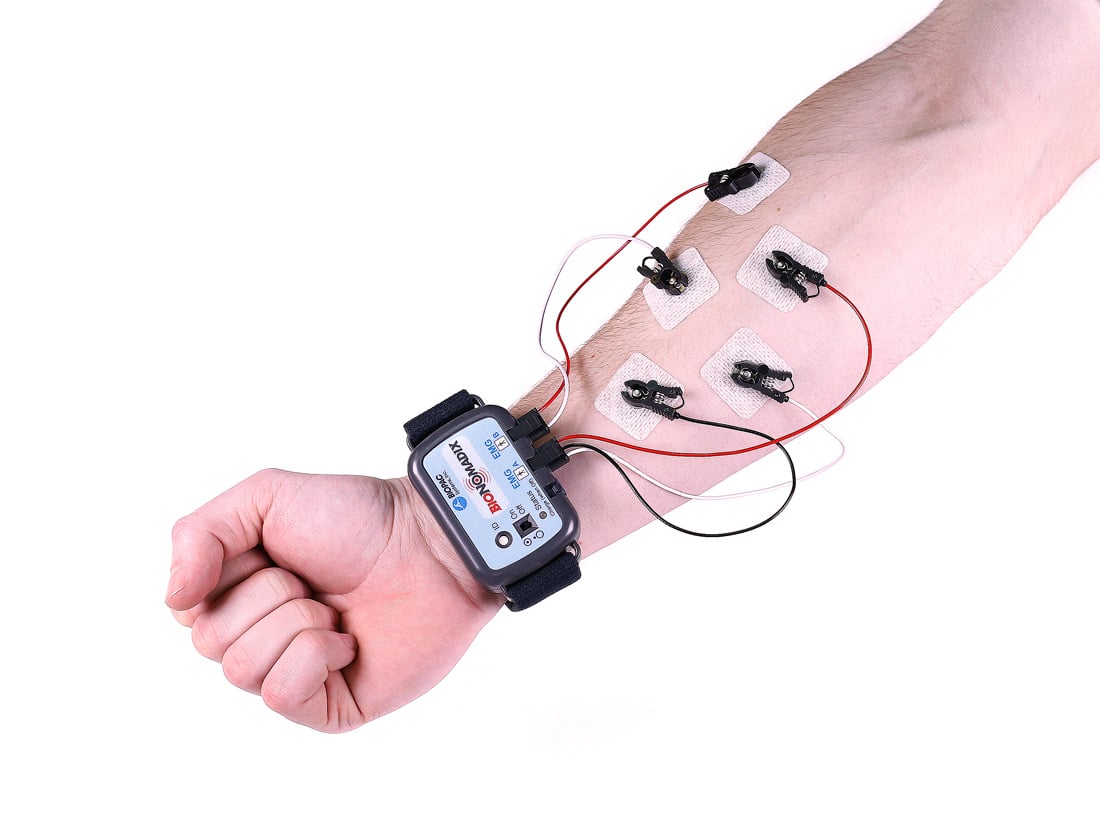
Click the points on the photo to see how the BioNomadix transmitter is worn on the subject and where the cabling connects.

BioNomadix transmitter worn on the wrist, connected to electrodes on the skin — interactive diagram

Key features

Freedom of movement without sacrificing quality

Transmitter worn on the body, receiver connected directly to the MP200/MP160/MP150 — data quality comparable to standard wired BIOPAC modules.

Two independent ECG channels

Simultaneous recording of Leads I and II — AcqKnowledge lets you mathematically derive the remaining limb leads from them.

Low intrinsic noise — 0.9 µV rms

CMRR of typically 110 dB at 50/60 Hz ensures a clean recording even in electrically noisy environments.

Heart Rate mode (alternate signal)

A switch on the receiver module outputs computed heart rate instead of the raw ECG trace — no additional processing needed in software.

2000 Hztransmission rate
0.05-150 Hzmax. bandwidth
72-90hbattery life
10 mrange (line of sight)

Full technical specification

Bandwidth
Max. 0.05 - 150 Hz; factory setting 1 - 35 Hz
Receiver filters
HP: 0.05 Hz or 1 Hz; LP: 35 Hz or 150 Hz (switch on the receiver module)
Gain
Fixed x2000
Max. measurable signal
10 mV pk-pk
Intrinsic noise (shorted inputs)
0.9 µV rms (0.05-150 Hz bandwidth)
CMRR
Typically 110 dB at 50/60 Hz, min. 90 dB
Differential input impedance
2 MΩ
Wireless range
Up to 10 m line of sight, typically in laboratory conditions
Transmission latency
Fixed component of 15.6 ms + variable component of ±0.5 ms rms
Battery life
Up to 72-90h of continuous operation, full charge in approx. 1h
Transmitter weight / dimensions
Approx. 54 g, approx. 6×4×2 cm
Receiver dimensions
Approx. 380 g, approx. 4×11×19 cm
Mounting
137 cm Velcro strap (BN-STRAP-137) included
Compatibility
MP200 (and older MP160/MP150) + AcqKnowledge

Where to place the electrodes

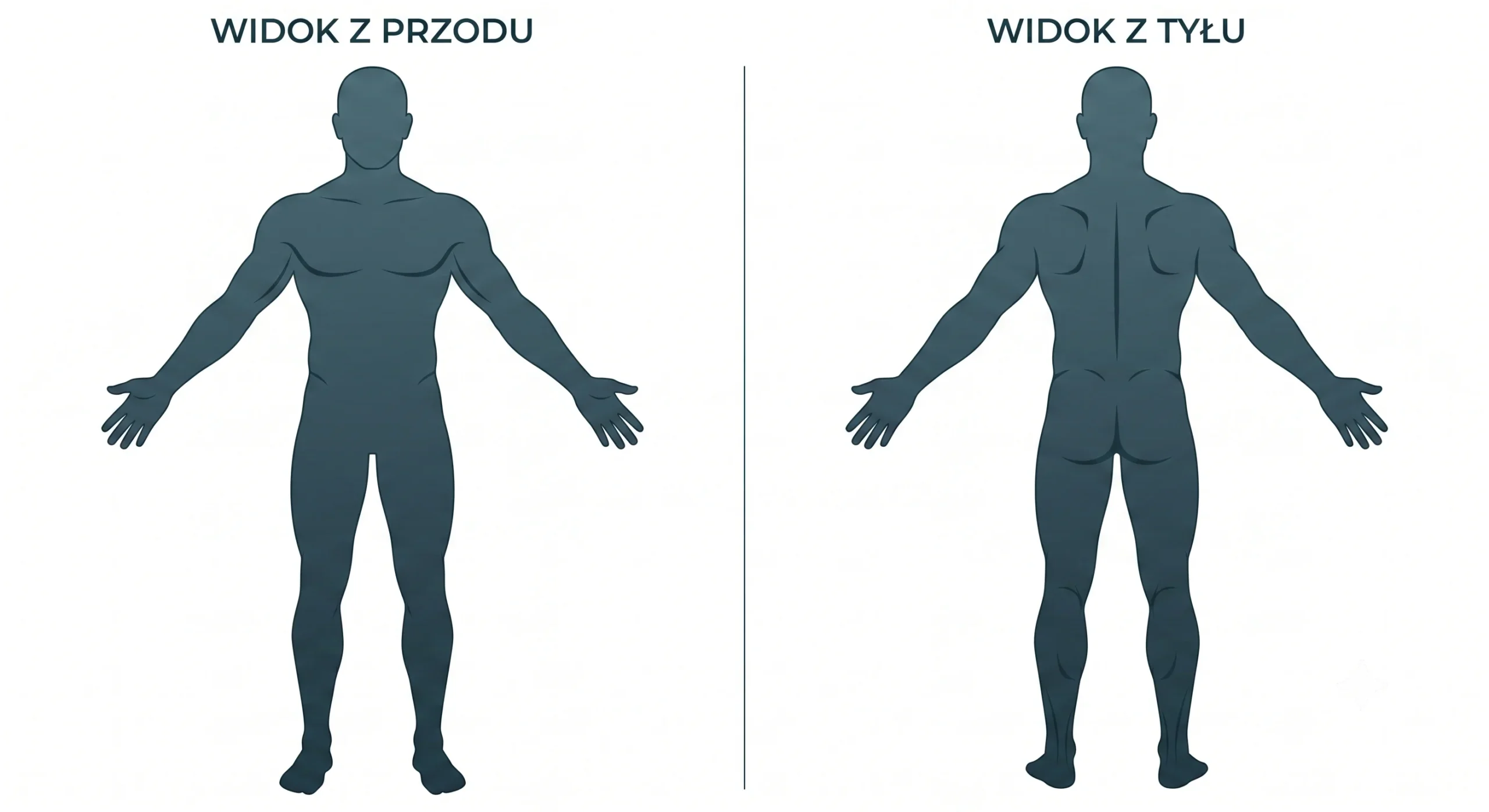
Click the points on the silhouette to see the typical electrode layout for simultaneous recording of Leads I and II, plus the ground electrode.

The BN-ECG2 simultaneously records Leads I and II (Lead III and the augmented leads aVR/aVL/aVF are then derived mathematically in AcqKnowledge) — this requires 3 active electrodes: RA (shared by both leads), LA and LL, plus a ground electrode (GND). Standard BIOPAC layout (Einthoven's triangle), modified for the torso (the short BioNomadix leads do not reach the limbs) — for illustration.

General body silhouette — front view, electrode placement points for ECG (RA, LA, LL) and ground
I II III RA LA LL GND

Einthoven's triangle

The RA, LA and LL electrodes form three limb leads: I (LA−RA), II (LL−RA) and III (LL−LA).

The BN-ECG2 measures I and II directly — Lead III follows mathematically (Einthoven's law: III = II − I), with no extra electrode needed. GND is not part of the triangle — it is a reference electrode that reduces interference.

How it works

01

Transmitter on the subject

Records Leads I and II, worn with a strap or the BioShirt/BN-Shirt garment.

02

Receiver + MP200

Transmission at 2000 Hz to the data acquisition system, up to 10 m line of sight.

03

Analysis in AcqKnowledge

Derivation of the remaining limb leads, P-Q-R-S-T wave detection, HRV analysis.

Experimental applications

Wireless ECG recording removes the movement restriction that cabling imposes, opening up applications not possible with wired amplifiers.

Ambulatory cardiology

ECG recording outside a stationary laboratory setup, with no need to keep the subject fixed at a workstation.

HRV analysis

Studying heart rate variability under stress and motor load, where wired electrodes would rule out the movement involved.

Complex psychophysiology paradigms

Protocols where cables would restrict the subject's natural behavior — free interaction, motor tasks, simulations.

Biomechanics, sport and VR

Synchronous ECG recording during physical activity or in VR simulators, where full freedom of movement matters.

Frequently asked questions

Download materials click to expand

Interested in this product?

Contact us for a detailed quote and technical advice.

Related products

BiometricsECG (Heart Activity)Research & Scientific Instruments

BiometricsECG (Heart Activity)Research & Scientific InstrumentsRSP (Respiration)

Ask about this product

Product: BioNomadix Two-Channel Wireless ECG Amplifier