Field test instruments and fusion splicers for network installers and operators.
100 products in this department
Browse the departmentLaboratory instrumentation for photonics, laser technology and R&D.
222 products in this department
Browse the departmentFiber-optic sensing systems: DAS, DTS, DSS, FBG and OFDR.
80 products in this department
Browse the departmentEye tracking, fNIRS, EEG and biometrics for science and business.
46 products in this department
Browse the departmentHome » Products » Research & Scientific Instruments » Biometrics » Dynamometry (Force & Pressure) » BioNomadix 2Ch Wireless Heel-Toe Strike Transmitter+Receiver
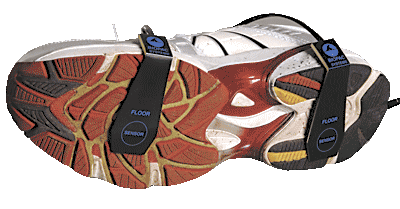
The wireless, 2-channel BN-STRIKE amplifier records the moments of heel and toe strike while walking, with no cable constraints.
Purpose-built for gait analysis and biomechanics — it detects the phases of foot-ground contact on one or both feet of a freely moving subject.
The BioNomadix transmitter and receiver alone do not record or store data. Measurement requires an MP200 data acquisition unit (or the earlier MP160/MP150) together with AcqKnowledge software.
BN-STRIKE also requires a separately ordered BN-STRIKE-XDCR transducer (heel/toe pressure sensors). The receiver plugs into an MP200 channel input, and the recorded signal is added to the shared, synchronized timeline alongside the system's other modules.
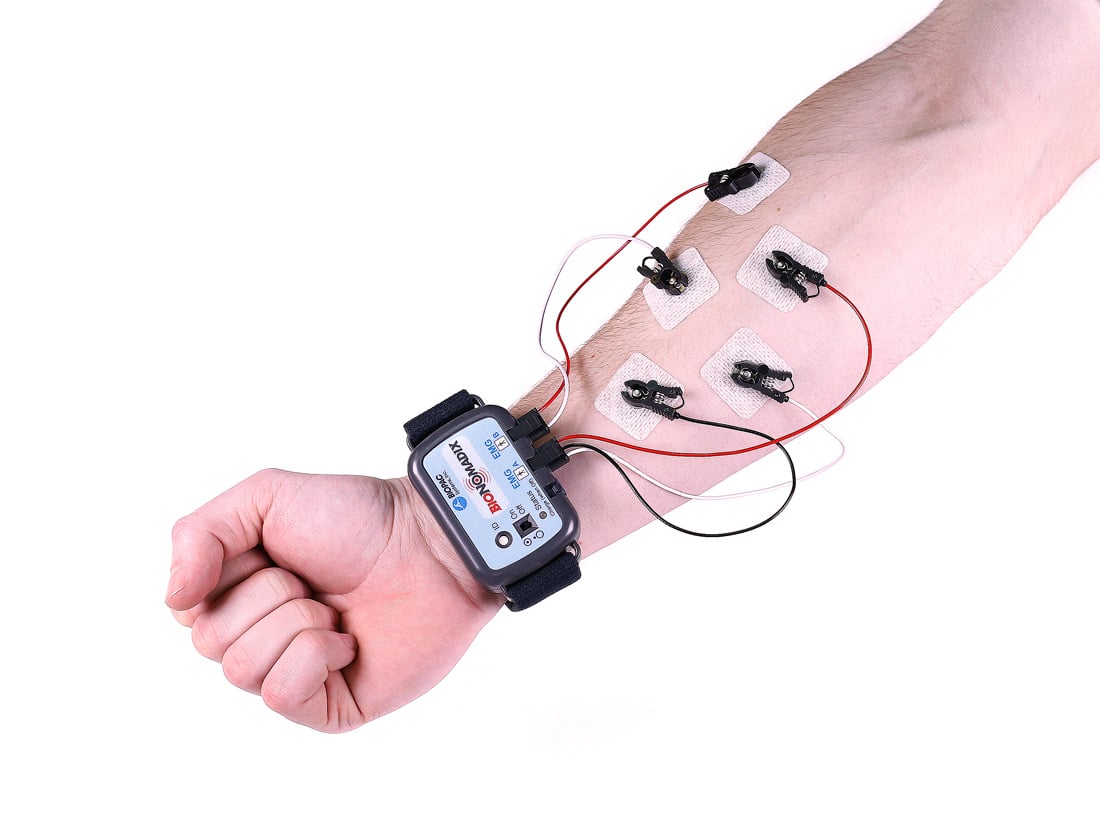
Click the points on the photo to see how the BioNomadix transmitter is worn on the subject and where the cabling connects.
A compact wireless module — mounted close to the measurement site, it sends the signal to the receiver at the MP200/MP160/MP150.
An adjustable Velcro strap secures the transmitter on the subject's body without restricting natural movement.
A multi-pin connector on the transmitter — this is where the cabling to the electrodes or transducer is attached.
Color-coded leads connect the transmitter to the electrodes or the transducer applied at the measurement site.
No cable between the subject and the acquisition system — the subject moves naturally over any distance within the receiver's range, without the constraints typical of wired sensors.
BN-STRIKE is only the transmitter-receiver. Signal acquisition requires a separately ordered BN-STRIKE-XDCR transducer with two FSR pressure sensors — one under the heel, one under the toes.
Independent signals from the heel and toe sensors make it possible to identify heel strike and toe-off moments in the gait cycle — the basis of gait phase analysis in biomechanics and sports science.
Unlike modules worn on the torso, the BN-STRIKE transmitter attaches near the subject's ankle, close to the measurement point, and connects by cable to the transducer on the foot.
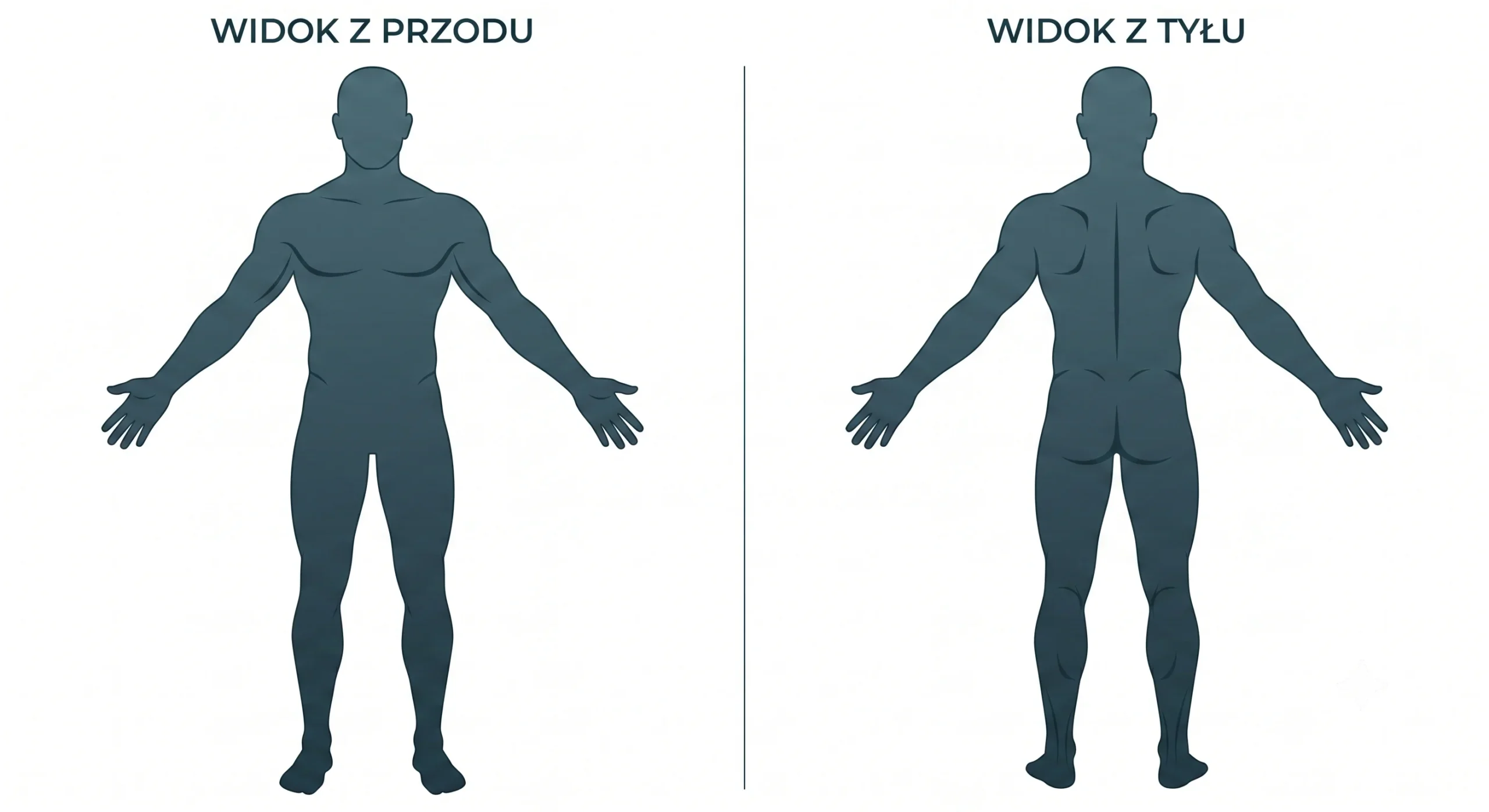
Click the point on the silhouette to see where the BN-STRIKE-XDCR transducer is mounted.
Location confirmed in BIOPAC materials for this product (transmitter on the ankle, transducer with FSR sensors under the heel and toes).
Two FSR pressure sensors — one under the heel, one under the toes. The transmitter is mounted separately on the ankle, connected to the transducer by cable.
Two FSR sensors — under the heel and under the toes — connected by cable to the transmitter mounted on the ankle.
Wireless transmission at 2000 Hz to the data acquisition system, with a range of up to 10 m in line of sight.
Identification of heel strike and toe-off moments and determination of gait cycle phases on both channels.
Wireless measurement of heel and toe strike supports studies where a natural gait pattern, unconstrained by cables, matters most.
Determining foot-ground contact phases — heel strike and toe-off — in the gait cycle of a freely moving subject.
Synchronizing foot strike moments with other biomechanical signals recorded simultaneously in the MP system.
Evaluating stepping patterns and the dynamics of foot-ground contact during athletic activity.
Recording foot contact events as a time marker in studies combining movement parameters with physiological signals.
No. BN-STRIKE is only the wireless amplifier/transmitter-receiver. Measurement requires a separately ordered BN-STRIKE-XDCR transducer, fitted with two FSR pressure sensors (heel and toe), which connects to the transmitter mounted on the subject's ankle.
BN-STRIKE has two independent channels, which can be used to measure the heel and toe of one foot, or — depending on the transducer configuration — both of the subject's feet.
On the subject's ankle, close to the BN-STRIKE-XDCR transducer on the foot — unlike other BioNomadix modules mounted on the torso (e.g. ECG, EMG).
MP200, as well as the earlier MP160/MP150, within the AcqKnowledge environment.
Related products
BiometricsECG (Heart Activity)Research & Scientific Instruments
BiometricsDynamometry (Force & Pressure)EMG (Muscle Activity)Research & Scientific Instruments
BiometricsEMG (Muscle Activity)Research & Scientific Instruments
Product: BioNomadix 2Ch Wireless Heel-Toe Strike Transmitter+Receiver