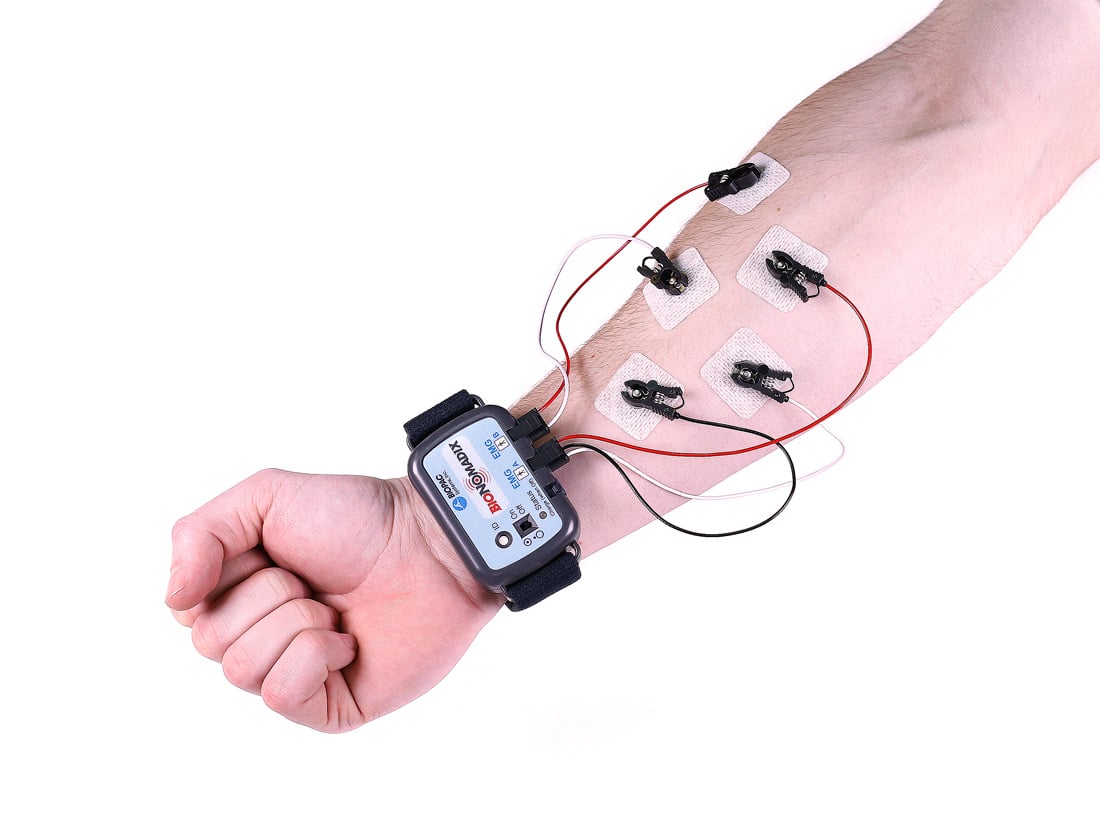
Field test instruments and fusion splicers for network installers and operators.
100 products in this department
Browse the departmentLaboratory instrumentation for photonics, laser technology and R&D.
222 products in this department
Browse the departmentFiber-optic sensing systems: DAS, DTS, DSS, FBG and OFDR.
80 products in this department
Browse the departmentEye tracking, fNIRS, EEG and biometrics for science and business.
46 products in this department
Browse the departmentHome » Products » Research & Scientific Instruments » Biometrics » PPG / SpO2 (Pulse & Saturation) » BioNomadix Wireless PPG and EDA Amplifier
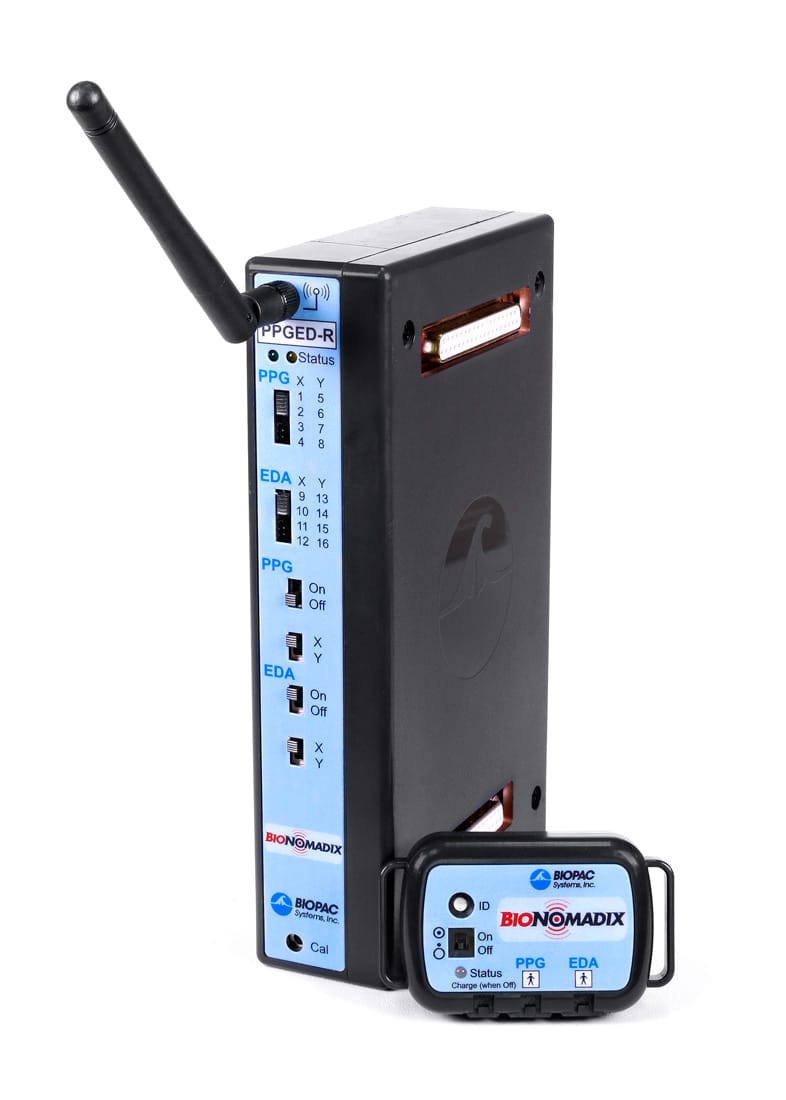
The BioNomadix PPG+EDA module combines pulse (PPG) and skin conductance (EDA) measurement in a single wireless transmitter.
Two key indicators of autonomic nervous system arousal, recorded simultaneously and without cable constraints.
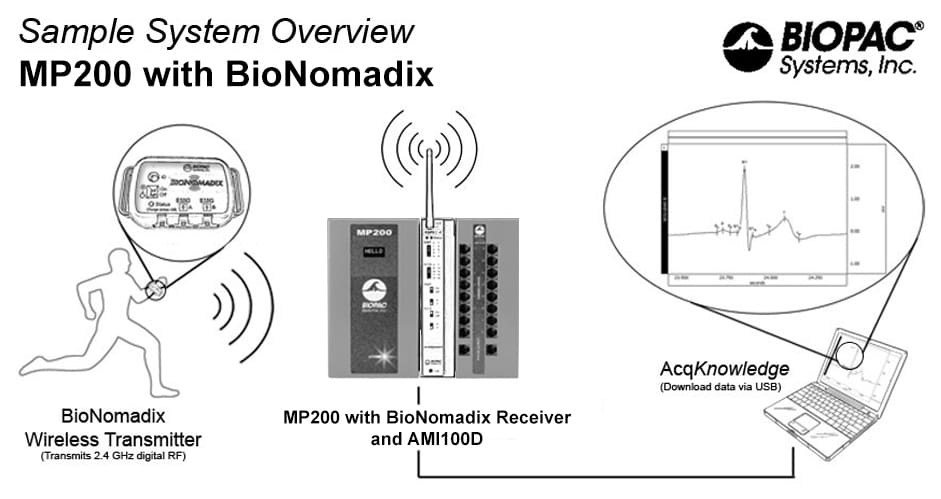
The BioNomadix transmitter and receiver alone do not record or store data. Measurement requires an MP200 data acquisition unit (or the older MP160/MP150) together with AcqKnowledge software.
The BioNomadix PPG+EDA receiver plugs into an MP200 channel input, and the recorded signal is placed on a shared, synchronized timeline together with other modules — both wired and wireless.
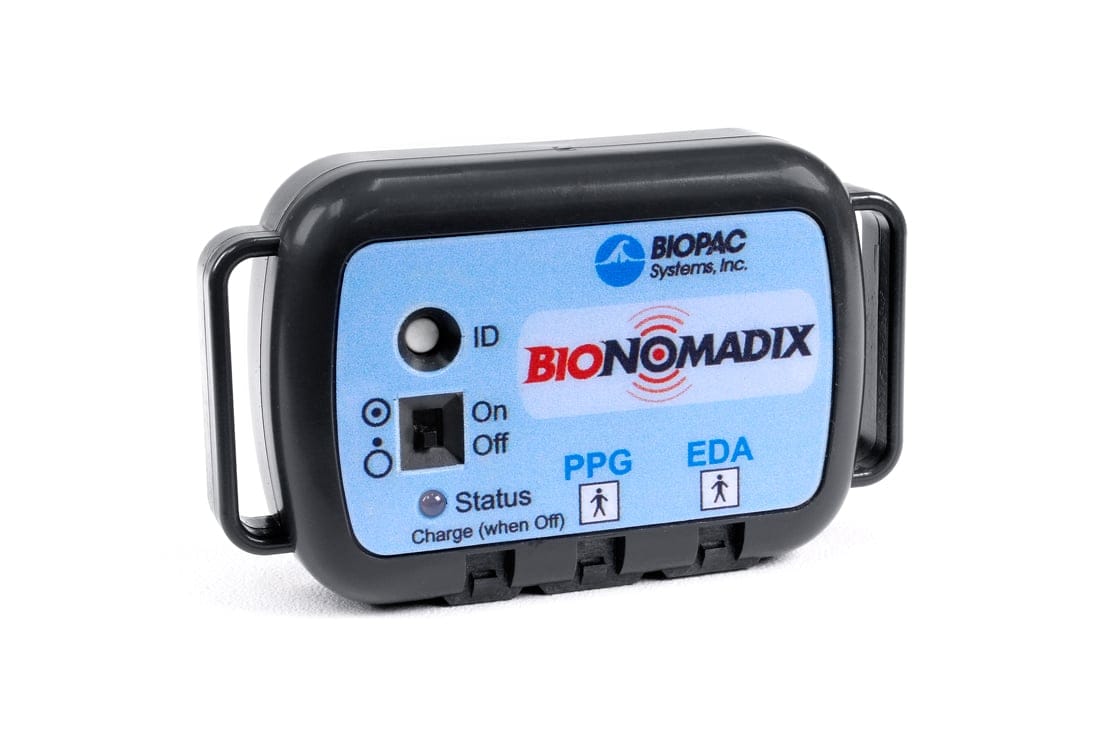
Click the points on the photo to see how the BioNomadix transmitter is worn on the subject and where the cabling connects.
A compact wireless module — mounted close to the measurement site, it sends the signal to the receiver at the MP200/MP160/MP150.
An adjustable Velcro strap secures the transmitter on the subject's body without restricting natural movement.
A multi-pin connector on the transmitter — this is where the cabling to the electrodes or transducer is attached.
Color-coded leads connect the transmitter to the electrodes or transducer placed at the measurement site.
One transmitter, two independent physiological signals recorded simultaneously.
The built-in battery enables continuous recording with no charging breaks.
Optional mains interference reduction without loss of signal quality.
Designed for research in VR, neuromarketing, and UX, where cables would restrict the subject's natural behavior.
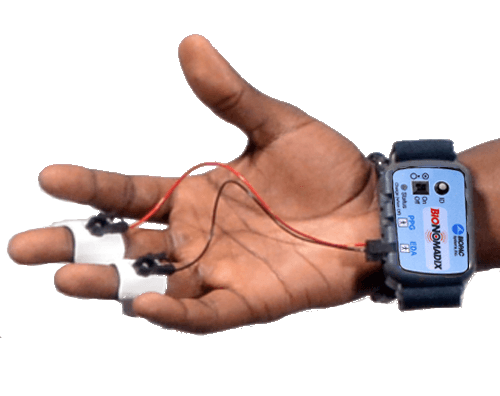
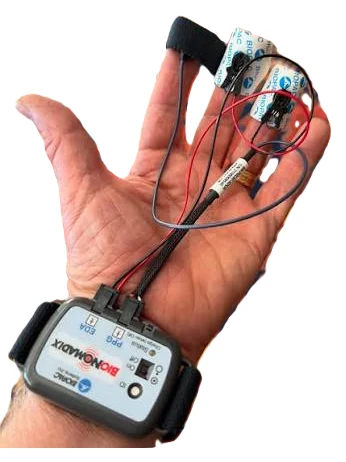
Click the points on the photo to see the typical placement of the PPG transducer and EDA electrodes.
Locations confirmed in BIOPAC materials for these transducers (Pulse Transducer, EDA Electrode & Recording Preparation). EDA does not require a ground electrode — the BioNomadix datasheet explicitly excludes this connection for EDA.
Fingertip (here: index finger), secured with a band. Alternatively, an earlobe clip.
Inner side of the middle phalanges of two fingers on the non-dominant hand. Does not require a ground electrode.
EDA and PPG connectors are labeled directly on the housing — the leads run to the electrodes/transducer on the fingers.
Simultaneous measurement of PPG (pulse) and EDA (skin conductance) in a single module.
Wireless transmission to the MP200, MP160, or MP150.
HRV, arousal level (SCL/SCR), and their correlation in real time.
Simultaneous, non-invasive measurement of pulse (PPG) and skin conductance (EDA) is a standard approach in studying autonomic nervous system responses to stimuli and levels of emotional arousal.
Assessing emotional response to stimuli — advertisements, products, interfaces — through simultaneous measurement of pulse and skin conductance, with no cable constraints for the subject.
Because the system pairs separate wireless modules, physiological responses of several participants can be monitored simultaneously side by side — for example, in studies of social interaction.
The absence of cables allows physiological arousal to be recorded during natural movement in VR simulators, without limiting the subject's immersion.
Correlating HRV and arousal level (SCL/SCR) at workstations allows objective assessment of the subject's workload and stress.
Neuromarketing, UX/Human Factors, virtual reality research, and assessment of emotional arousal levels — anywhere the subject's freedom of movement matters.
No. Transmitter-receiver communication is fully wireless, and the receiver connects directly to the MP200/MP160/MP150.
No — it's optional. Most applications do not require enabling it.
Related products
Eye TrackingMobile (Glasses)Research & Scientific Instruments
AccessoriesEye TrackingResearch & Scientific Instruments
Product: BioNomadix Wireless PPG and EDA Amplifier