Field test instruments and fusion splicers for network installers and operators.
100 products in this department
Browse the departmentLaboratory instrumentation for photonics, laser technology and R&D.
222 products in this department
Browse the departmentFiber-optic sensing systems: DAS, DTS, DSS, FBG and OFDR.
80 products in this department
Browse the departmentEye tracking, fNIRS, EEG and biometrics for science and business.
46 products in this department
Browse the departmentHome » Products » Research & Scientific Instruments » Biometrics » EOG (Electrooculography) » Wired EOG amplifier (BIOPAC EOG100D)
A wired electrooculogram (EOG) amplifier from the BIOPAC Smart Amplifier series — measurement electronics at the electrode reduce EMI and motion artifacts, and acquisition parameters configure automatically in AcqKnowledge. Requires the AMI100D interface and an MP160 or MP200 unit (not MP150), plus AcqKnowledge 5.0.4 or newer.
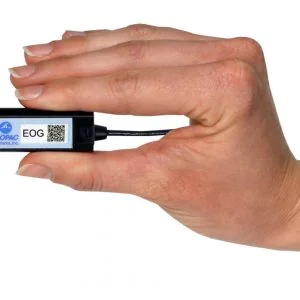
The EOG100D is an amplifier from the Smart Amplifier series for electrooculogram (EOG) measurement — the measurement electronics sit directly at the electrode, rather than in a module by the acquisition unit.
Because the converter is located so close to the source, the signal is less susceptible to electromagnetic interference (EMI) and motion artifacts, and acquisition parameters configure automatically in AcqKnowledge once the module is connected.
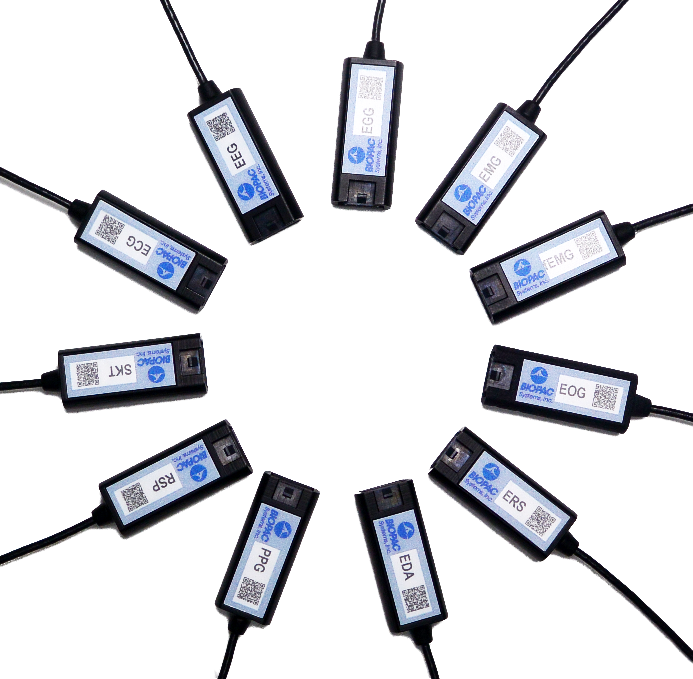
Reference photo of the whole Smart Amplifier 100D family — the EOG100D module has an identical housing.
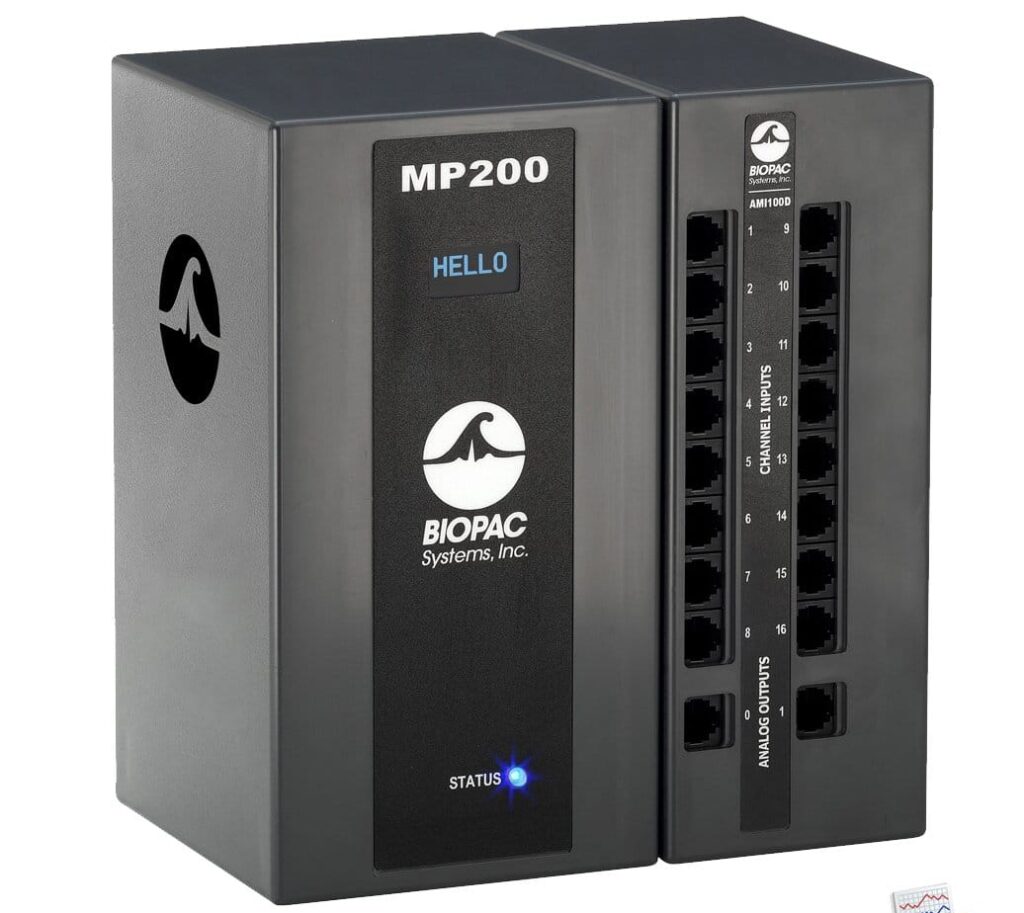
The EOG100D module by itself does not record or store data. It requires connection via the AMI100D interface to an MP160 or MP200 data acquisition unit (Smart Amplifier modules do NOT work with the MP150), together with AcqKnowledge version 5.0.4 or newer.
Measurement also requires a universal biopotential lead BN-EL*-LEAD2/LEAD3 — the same one used by the other biopotential modules in this series (ECG100D, EMG100D). There is no dedicated EOG lead — see the section below for details.
EOG100D is the amplifier alone — measurement requires a separately ordered electrode lead and electrodes. Unlike some other modules in this series, EOG100D has no dedicated EOG lead — it uses the same universal biopotential lead as the other biopotential modules (ECG100D, EMG100D).
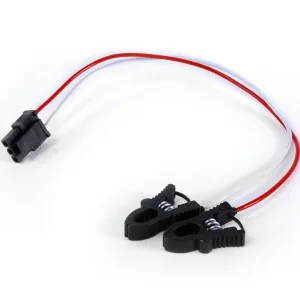
Manufacturer photo (BIOPAC) — BN-EL-LEAD2 biopotential lead, shared across ECG/EMG/EOG/EGG/EEG.
BN-EL*-LEAD2 / BN-EL*-LEAD3
The same general-purpose electrode lead used by the ECG100D and EMG100D modules — there is no separate, dedicated EOG lead. Used with standard Ag/AgCl biopotential electrodes.
The Smart Amplifier architecture places the amplifier right at the electrode — significantly reducing EMI interference and motion artifacts compared with a traditional module located at the acquisition unit.
Once connected, the module automatically configures acquisition parameters in AcqKnowledge — no manual switch settings required.
AcqKnowledge can compute a derivative-of-EOG (velocity) signal using an IIR bandpass filter with a 30 Hz center frequency and Q=0.8 — supporting automatic saccade and nystagmus detection, implementing in software the concept known from the older EOG100C module's "Derivative of EOG" mode.
Do not use gold-plated contact electrodes — their high input impedance causes charge build-up and distorts the EOG signal.
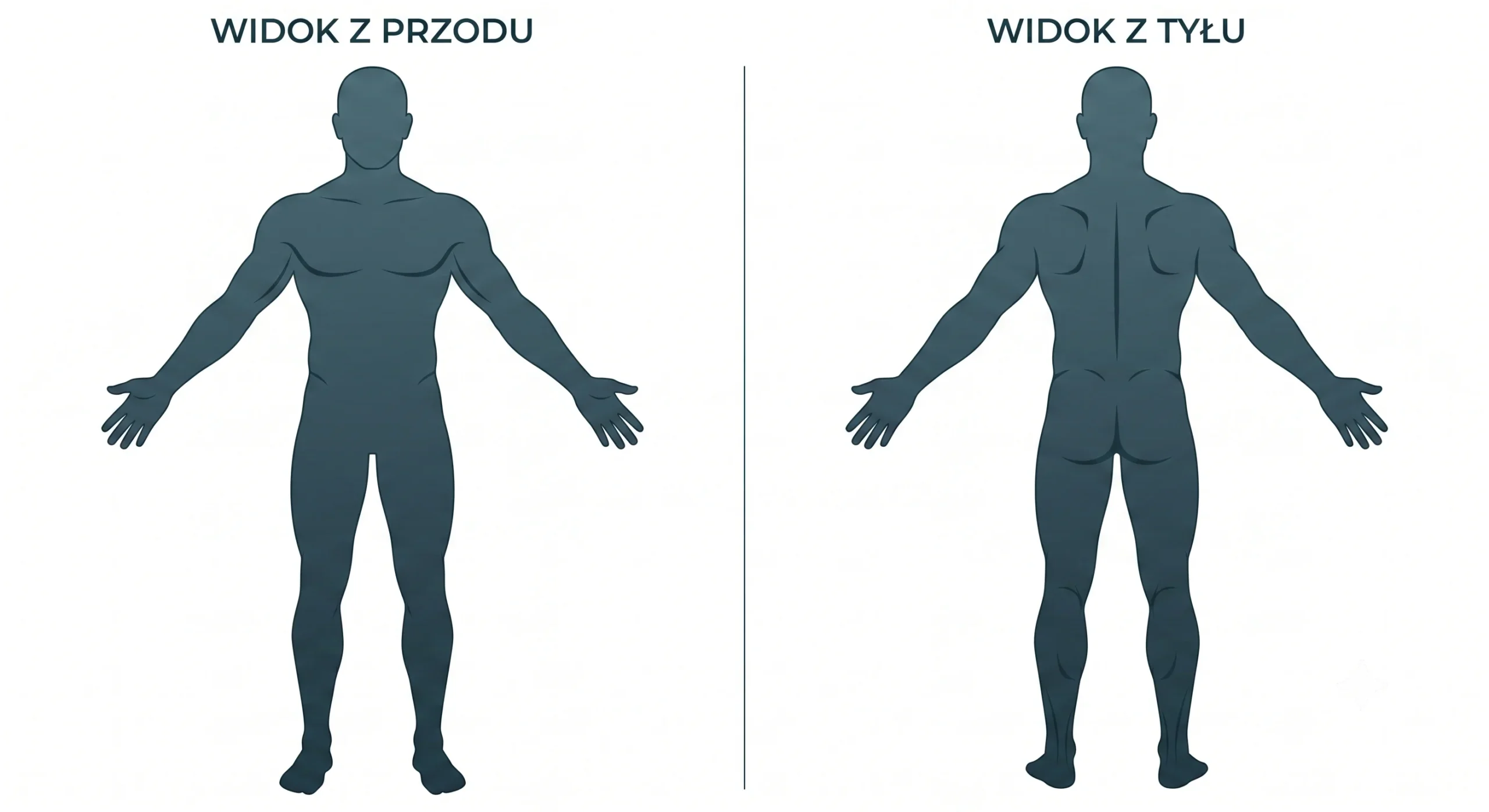
Click the points on the silhouette to see the approximate EOG electrode layout together with the ground electrode.
Active electrodes: approximate, generally accepted physiological standard (around the outer corners of the eyes for horizontal movement) — not explicitly confirmed in BIOPAC materials for this model. A ground (GND) electrode is typically required in biopotential measurements of this kind — for the EOG100D module itself this has not been explicitly confirmed in the available source materials; the exact position shown is approximate.
Around the outer corner of the left eye — generally accepted site for recording horizontal eye movements.
Around the outer corner of the right eye — together with the left-eye electrode it forms the horizontal movement recording channel. The exact layout (horizontal/vertical, blinks) is chosen to fit the study protocol.
Reference electrode, typically required in biopotential measurements of this kind — for the EOG100D module this has not been explicitly confirmed in the available source materials. The exact position on the face/forehead is approximate.
Ag/AgCl electrodes placed around the eyes, connected via the universal biopotential lead BN-EL*-LEAD2/LEAD3 to the EOG100D module.
The module amplifies the signal right at the electrode and sends it over an RJ12 cable to the AMI100D interface, and from there to the acquisition unit.
Recording of the raw EOG signal or the derivative (velocity) mode supporting automatic saccade and nystagmus detection.
EOG measurement supports research into eye movements, sleep stages, and gaze-controlled interfaces.
Recording fast eye movements (saccades) in perceptual and cognitive experiments.
Detecting REM sleep based on characteristic eye movements during sleep.
Using the EOG signal as a control channel in brain-computer interface research.
Analyzing eye movements as an indicator of the direction and dynamics of visual attention.
EOG100D places the amplifier directly at the electrode (instead of in a module at the acquisition unit), which reduces EMI interference and motion artifacts, and automatically configures parameters in AcqKnowledge. It also requires the AMI100D interface and an MP160/MP200 unit (not the MP150), unlike the older 100C series. The "Derivative of EOG" mode concept (a derivative/velocity signal for saccade and nystagmus detection) exists in both generations, but in EOG100D it is implemented in software — via an IIR filter in AcqKnowledge — rather than a hardware switch as in the EOG100C.
No. EOG100D uses the same universal biopotential lead (BN-EL*-LEAD2/LEAD3) used by the ECG100D and EMG100D modules. There is no separate, dedicated EOG lead — this is a confirmed fact, not a documentation gap.
Only the MP160 or MP200, via the AMI100D interface, with AcqKnowledge software version 5.0.4 or newer. It does not work with the MP150.
Related products
Biometrics AccessoriesResearch & Scientific Instruments
BiometricsGSR / EDA (Skin Conductance)PPG / SpO2 (Pulse & Saturation)Research & Scientific Instruments
Product: Wired EOG amplifier (BIOPAC EOG100D)