
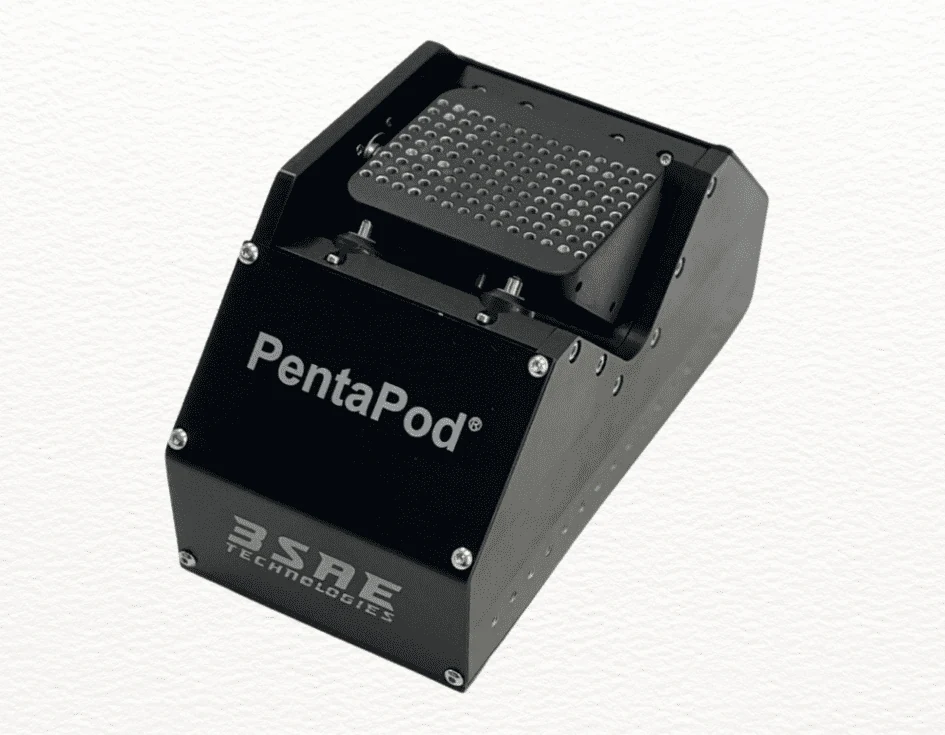
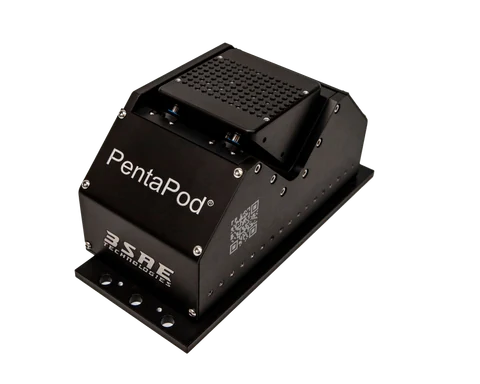
3SAE PentaPod positioner — black housing with a threaded mounting platform 6 axes · integrated controller

3SAE PentaPod®

Multi-axis positioner for photonic alignment

PentaPod is a parallel-kinematic positioner with six degrees of freedom (XYZ and three rotations). The controller is built into the housing, eliminating the need for a separate control cabinet. The PPD-01-0130 version also provides Ethernet with PoE and two analog measurement inputs. Designed for silicon photonics testing and assembly, it is suitable for both laboratory and production environments.

  • 6 axes with a programmable virtual pivot point.
  • Built-in multi-channel scanning and alignment routines.
  • Coupling repeatability of ±0.02 dB (typical).
  • Integrated fanless controller for cleanroom applications.
  • MTBF of 20,000 hours; actuator replacement in approximately 20 minutes.
6DOF positioner

Six axes in one compact module

Three linear axes (X, Y, Z) and three rotations (θX, θY, θZ). The virtual pivot point is software-configurable over a range of up to 8 m in X, Y and Z.

Video: “Scaling Solved: The 3SAE PentaPod® Multi-Axis Positioner”. Source: 3SAE Technologies YouTube channel.

Linear motion along X

Independent travel range
+3.0 / −6.0 mm
Minimum incremental motion
0.05 µm
Maximum velocity
3.6 mm/s
Unidirectional repeatability
0.2 µm
Bidirectional repeatability
0.5 µm

Values from the 3SAE datasheet. Centered load capacity: up to 2 kg; stiffness: 24 N/µm.

Parallel kinematics

Laboratory precision, production-line robustness

PentaPod is a photonic alignment microrobot, rather than a conventional stack of stages or a hexapod. According to 3SAE, its patented parallel-kinematic design eliminates the 24 rotary bearing sets of traditional Stewart-platform hexapods, delivering high stiffness, short settling times and low crosstalk between axes.

The technology was developed in 2016 and integrated into the PentaPod Fusion Splicer in 2019. It has been used in high-volume manufacturing for years.

  • wafer probing
  • chip testing
  • binning
  • silicon photonics assembly
PentaPod on a mounting plate — side view of the housing and platform
Platform with an M3 threaded hole grid
01

Fast, automated alignment

Built-in scanning and optimization routines support multiple channels, with simultaneous input and output optimization. Alignment can be configured for different optical-axis orientations, including grating and edge couplers. Real-time tracking supports compensation for thermal stress and curing shrinkage.

02

Integrated controller

The integrated fanless controller saves rack space. A USB-C or Ethernet connection simplifies integration and reduces the moving cable bundle around the stage.

03

Designed for cleanroom use

No fans or sweeping cables around the stage. Its 197 cm² footprint saves valuable production space. Platform-independent ASCII commands simplify programming and integration.

04

Stability and safety

The stepper-drive design does not require servo tuning. 3SAE describes the design as eliminating servo oscillation and runaway; Intelligent Initialization™ is designed to prevent hazardous motion of long fixtures.

PentaPod stages are also used in the 3SAE PFS.

Measured performance

Parameters that determine alignment performance and equipment uptime.

±0.02dBcoupling repeatability (typical, fully randomized)
20,000hMTBF — mean time between failures
20minMTTR — actuator replacement, typically on site
24N/µmstiffness
0.05µmminimum incremental motion in X, Y and Z
21salignment from a random 50 µm window (65 s for 100 µm)

Technical specifications

Travel range

Degrees of freedom
6 (X, Y, Z, θX, θY, θZ)
X travel range
+3.0 / −6.0 mm
Y, Z travel range
±6.0 mm
θX, θY, θZ travel range
±100 mrad
Virtual pivot point
software-configurable over 8 m in X, Y and Z

Resolution and repeatability

Minimum incremental motion X, Y, Z
0.05 µm
Minimum incremental motion θX, θZ / θY
1.7 µrad / 3.4 µrad
Unidirectional repeatability X, Y / Z
0.2 µm / 0.3 µm
Unidirectional repeatability θX, θY, θZ
10 µrad
Bidirectional repeatability X, Z / Y
0.5 µm / 1 µm
Bidirectional repeatability θX, θZ / θY
20 µrad / 40 µrad

Dynamics and load capacity

Maximum velocity X, Z / Y
3.6 mm/s / 2.4 mm/s
Maximum velocity θX, θZ / θY
78 mrad/s / 117 mrad/s
Centered load capacity
2000 g
Stiffness
24 N/µm
Actuator type
stepper

Optical alignment

Coupling repeatability
±0.02 dB typical (fully randomized)
Alignment time, random 50 µm window
21 s
Alignment time, random 100 µm window
65 s
Optimization
multi-channel, simultaneous input and output optimization
Tracking
real-time, on demand

Controller and communication

Controller
integrated, fanless
Photocurrent input (PPD-01-0130)
50 Ω (SMB), 2 kHz sampling, 20 kHz analog bandwidth
Amplifier
integrated TIA, logarithmic response over 7 decades
Interfaces
USB-C; Ethernet with PoE (USB & Ethernet version); optional EtherCAT
Software
GUI, platform-independent ASCII commands and libraries; LabVIEW source code available from the manufacturer

Construction and reliability

Dimensions (W × D × H)
215.0 × 91.7 × 101.5 mm
Weight
approximately 2 kg
Stage footprint
197 cm²
Power supply
18 V DC, 4 A
MTBF / MTTR
20,000 h / 20 min
PPD-01-0125

PentaPod® (6 axes) — USB

Carriage platform with an M3 threaded hole grid, control software, USB Type A/C cable, power supply, electronic user manual and a one-year manufacturer's warranty covering parts and labor.

PPD-01-0130

PentaPod® (6 axes) — USB & Ethernet

Includes the above, plus integrated Ethernet with PoE and two analog input channels.

Source: 3SAE PentaPod datasheet (PDF, English) and the 3SAE Technologies product page. Specifications are subject to change without notice.

PentaPod vs. hexapods

Both designs provide six axes and a virtual pivot point. The comparison below summarizes 3SAE's claims; hexapod features vary by model and configuration.

FeaturePentaPod®Hexapods (Stewart platform)
Scanning and alignmentbuilt invaries by model
Controllerintegratedoften separate; varies by model
Cablingsingle USB-C or Ethernet connectiondepends on the model and controller
Fannonedepends on the controller model
Tuningnot requiredon application or load changes
Oscillation and runawayeliminated by design, according to 3SAEdepends on the drive and control system
Field serviceabilityyesgenerally not
MTBF> 20,000 hrarely specified
Inverted mountingyesyes (some models)

Source: 3SAE “PentaPod®/OctaPod™ vs. Hexapod” comparison (PDF, English).

Frequently asked questions

How does PentaPod differ from a conventional multi-axis positioner?

It is an industrial photonic alignment microrobot, rather than a conventional stack of stages or a hexapod. It is compact, designed for cleanroom use and includes built-in alignment routines.

How long has PentaPod technology been in use?

The technology was developed in 2016 and integrated into the PentaPod Fusion Splicer in 2019. According to 3SAE, it is used in high-volume manufacturing worldwide.

Can PentaPod be integrated with other 3SAE equipment?

PentaPod can be used in workstations with 3SAE equipment. Fixture selection, interfaces and configuration depend on the application. Compatibility with a particular splicer or fiber preparation system must be confirmed before ordering.

How long does actuator replacement take?

Approximately 20 minutes. Return to the manufacturer is usually unnecessary; most repairs can be carried out on site.

Can PentaPod be customized for OEM integration?

Yes. 3SAE's engineering team develops integration solutions for OEMs and research institutions. We can help communicate your workstation requirements and select the appropriate version.

Downloads click to expand

3SAE PentaPod — datasheet (PDF, English)

Interested in this product?

Contact us for a detailed quotation and technical advice.

Related products

Lab Splicer AccessoriesPhotonics & R&D

Fiber Splicing & ProcessingTapering

Fiber Splicing & ProcessingLab Fusion SplicersTapering

Product enquiry

Product: 3SAE PentaPod