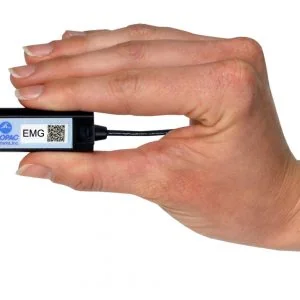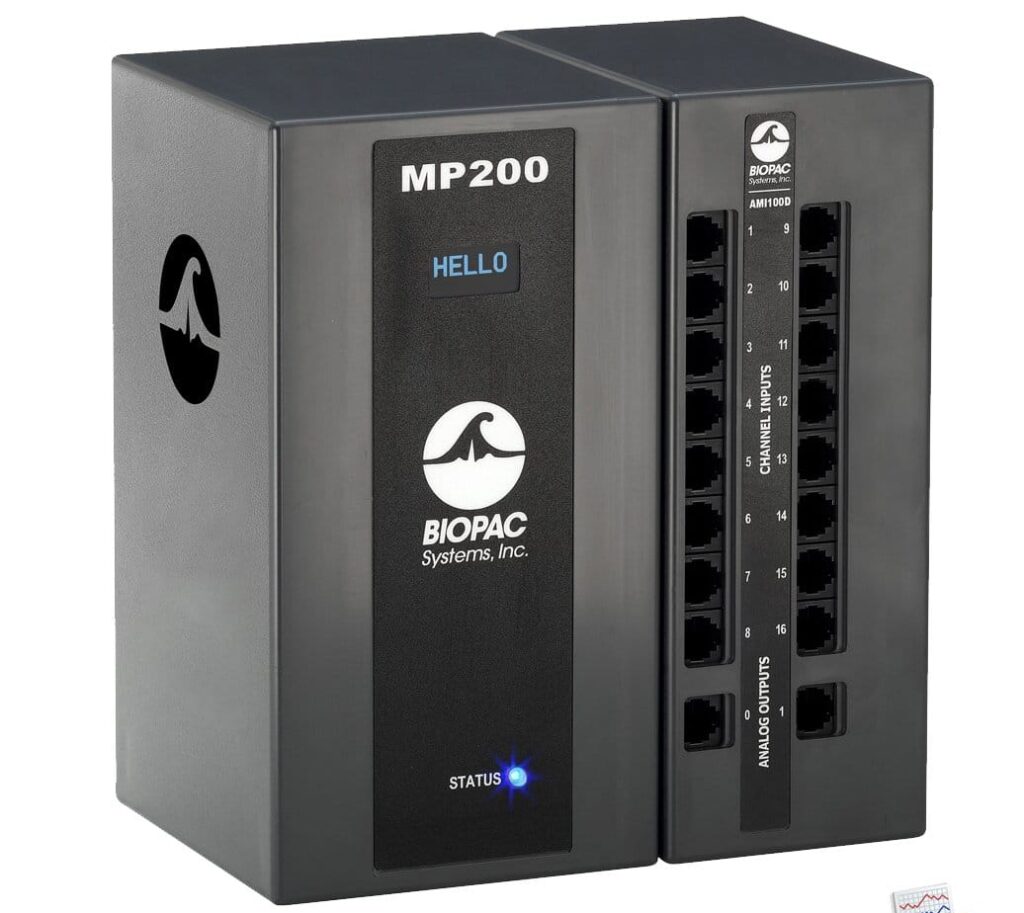
Wired EMG amplifier (BIOPAC EMG100D)
A wired electromyography (EMG) amplifier from the BIOPAC Smart Amplifier series — measurement electronics at the electrode reduce EMI and motion artifacts, and acquisition parameters configure automatically in AcqKnowledge. Requires the AMI100D interface and an MP160 or MP200 unit (not MP150), plus AcqKnowledge 5.0.4 or newer.

BIOPAC Smart Amplifier · EMG Measurement

EMG100D is an electromyographic amplifier from the Smart Amplifier series — measurement electronics placed directly at the electrode, instead of in a module near the acquisition unit.

Thanks to the close location of the signal converter, the signal is less susceptible to electromagnetic interference (EMI) and motion artifacts, and acquisition parameters are configured automatically in AcqKnowledge once the module is connected.

Part of a larger system

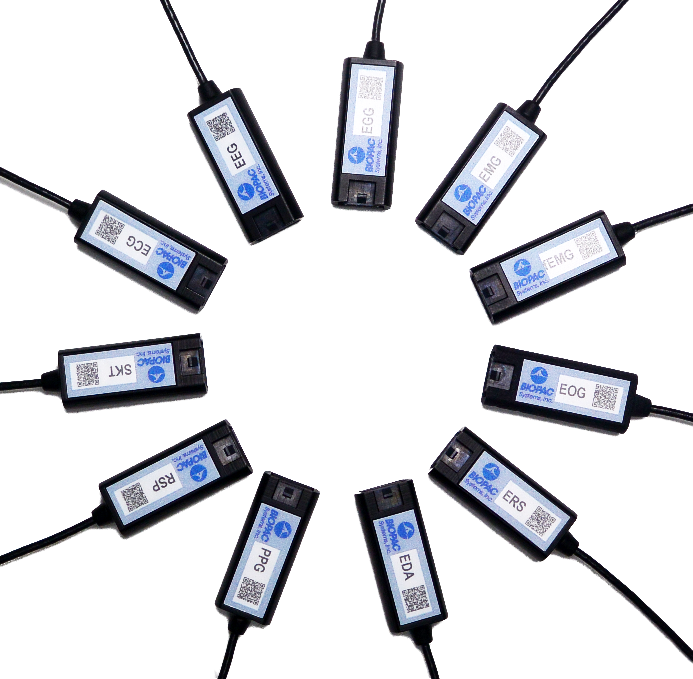
BIOPAC Smart Amplifier 100D family — illustrative photo of the whole lineup (EMG100D is one of the modules in this family)

Illustrative photo of the entire Smart Amplifier 100D family — the EMG100D module has an identical housing.

EMG100D is an expansion module, not a standalone system

The EMG100D module itself does not record or store data on its own. It requires connection through the AMI100D interface to an MP160 or MP200 data acquisition unit (Smart Amplifier modules do NOT work with MP150), together with AcqKnowledge software version 5.0.4 or later.

In addition, EMG100D requires a separately ordered electrode lead — this is the same universal biopotential lead used with the other biopotential modules in this series (it is not a lead dedicated specifically to EMG), details in the section below. The module connects with a 3 m RJ12 cable to the AMI100D interface, and the recorded signal is placed on a shared, synchronized timeline together with other modules in the system.

Required electrode lead

EMG100D is just the amplifier — measurement requires a separately ordered electrode lead and electrodes. Unlike some other modules in this series, EMG100D does not have a dedicated, EMG-specific lead.

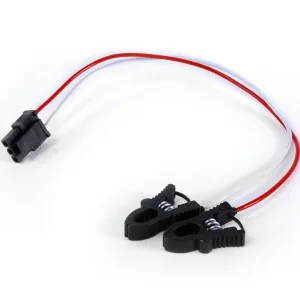
Universal BN-EL biopotential lead with the 100D module Manufacturer photo (BIOPAC) — BN-EL-LEAD2 biopotential lead, shared across ECG/EMG/EOG/EGG/EEG. BN-EL*-LEAD2 / BN-EL*-LEAD3

Universal biopotential lead

EMG100D uses the same universal biopotential lead as the other biopotential modules in this series (including ECG100D, EOG100D) — there is no dedicated EMG lead. The lead connects the electrodes to the amplifier and is available in LEAD2/LEAD3 variants.

  • Shared across the entire biopotential module family (ECG, EOG, EMG) — not a part dedicated exclusively to EMG
  • Used with standard biopotential electrodes from the EL500/EL254/EL258 series (per the catalog — no dedicated EMG electrode set)
  • Electrodes must be Ag/AgCl type — details in the features and specification section

Key features

Electronics close to the electrode

The Smart Amplifier architecture places the amplifier right at the electrode — significantly reducing EMI interference and motion artifacts compared with a traditional module located near the acquisition unit.

Automatic configuration

Once connected, the module automatically configures the acquisition parameters in AcqKnowledge — no manual switch settings needed.

Derived signals: integrated EMG and RMS

AcqKnowledge computes an integrated version and an RMS (root mean square) value from the raw EMG signal, with an optional comb filter that removes 50/60 Hz mains interference and its harmonics.

Ag/AgCl electrodes only

Electrodes with gold-plated contacts should not be used — their high input impedance causes charge buildup and distorts the EMG signal.

×500gain
0.2 µV rmsintrinsic noise (10–500 Hz)
5–500 Hzmeasurement bandwidth
MP160/200compatibility (via AMI100D)

Full technical specification

Signal
Electromyographic (EMG) signal
Gain
×500
Intrinsic noise
0.2 µV rms (measured in the 10–500 Hz band)
HP filter
10 Hz
LP filter
500 Hz
Bandwidth (wideband)
5 – 500 Hz
Derived signals
Integrated EMG and RMS (root mean square), with an optional comb filter removing 50/60 Hz mains interference and its harmonics
Required lead
BN-EL*-LEAD2/LEAD3 — universal biopotential lead shared with ECG100D and EOG100D; no dedicated EMG lead
Module dimensions / weight
Approx. 1.8×4.6×1.1 cm, approx. 48 g (amplifier alone approx. 9 g)
Cable
3 m, RJ12, to the AMI100D interface
Electrodes
Ag/AgCl only — gold-plated electrodes cause charge buildup and distort the signal
Compatibility
MP160 or MP200 (via the AMI100D interface) + AcqKnowledge 5.0.4 or later

Where to place the electrodes

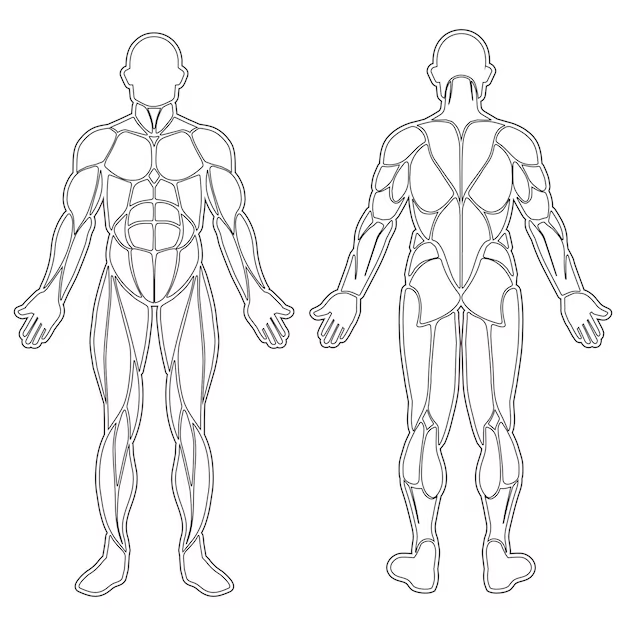
Click the points on the silhouette to see the locations where EMG activity of selected muscles can be measured using the wired EMG100D module.

Locations were prepared based on the publicly available recommendations of the SENIAM project (Hermens et al., European Recommendations for Surface EMG, 1999) — for illustrative purposes, without reproducing the original diagrams; not explicitly confirmed as a manufacturer recommendation for this specific module. Each point marks a measurement site — in practice this is a pair of electrodes (bipolar lead) along the belly of the given muscle, plus one shared reference/ground electrode at an electrically neutral bony point (e.g. wrist, elbow) — required in every EMG100D connection.

Silhouette of human body muscles — front and back view, EMG electrode placement points

How it works

01

Electrodes on the subject

Biopotential electrodes connected with a BN-EL*-LEAD2/LEAD3 lead over the belly of the studied muscle.

02

EMG100D + AMI100D + MP160/200

The module amplifies the signal right at the electrode and sends it via an RJ12 cable to the AMI100D interface, and from there to the acquisition unit.

03

Analysis in AcqKnowledge

Automatic channel configuration, calculation of the integrated signal and RMS, and further analysis.

Experimental applications

EMG measurement supports research into muscle activity in the context of movement, load, and fatigue.

Gait analysis and biomechanics

Recording muscle activity in studies of gait and movement patterns.

Sports medicine

Assessing muscle engagement and coordination during physical exertion.

Muscle fatigue research

Using the RMS signal to track changes in muscle activity over the course of exertion.

Motor control research

EMG as a signal supporting kinesiological and motor control research.

Frequently asked questions

Download materials click to expand

Interested in this product?

Contact us for a detailed quote and technical advice.

Related products

Eye TrackingMobile (Glasses)Research & Scientific InstrumentsSoftware

Eye TrackingResearch & Scientific InstrumentsSoftware

AccessoriesEye TrackingResearch & Scientific Instruments

BiometricsMain UnitsResearch & Scientific Instruments

Ask about this product

Product: Wired EMG amplifier (BIOPAC EMG100D)