Field test instruments and fusion splicers for network installers and operators.
100 products in this department
Browse the departmentLaboratory instrumentation for photonics, laser technology and R&D.
223 products in this department
Browse the departmentFiber-optic sensing systems: DAS, DTS, DSS, FBG and OFDR.
80 products in this department
Browse the departmentEye tracking, fNIRS, EEG and biometrics for science and business.
46 products in this department
Browse the departmentHome » Products » Research & Scientific Instruments » Wired cardiac output / ICG module (BIOPAC NICO100D)
A wired impedance cardiography (ICG) module from the BIOPAC Smart Amplifier series — it records baseline thoracic impedance (Z) and its derivative dZ/dt, used to derive stroke volume and cardiac output. Measurement electronics sit close to the electrodes, with automatic configuration in AcqKnowledge. For research use only (not a medical device). Requires the AMI100D interface and an MP160 or MP200 unit (not MP150), plus AcqKnowledge 5.0.4 or newer.
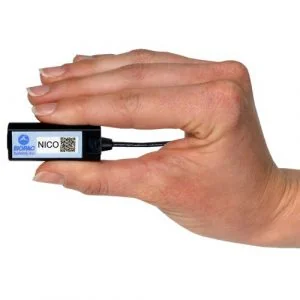
NICO100D is a Smart Amplifier series module for impedance cardiography (ICG) — it records baseline thoracic impedance (Z) and its time derivative dZ(t)/dt, used to derive stroke volume and cardiac output.
Thanks to the Smart Amplifier architecture, the measurement electronics sit closer to the electrodes, and acquisition parameters configure automatically in AcqKnowledge once the module is connected.
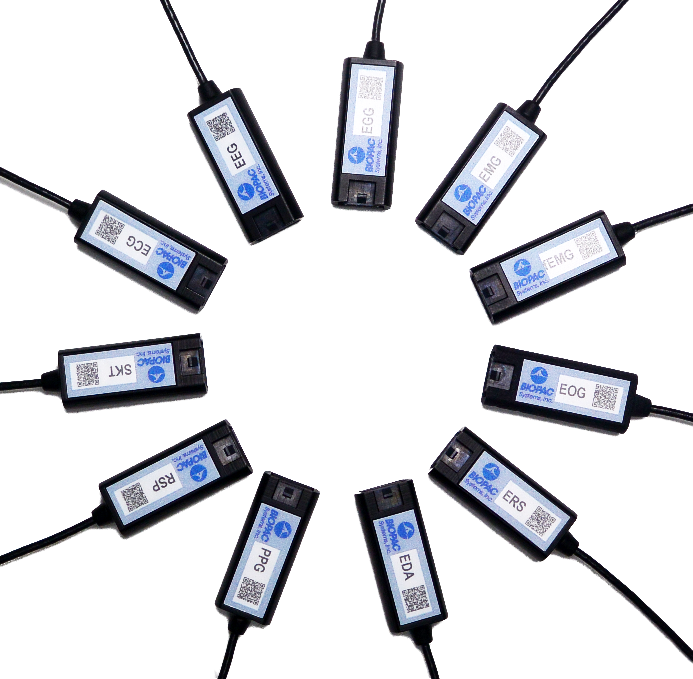
Illustrative photo of the entire Smart Amplifier 100D family — the NICO100D module has an identical housing.
The NICO100D module on its own does not acquire or record data. It requires connection via the AMI100D interface to an MP160 or MP200 data acquisition unit (Smart Amplifier modules do NOT work with the MP150), together with AcqKnowledge version 5.0.4 or later.
In addition, NICO100D requires the MEC104D modulator/demodulator module — needed for each of the three available electrode configurations — plus one of these configurations: details in the section below.
NICO100D is the amplifier alone — measurement always requires the MEC104D module plus one of three lead/electrode configurations, matched to the study protocol.
Required common element for all three NICO100D measurement configurations — without it, none of the configurations below will work.
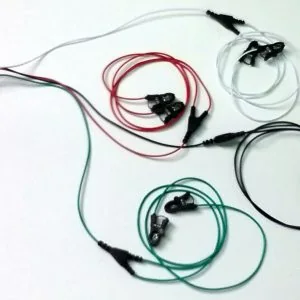
Manufacturer (BIOPAC) photo — LEAD132 (D-series) 8-clip lead.
LEAD132 + EL500 / EL503
Described as the optimal (recommended) measurement configuration. Uses the LEAD132 8-clip lead.
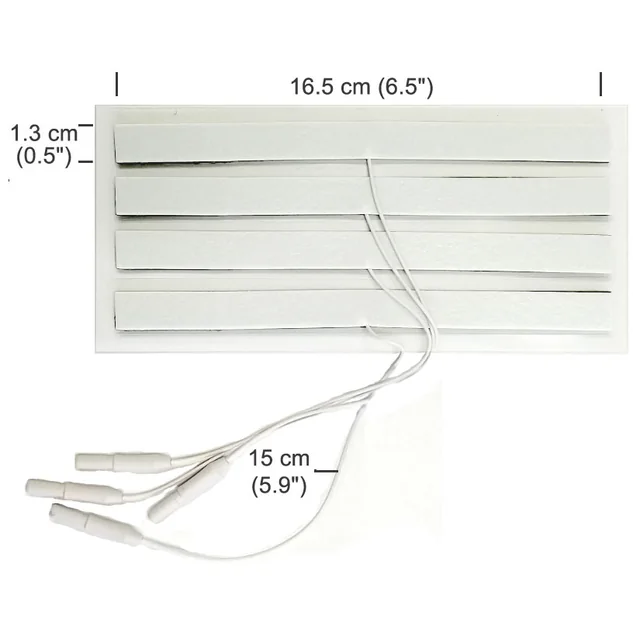
Manufacturer (BIOPAC) photo — EL526 ICG electrode band.
CBL246 + EL526
Also called the TREV configuration. Uses the CBL246 adapter cable together with the dedicated EL526 ICG electrode band.
Manufacturer (BIOPAC) photo — LEAD131 4-clip lead.
LEAD131 + EL503 / EL500
Uses the LEAD131 4-clip lead.
The Smart Amplifier architecture places the measurement electronics closer to the electrodes — this reduces the signal's susceptibility to interference compared with a traditional module located at the acquisition unit.
Once connected, the module automatically configures the acquisition parameters in AcqKnowledge — no manual switch settings required.
Simultaneously records baseline thoracic impedance (Z) and its time derivative dZ(t)/dt — the basis for deriving stroke volume and cardiac output using the impedance cardiography method.
BIOPAC has not validated this measurement against reference methods (thermodilution) for absolute stroke volume/cardiac output values. Do not use two NICO100D modules (or the related EBI100D) simultaneously on the same subject.
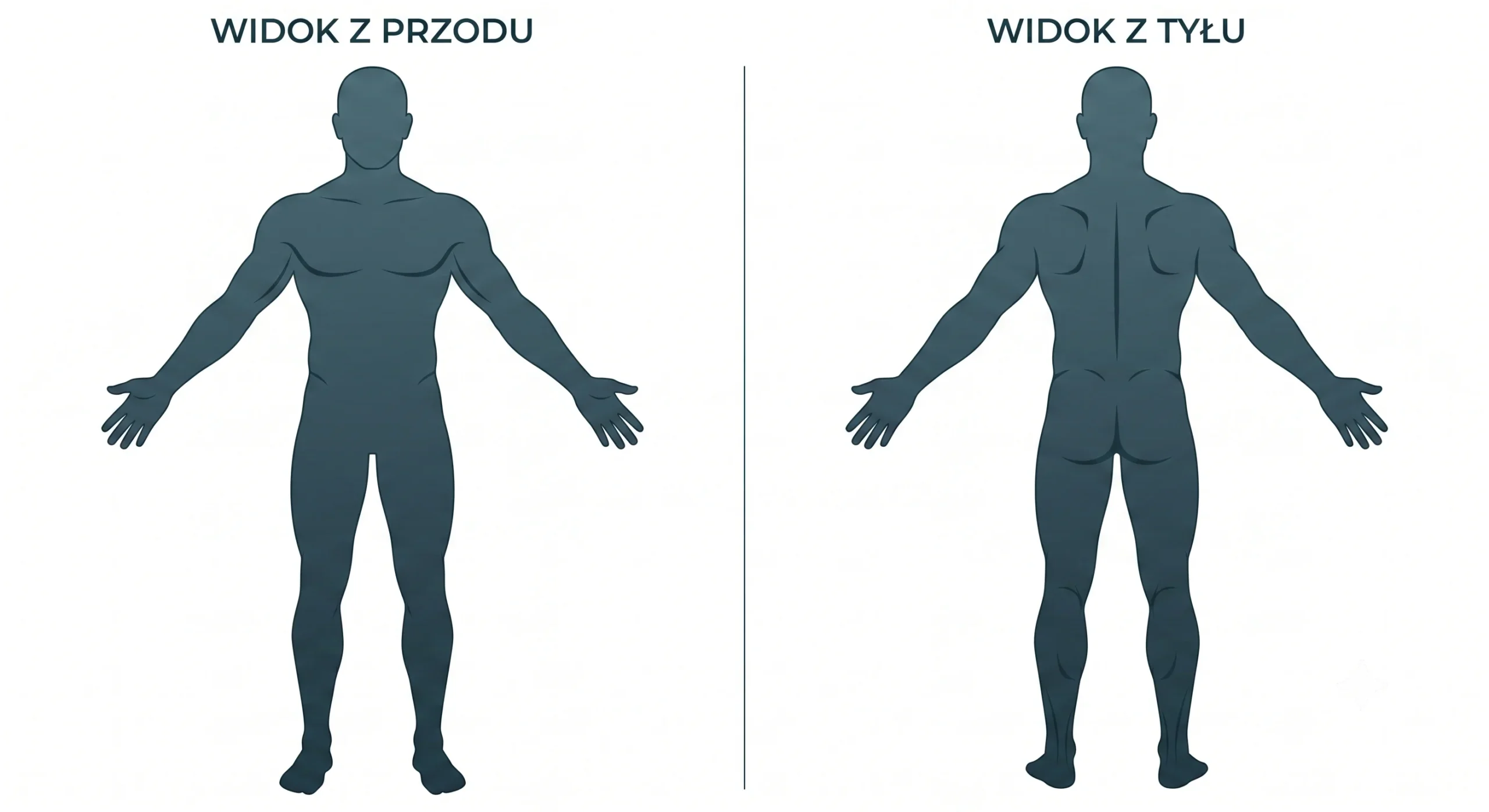
Click the points on the silhouette to see the general ICG electrode layout — the neck band and the thorax band. Electrodes are placed on the neck and on the thorax, following the standard tetrapolar/octapolar arrangement used in impedance cardiography. The exact points and their number depend on the selected configuration (A, B or C).
Neck/thorax placement confirmed in NICO100D source materials.
Neck band electrodes are placed bilaterally around the base of the neck. The exact number of points and spacing depend on the selected configuration (A, B or C).
Counterpart to the electrode(s) on the left side of the neck — the neck band operates as a pair, bilaterally around the base of the neck.
Thorax band electrodes are placed bilaterally at the level of the lower chest (near the xiphoid process). Together with the neck band they form the arrangement used to measure impedance Z and dZ(t)/dt.
Counterpart to the electrode(s) on the left side of the thorax — the thorax band operates as a pair, bilaterally at the level of the lower chest.
Electrodes placed on the neck and thorax, connected via MEC104D and the selected configuration (A, B or C) to the NICO100D module.
The module excites the impedance signal (100 kHz, 4 mA rms) and sends it via the RJ12 cable to the AMI100D interface, and from there to the acquisition unit.
Recording of the Z and dZ(t)/dt channels and derivation of stroke volume and cardiac output for research purposes.
Impedance cardiography supports research into non-invasive cardiovascular hemodynamics in a research/educational context.
Determining stroke volume based on the dZ(t)/dt signal.
Non-invasive assessment of cardiac output in research protocols.
Analysis of hemodynamic parameters in research on the cardiovascular system.
ICG signal as part of protocols studying autonomic nervous system reactivity to stimuli.
The three configurations correspond to different measurement protocols. Configuration A (LEAD132 + EL500/EL503, "Simulated Equipotential") is described as optimal/recommended. Configuration B (CBL246 + EL526, "Fully Equipotential"/TREV) uses a dedicated electrode band. Configuration C (LEAD131 + EL503/EL500, "Non-equipotential") is a simplified variant. Each requires the MEC104D module. The choice depends on the adopted research protocol.
No. NICO100D is intended for research and educational purposes only. BIOPAC has not validated this method (impedance cardiography) against gold-standard thermodilution for absolute stroke volume and cardiac output values.
Only MP160 or MP200, via the AMI100D interface, with AcqKnowledge software version 5.0.4 or later. It does not work with the MP150.
No. Do not use two NICO100D modules (or the related EBI100D module) simultaneously on the same subject — the mass (ground) reference runs through this module rather than through a separate ground electrode as in classic biopotential modules.
Related products
Biometrics AccessoriesResearch & Scientific Instruments
Product: Wired cardiac output / ICG module (BIOPAC NICO100D)