Field test instruments and fusion splicers for network installers and operators.
100 products in this department
Browse the departmentLaboratory instrumentation for photonics, laser technology and R&D.
222 products in this department
Browse the departmentFiber-optic sensing systems: DAS, DTS, DSS, FBG and OFDR.
80 products in this department
Browse the departmentEye tracking, fNIRS, EEG and biometrics for science and business.
46 products in this department
Browse the departmentHome » Products » Research & Scientific Instruments » Biometrics » GSR / EDA (Skin Conductance) » Wired EDA/GSR amplifier (BIOPAC EDA100D)
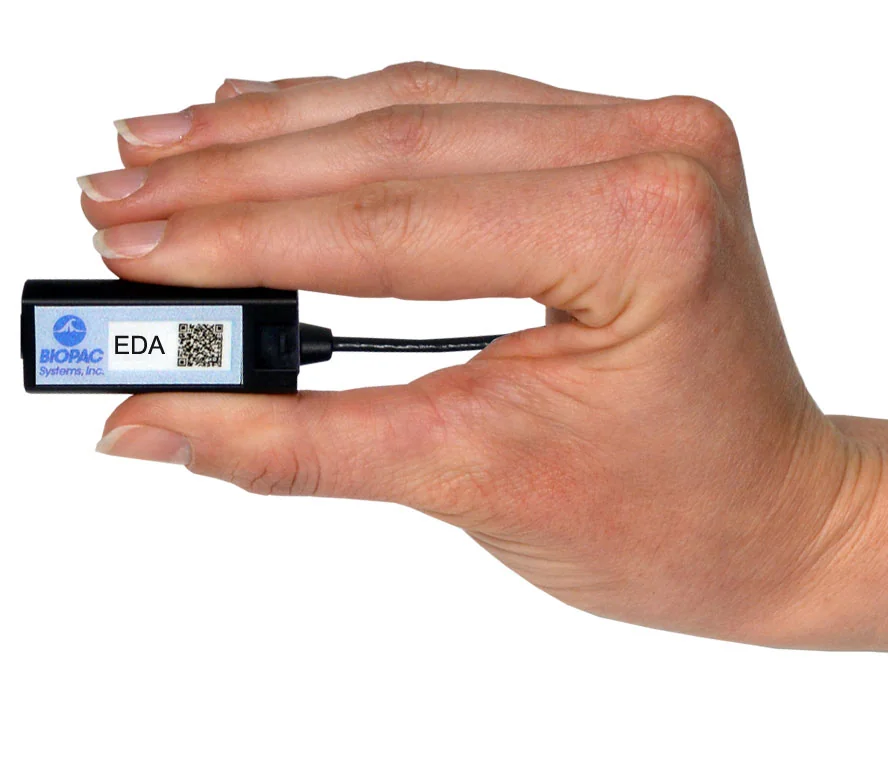
A wired EDA/GSR amplifier from the BIOPAC Smart Amplifier series — measurement electronics placed close to the electrodes reduce interference and artifacts, and acquisition parameters configure automatically in AcqKnowledge. Requires the AMI100D interface and an MP160 or MP200 unit (not MP150), plus AcqKnowledge 5.0.4 or newer.
EDA100D is an amplifier from the Smart Amplifier series — measurement electronics placed directly at the electrode instead of in a module near the acquisition unit.
Thanks to the transducer's proximity to the electrode, the signal is less susceptible to electromagnetic interference (EMI) and motion artifacts, and acquisition parameters configure themselves automatically in AcqKnowledge once connected.
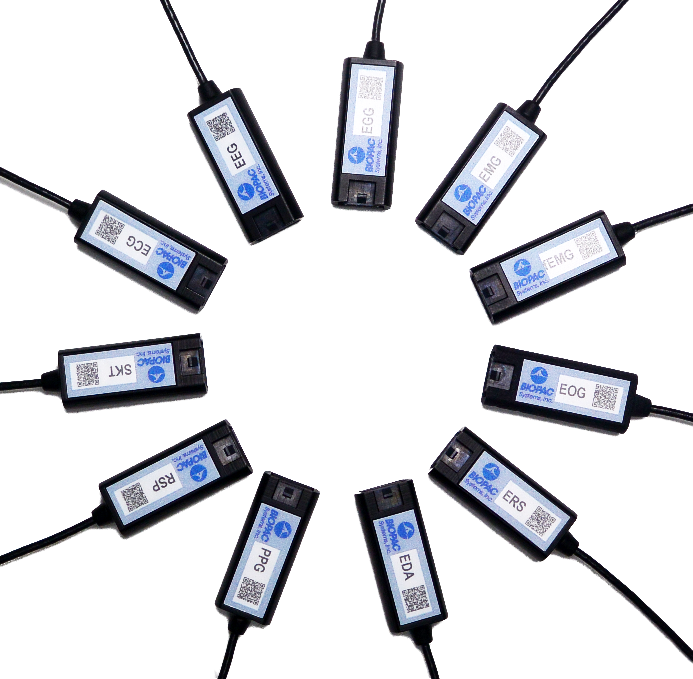
Illustrative photo of the entire Smart Amplifier 100D family — the EDA100D module has an identical housing.
The EDA100D module itself does not record or store data on its own. It requires connection through the AMI100D interface to an MP160 or MP200 data acquisition unit (Smart Amplifier modules do NOT work with the MP150), together with AcqKnowledge software version 5.0.4 or newer.
In addition, EDA100D requires a separately ordered electrode lead — see the section below for details. The module connects via a 3 m RJ12 cable to the AMI100D interface, and the recorded signal is placed on a shared, synchronized timeline together with other modules in the system.
EDA100D is the amplifier alone — measurement requires a separately ordered electrode lead and electrodes.
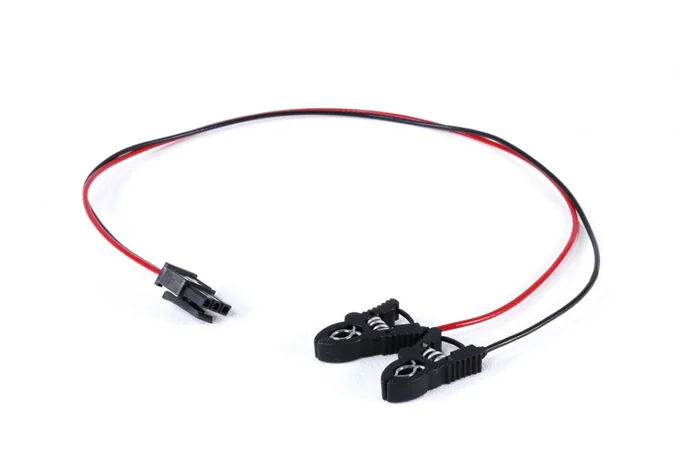
Manufacturer (BIOPAC) photo — BN-EDA-LEAD2 lead with finger electrodes.
BN-EDA-LEAD2 / BN-EDA25-LEAD2
A dedicated lead connecting the EDA100D module to the electrodes — available in two lengths. Used with EL507 electrodes and/or GEL101A electrolyte gel.
The Smart Amplifier architecture places the amplifier right at the electrode — significantly reducing EMI interference and motion artifacts compared with a traditional module located near the acquisition unit.
Once connected, the module automatically configures acquisition parameters in AcqKnowledge — no manual switch settings required.
Several Smart Amplifier modules can be used simultaneously on the same subject, without mutual interference between channels.
Do not use electrodes with gold-plated contacts — their high input impedance causes charge build-up and distorts the EDA signal.
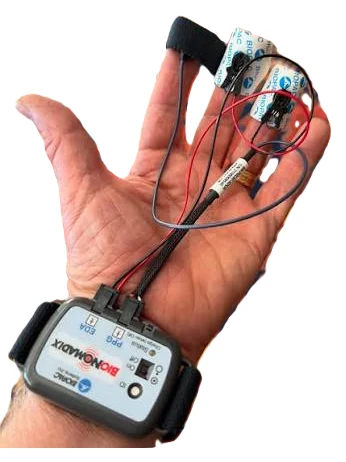
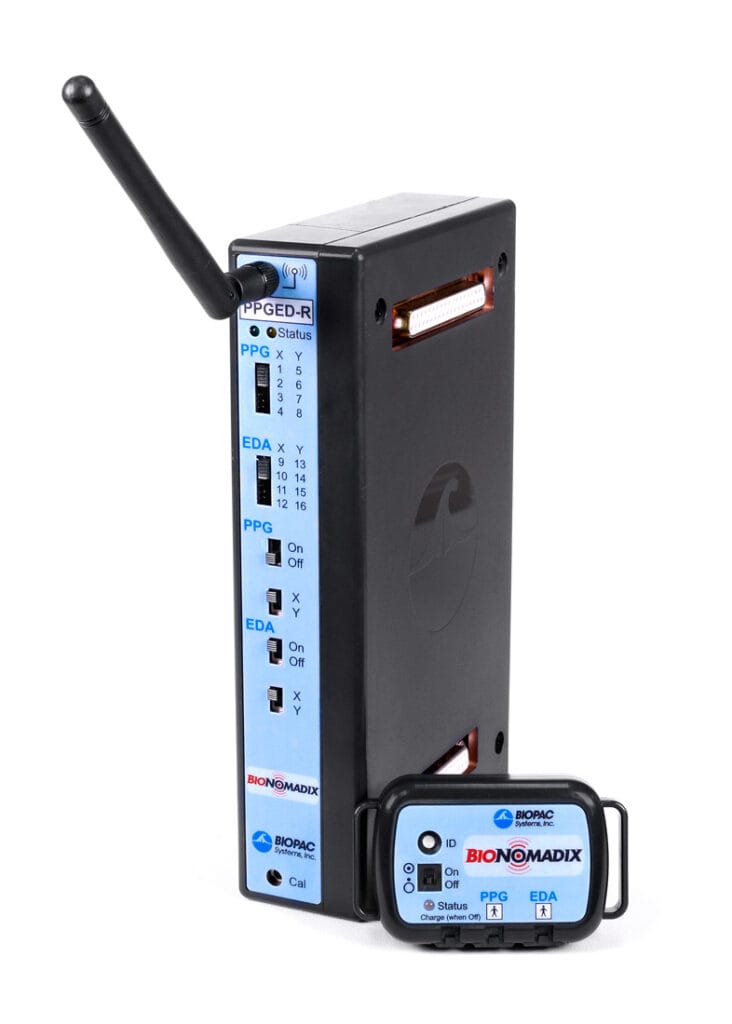
Click the points on the photo to see the typical electrode placement for EDA — on the distal pads of the 2nd and 3rd fingers of the non-dominant hand.
The illustrative photo comes from BioNomadix materials — it also shows a wireless transmitter, which the EDA100D does not have (EDA100D is a wired Smart Amplifier module). The electrode placement on the fingers itself is the same, generally accepted EDA measurement convention, independent of the amplifier module. A ground electrode is not required.
Inner side of the middle phalanx of the index finger of the non-dominant hand.
Inner side of the middle phalanx of the middle finger of the non-dominant hand. Electrodes are connected via the BN-EDA-LEAD2 / BN-EDA25-LEAD2 lead to the EDA100D module; a ground electrode is not required.
EL507 electrodes with GEL101A gel connected via the BN-EDA-LEAD2 lead to the EDA100D module.
The module amplifies the signal right at the electrode and sends it via an RJ12 cable to the AMI100D interface, and from there to the acquisition unit.
Automatic channel configuration, SCL/SCR recording, and further analysis.
EDA/GSR measurement supports research into sympathetic nervous system arousal and emotional responses.
Recording SCL and SCR as an indicator of arousal and response to stimuli.
Analysis of phasic and tonic changes in skin conductance in response to emotional stimuli.
Measuring autonomic responses to advertising materials and consumer stimuli.
EDA as one of the signals in protocols combining ECG, respiration, and other physiological parameters.
EDA100D places the amplifier directly at the electrode (instead of in a module near the acquisition unit), which reduces EMI interference and motion artifacts, and automatically configures parameters in AcqKnowledge. It also requires the AMI100D interface and an MP160/MP200 unit (not the MP150), unlike the older 100C series.
Only Ag/AgCl electrodes (e.g. EL507) with GEL101A gel, connected via the BN-EDA-LEAD2 or BN-EDA25-LEAD2 lead. Gold-plated electrodes are unsuitable — their high input impedance distorts the EDA signal.
Only MP160 or MP200, via the AMI100D interface, with AcqKnowledge software version 5.0.4 or newer. It does not work with the MP150.
Related products
Biometrics AccessoriesResearch & Scientific Instruments
BiometricsECG (Heart Activity)Research & Scientific InstrumentsRSP (Respiration)
BiometricsGSR / EDA (Skin Conductance)PPG / SpO2 (Pulse & Saturation)Research & Scientific Instruments
Product: Wired EDA/GSR amplifier (BIOPAC EDA100D)